By Davida Spaine-Solomon
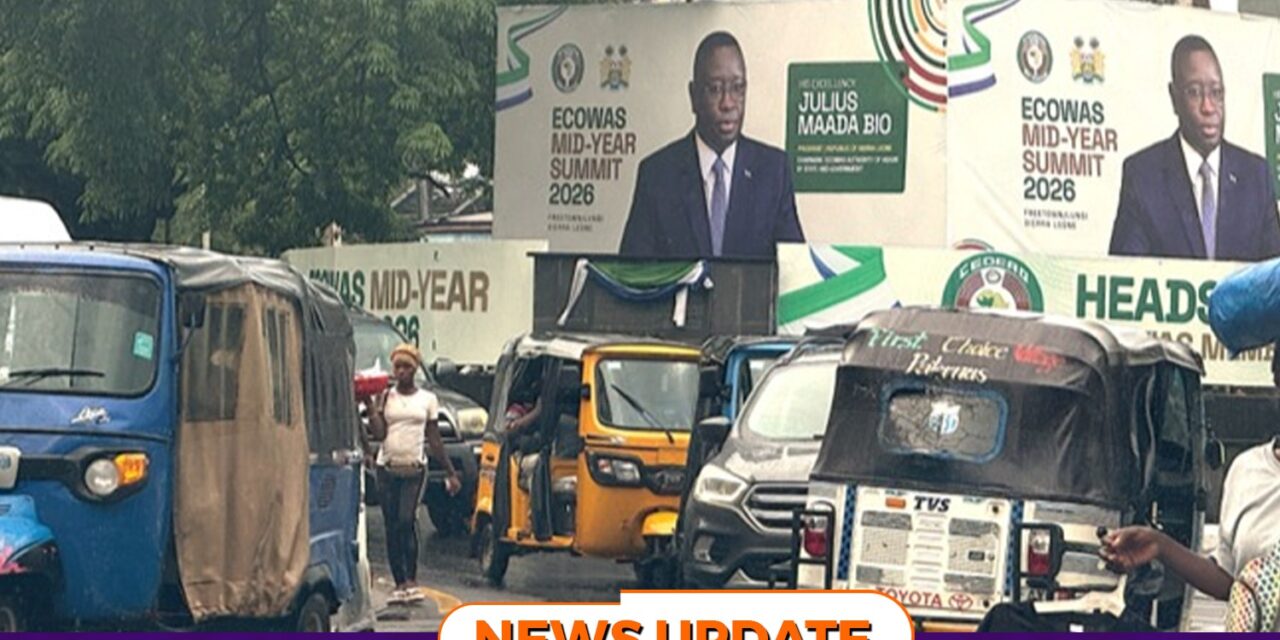
Freetown 13th July 2026 – Sierra Leone is spending a fraction of what it once did to host a major continental gathering, according to a new report by the Institute for Governance Reform (IGR). The country is preparing to welcome West African leaders for the 69th Ordinary Session of the ECOWAS Authority of Heads of State and Government this July, with costs sharply lower than the infamous 1980 Organisation of African Unity (OAU) Summit.
IGR’s quarterly journal Critical Perspectives of Governance estimates Sierra Leone will spend $124 million on the 2026 ECOWAS Mid-Year Summit — equivalent to $30.49 million in 1980 prices. By contrast, the OAU Summit consumed $200 million, worth $801 million today. That four-day event drained foreign reserves, fuelled hyperinflation, and triggered shortages that scarred the economy for years.
The Truth and Reconciliation Commission later concluded the summit consumed 20 percent of GDP and more than half of the development budget, destabilising the country’s finances and politics.
The report underscores the opportunity cost: had the $200 million been invested at a conservative 12 percent annual return, it would have grown to $36.73 billion by 2026 more than four times Sierra Leone’s current GDP.
Three structural shifts explain the lower bill:
Public-Private Partnership: The centrepiece Lungi International Conference Centre is being built under a PPP with Turkish firm FB Group, financed through bank borrowing with government guarantees rather than direct budget allocations.
Strategic Location: Hosting near the international airport reduces logistical and security costs while supporting decentralisation goals.
Smaller Scale: ECOWAS brings together West African leaders, not the full continental membership of the OAU, cutting the footprint significantly.
IGR calculates the ECOWAS investment at 1.5 percent of GDP, compared with the 20 percent consumed in 1980. The report credits stronger institutions, multiparty democracy, procurement laws, parliamentary oversight, and audits for improved fiscal discipline. Unlike Siaka Stevens in 1980, President Julius Maada Bio cannot unilaterally direct reserves without scrutiny.
Still, concerns remain. Media outlets have questioned the value-for-money terms of the Lungi PPP, citing rising flight ticket prices and airport taxes. Critics warn the new facilities could prove unaffordable for ordinary Sierra Leoneans once the summit ends. IGR argues these risks hinge on governance of the PPP, not the summit itself, and can be mitigated through transparency.
The legacy of 1980 still lingers: The Bintumani Conference Centre and OAU Villas remain in use, though some villas were controversially sold to elites for as little as $10,000. IGR concludes the lesson is not to avoid hosting major events, but to plan them transparently, finance them sustainably, and tie them to long-term development.
If Sierra Leone holds course, the 2026 ECOWAS Summit could transform Lungi into a lasting economic gateway, boosting tourism, investor confidence, and jobs in hospitality and transport long after the delegates depart.