By Andrew Chokpeleh
Freetown, 2nd September, 2026 – Sierra Leone has renewed its call for greater African representation at the International Court of Justice (ICJ), arguing that the continent’s longstanding commitment to resolving disputes through dialogue, negotiation and international law justifies a stronger voice on the world’s highest judicial body.
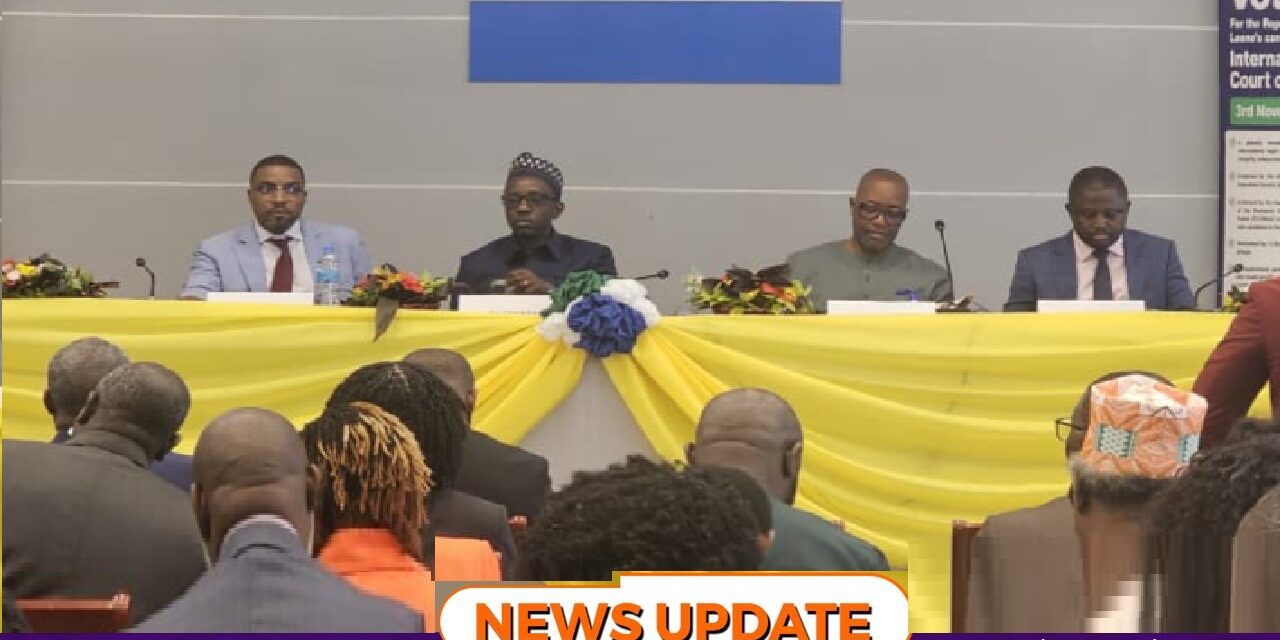
The call was made during a symposium on “The Role of the International Court of Justice in Settling Disputes in Africa,” held at the Foreign Service Academy, Ministry of Foreign Affairs and International Cooperation in Freetown on 2nd September 2026, where government officials and legal experts highlighted Africa’s consistent preference for peaceful dispute resolution over armed conflict while rallying support for Sierra Leone’s candidate to the ICJ, Professor Dr. Charles Chernor Jalloh.
Delivering the keynote address, Attorney General and Minister of Justice, Alpha Sesay, said a world governed solely by power rather than law would leave smaller nations vulnerable. He noted that while powerful countries often have multiple means of safeguarding their interests, smaller states depend on international law and multilateral institutions to protect their sovereignty and promote peace.
Sesay emphasized that Africa has consistently demonstrated its commitment to resolving disputes through legal processes rather than warfare, noting that the continent had referred 37 contentious cases to the International Court of Justice. He argued that Africa should not only continue supporting the international legal order but should also be adequately represented within global institutions responsible for administering justice.
Highlighting Sierra Leone’s own commitment to international law, the Attorney General recalled the country’s decision to establish the Special Court for Sierra Leone (RSCSL) following the country’s eleven-year civil war. He described the move as a demonstration of Sierra Leone’s respect for the rule of international law despite the enormous challenges the nation faced in the aftermath of the conflict. He further noted that Sierra Leone has consistently contributed to continental discussions advocating for Africa’s full representation on the United Nations Security Council and other international institutions.
Minister of Foreign Affairs and International Cooperation, Abdul Rahman Rado Swaray, said Professor Dr. Charles Chernor Jalloh’s candidacy for the International Court of Justice has received overwhelming regional support. He disclosed that Jalloh has been endorsed by both the Economic Community of West African States (ECOWAS) and the African Union (AU) to represent West Africa, describing the endorsement as recognition of his outstanding contributions to the development of international law and legal scholarship.
According to Swaray, Professor Jalloh has played a significant role in mentoring legal professionals across the world while contributing extensively to the advancement of international justice. He said Sierra Leone’s decision to present Jalloh as its candidate reflects the country’s confidence in his expertise and his ability to contribute meaningfully to the work of the Court.
Professor Dr. Charles Chernor Jalloh stressed the importance of the International Court of Justice at a time when geopolitical tensions continue to rise, and many nations increasingly resort to conflict instead of dialogue.
He explained that the ICJ was established to ensure that disputes between states are resolved through law rather than war, noting that the Court’s judgments are binding on UN member states that have chosen to submit themselves to judicial settlement in the World Court.
Professor Jalloh observed that Africa has repeatedly relied on international law to resolve disputes involving boundaries, sovereignty and political tensions, helping to prevent conflicts across the continent. He cited the boundary dispute between Burkina Faso and Mali as one of the examples, where African states chose legal settlement over armed confrontation, demonstrating the continent’s confidence in international judicial mechanisms.
He maintained that Africa’s commitment to peaceful dispute resolution provides a strong justification for greater representation on the International Court of Justice. Such representation, he said, would enable the continent to participate more effectively in shaping international jurisprudence, while strengthening global efforts to resolve disputes peacefully.
Professor Jalloh also underscored that judges of the ICJ do not serve as representatives of their governments but act independently in accordance with international law, a principle, he said, the Government of Sierra Leone has respected throughout his nomination process.