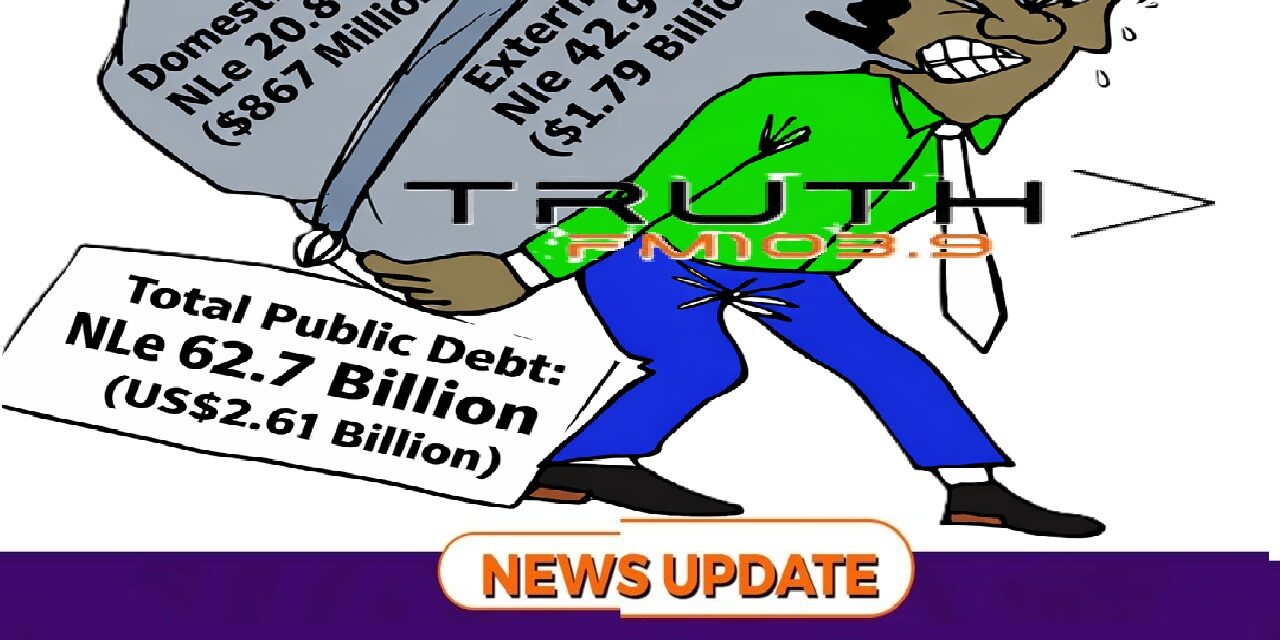
Freetown, 8th June 2026 — Sierra Leone’s public debt stock closed 2025 at NLe 62.7 billion (US$2.61 billion), according to the latest figures from the Public Debt Management Division (PDMD), Ministry of Finance.
The updated debt report, released in June 2026, shows that while domestic borrowing remains steady, external debt continues to dominate the country’s liabilities, raising concerns about sustainability as new loans are ratified.
At end‑2025, domestic debt stood at NLe 20.8 billion (US$867 million), accounting for roughly one‑third of the total. Treasury bills and bonds made up the bulk of this, alongside arrears and ways‑and‑means advances. Meanwhile, external debt reached NLe 42.9 billion (US$1.79 billion), reflecting Sierra Leone’s reliance on multilateral and bilateral creditors.
The debt‑to‑GDP ratio remains high. With a rebased GDP estimated at NLe 157.5 billion (US$6.56 billion) in 2025, total public debt represented 39.8 percent of GDP, underscoring the fiscal pressures facing the government.
Projections for 2026- The PDMD projects that by end‑2026, total public debt will rise further to NLe 64.7 billion (US$2.70 billion), driven by new external loans and continued reliance on domestic instruments. Domestic debt is expected to edge up to NLe 21.3 billion (US$888 million), while external debt is forecast to hit NLe 43.4 billion (US$1.81 billion).
Interest payments are also projected to increase, with domestic interest obligations climbing in line with higher Treasury bill and bond issuances. Exchange rate assumptions of NLe 26.5 per US$1 further highlight the vulnerability of external debt servicing costs.
New Loan Commitments- Between 2025 and early 2026, Sierra Leone ratified several new external loans, including:
US$38.2 million from the Islamic Development Bank for the Livestock and Livelihoods Development Project.
€62.2 million (approx. US$67 million) from the IsDB for the Reconstruction of the Kambia–Tomparie–Kamakwie Road Project. US$30 million from OFID for livestock and livelihoods and US$55 million from BADEA for the Bauya–Benducha Road Project.
These loans, with maturity periods ranging from 20 to 30 years and grant elements averaging 35–37 percent, are expected to boost infrastructure and agriculture but will add to the external debt burden.
The updated debt stock figures underline Sierra Leone’s delicate balancing act: financing critical development projects while managing rising liabilities. While the debt‑to‑GDP ratio remains below the ECOWAS convergence threshold of 70 percent, the pace of new borrowing and the growing share of external debt could strain fiscal space if growth falters or revenues underperform.
With debt service already consuming a significant portion of domestic revenue, the government’s challenge would be to ensure that new borrowing translates into productive investments that expand the economy and ease repayment pressures.