By Ishmael Zay-Bangura
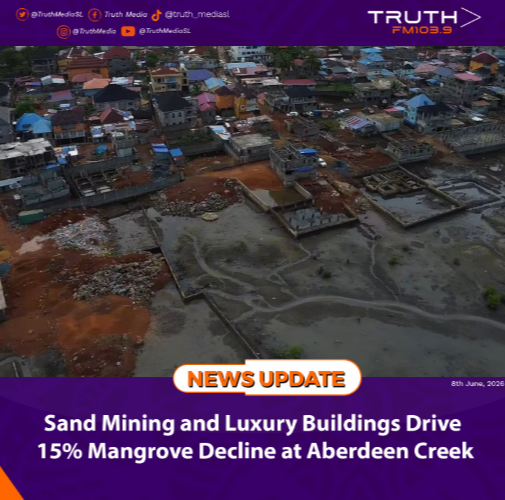
Freetown, 8th June, 2026—Every passing day, Aberdeen Creek grows smaller. Drone images tell a story that should jolt every resident of Aberdeen Creek’s awake.
According to Sierra Leone Monitor 2025, the publication stated that, in January 2017, the vital wetland stretched across 537 acres, noting that by February 2025, it had shrunk to just 458 acres.
Mangroves that once stood like green sentinels now lie in tangled heaps, their roots clawing in the air.
The Environmental Justice Foundation confirmed that the Aberdeen mangrove thick trees, those water-loving guardians where fish lay their eggs, butterflies and insects find shelter, have now reduced by 15 percent.
Every shovel of sand removed, every foundation poured, pushes Freetown closer to catastrophe. Think of it as a slow drowning in reverse: as the mangroves vanish, the land itself begins to bleed into the sea.
The Minister of Environment and Climate Change, Jiwoh Emmanuel Abdulai, told parliament that, “every tree and mangrove we lose undermines our shared future.” His voice carried the weight of someone counting losses not in acres, but in futures cut short.
From Aberdeen Bridge, the destruction is clear to see: mangroves are being cut down quickly for building projects, their roots ripped out for waterfront views. It is a brutal math: luxury for a few; catastrophe for all.
But it is not only wealthy developers destroying the mangroves. On the other side of the creek, another kind of extraction is happening. Sand mining has become a survival strategy for thousands of young men, with tied hands and empty pockets. They dig the creek’s own bones out from under it, selling sand for a meal.
The Mayor of Freetown, Yvonne Aki-Sawyerr, in an exclusive interview with Truth Media, said, “Aberdeen Creek has seen massive construction that is not hidden under the radar,” describing the creek’s suffering.
She further stated that, “the destruction of mangroves is even causing butterflies to disappear,” noting that when the butterflies go, something beautiful and essential leaves with them a silence where there used to be flutter.
Inside the Aberdeen Crab Town, many residents live in makeshift houses close to the creek. Without mangroves to hold the soil, land that generations have called home is being lost to illegal construction and sand mining. Families watch their doorsteps inch closer to the water. Elders remember when the creek was thick with life; children now play on eroding banks. The ground beneath them is no longer a birthright; it is a question mark.
Every tide brings a little less earth. Every sunset, a little less hope. But the story is not over, not yet. Because the same hands that dig can also plant. And the same city that looked away can still turn back.