By Emmanuel Mbowa
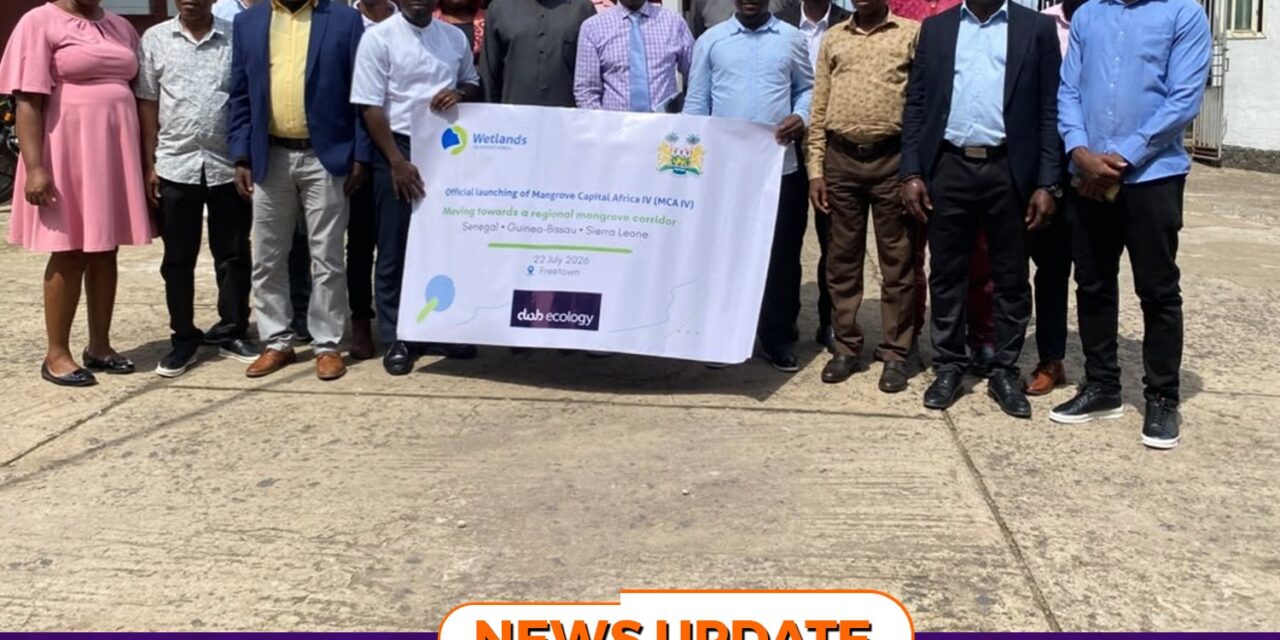
Freetown 29th July, 2026 – In an effort to strengthen ongoing restoration of wetlands in the coastal corridors of Senegal, Guinea-Bissau, and Sierra Leone, Wetlands International and partners have officially launched Mangrove Capital Africa Phase IV (MCA IV) in Freetown to restore degraded wetlands, with the theme: “Moving towards a regional mangrove corridor.”
Highlighting the valuable work and success stories from Phase III of Mangrove Capital Africa, Ibrahima Thiam, Executive Director of Wetlands International, said the new project marked an important milestone in efforts to build stronger collaboration to restore wetlands and the environment, noting that a collective approach remained the cornerstone in achieving their goals. “Together we restored degraded ecosystems, strengthened local governance, and supported sustainable livelihoods while improving resilience to climate change,” he said, adding that Sierra Leone had become a remarkable example of what could be achieved through strong partnerships.
“These achievements give us confidence, but they have also taught us important lessons,” he noted. “Mangroves cannot be protected in isolation. Their future depends on healthy rivers, productive estuaries, and resilient marine ecosystems.”He further stated, “Pollution, unsustainable land use, overfishing, and climate change all affect the health of our mangroves,” stressing that “if we only restore trees while ignoring the wider landscape, our efforts will never achieve their full potential.”
Against this backdrop, speaking during the launch at Family Kingdom in Aberdeen, Freetown, on 22nd July, 2026, Thiam said the new project introduces a vision based on mangrove corridors. “Rather than focusing on isolated ecosystems, we are addressing environmental challenges where they originate and strengthening the resilience of the entire ecosystem,” he said.
In achieving the goals of this new phase, he called for collaboration, noting that mangroves sustain fisheries and local livelihoods. He sated that “success, however, will depend on partnerships. Governments, local authorities, civil society, the private sector, and development partners all have a vital role to play.”
He concluded by reaffirming their commitment to working with their partners to ensure growth and sustainability. “Wetlands International remains fully committed to working alongside all of you, to strengthen capacity, strengthen evidence-based decision-making, and mobilize long-term investment.”
Launching Phase IV of Mangrove Capital Africa, Sheikh Ahmed Tunis, Executive Director of the National Protected Area Authority (NPAA), said he was thrilled to be part of this remarkable initiative following the successful completion of Phase III in Yawri Bay.
“Managing ecosystems at a large scale is the only way to ensure long-term ecological integrity and coastal protection,” he said, re-echoing the need for stronger collaboration among partners. “In short, if we work 360 degrees, we will protect the whole place, but if we do it in silos, we will lose everything. So, this 360-degree approach is one we appreciate and endorse from Wetlands International, supported by DOB Ecology funding,” he said.