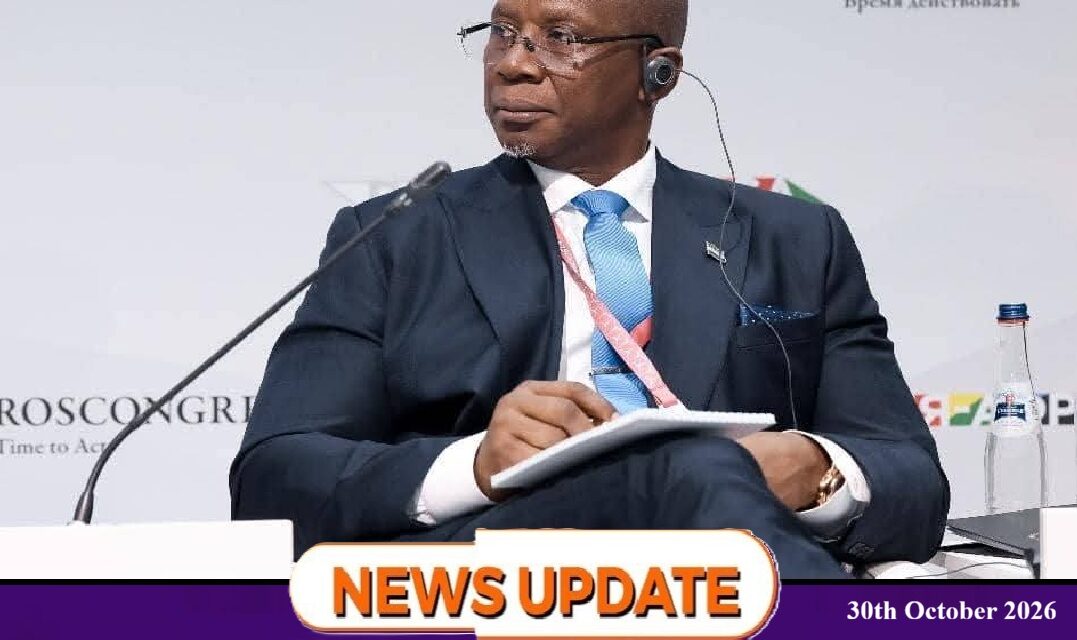
MOSCOW, Russia, 30th October 2026 – Sierra Leone’s Minister of Mines and Mineral Resources, Julius Daniel Mattai, has called for stronger cooperation with Russia to help unlock the country’s vast mineral wealth, expand geological exploration, develop local processing capacity, and build the technical skills needed to drive long-term economic growth.
Speaking at the Russia–Africa Summit in Moscow on October 28, 2026, Mattai said Sierra Leone’s abundant mineral resources would only translate into prosperity if backed by sound geological knowledge, effective governance, modern technology, and a skilled workforce.
The minister noted that Sierra Leone possesses significant deposits of iron ore and diamonds and has recently identified promising critical minerals, including lithium, while prospects also exist for cobalt, nickel, and coltan.
“We need to understand our geology better,” Mattai said, stressing the importance of detailed geological surveys and drilling programmes to accurately assess the country’s mineral resources and attract investment.
He referenced a memorandum of understanding signed in June 2024 on the inventory of Sierra Leone’s mineral resources, describing geological data as the foundation for future exploration and sustainable development of the sector.
A central theme of his address was the need for Sierra Leone to move beyond exporting raw minerals and instead develop a stronger mining value chain. He argued that greater investment in mineral processing, beneficiation, smelting, refining, and manufacturing would create jobs, strengthen local expertise, and enable the country to retain more value from its natural resources.
According to Mattai, achieving that goal will require substantial investment in infrastructure, particularly in reliable electricity, roads, and port facilities, as well as a transparent and predictable legal and fiscal environment that balances investor confidence with national interests.
He disclosed that the government is reviewing aspects of mining legislation to ensure greater clarity and certainty for investors while safeguarding Sierra Leone’s long-term development objectives.
The minister also highlighted plans to improve the country’s geological database through modern geophysical surveys, including radiometric and magnetic studies, which he said would help identify areas with mineral potential and reduce exploration risks.
“Reliable geological information is critical,” he noted, adding that better data would not only attract investors but also support more informed government decisions on resource management.
Mattai further stressed the importance of transparency in the management of mining revenues, saying the benefits of the sector must be reflected across the wider economy.
Looking at Africa’s broader economic prospects, he said the continent’s rapidly growing population presents opportunities for industrialisation, investment, and market expansion. At the same time, he argued that rising global demand for critical minerals allows African countries to negotiate partnerships that deliver more than the extraction of raw materials.
He noted that the concentration of mineral processing and refining capacity in a few global centres has created demand for more diversified supply chains, a development he believes could benefit mineral-rich African nations that adopt strategic development plans.
The minister expressed particular interest in strengthening cooperation with Russian universities and technical institutions in areas such as geology, geophysics, chemistry, mining engineering, and mineral processing.
Drawing on his own educational experience in the former Soviet Union, Mattai said expanded academic partnerships could support scholarships for Sierra Leonean students, staff exchanges, laboratory development, technical training, and the application of artificial intelligence in mineral exploration and geological modelling.
He also identified energy development as another area where collaboration with Russia could support industrialisation and mineral processing activities.
Reaffirming Sierra Leone’s openness to international partnerships, Mattai said the country seeks cooperation based on mutual respect, national sovereignty, and shared benefits rather than geopolitical alignment.
“We are not looking East. We are not looking West. We are not looking North or South. We are looking downward into the ground to make more discovery and move forward to make sure we prosper,” he declared.
The minister maintained that Sierra Leone’s ultimate objective is not simply to discover and extract more minerals, but to ensure that the country’s resource wealth translates into jobs, economic growth, technical expertise, and lasting national prosperity.