Story by Davida Spaine-Solomon with Photos by Larry Ronnie Tucker
Makarie, Northern Province, Sierra Leone, 16th June, 2026 — Across the African continent, voices rise to celebrate the Day of the African Child, commemorating the 1976 Soweto Uprising in South Africa. On that day, thousands of black school children marched to protest poor education, which led to police opening fire, leaving many children dead. It is a day meant to honor the promise that every child belongs in a classroom. But in the hills of Masongbo, Northern Province of Sierra Leone, the only sound rising is the metallic clink-clink-clink of iron meeting granite.
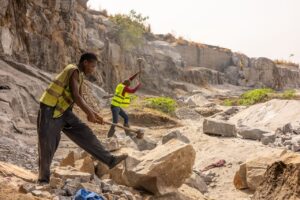
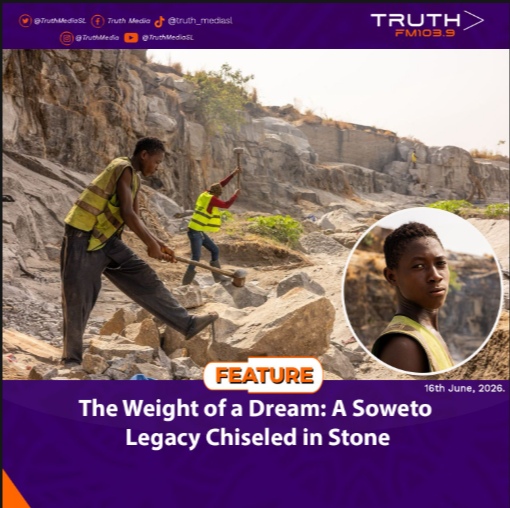
14-year-old John Tarawalie
Here, the “Right to Education” isn’t a lived reality; it’s a luxury that 14-year-old John Tarawalie can no longer afford.
John stands at the edge of a yawning quarry pit, a deep crater that serves as both a workplace and a desperate lifeline.
He is one of the thousands: in Sierra Leone, 35.1 % of children aged 5 to 14 are engaged in child labor, according to the U.S. Department of Labor’s International Labor Affairs Bureau (ILAB), based on data from the 2017 Multiple Indicator Cluster Survey (MICS 6).
While the world celebrates the “African Child’s Day,” John is busy breaking the very earth beneath him to ensure his family survives another week.
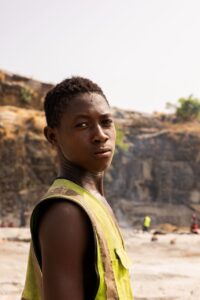
35.1 % of children aged 5 to 14 are engaged in child labor
A Breach of Promise- The sight of a 14-year-old swinging a sledgehammer isn’t just a local tragedy; it is a violation of international standards. Under ILO Convention No. 182, work in stone quarries is classified as one of the “Worst Forms of Child Labor” due to its hazardous nature. Furthermore, Article 28 of the UN Convention on the Rights of the Child—to which Sierra Leone is a signatory—explicitly mandates that the state makes secondary education “available and accessible to every child.”
For John, those legal protections feel like a different world. He decided to drop out of school at JSS3 because the economics of his household were not favorable. He decided to join his parents in the granite work, so that he could assist his younger ones to go to school.
John said the reason was painful, but questioned that, “why should one person go to school while two [other people] work?” referring to his parents, who don’t get much money in the work they do to take care of the home. John believes that when three people come together to work would earn the family more money, justifying his decision to join his parents in the granite work.
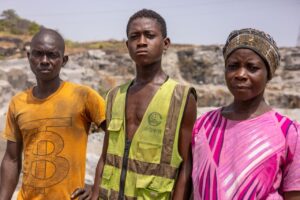 (John and his parents)
John sells crushed stones for NLe. 10 for a head pan. On a good day, he fills three. It is a pittance in an economy where the “free” in Free Quality School Education (FQSE) is often a misnomer. By the time a parent pays for uniforms, supplies, and community teacher levies, the classroom becomes a luxury.
“I still dream,” John says, his voice quiet against the backdrop of the pit. “I want to become a minister one day.”
The Invisible Toll- The work is a slow assault on the young. Beyond the risk of falling rocks or a misplaced hammer, which cost his father, Alpha, a toe years ago, there is the invisible threat of silicosis.
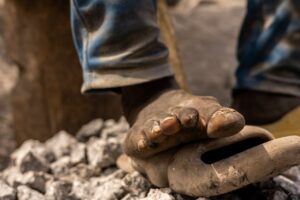
The fine granite dust John breathes daily is a silent killer, scarring lungs long before adulthood.
The fine granite dust John breathes daily is a silent killer, scarring lungs long before adulthood.
His father, Alpha, 32, watches his son work with a heavy heart. “The level he reached in school became too expensive,” Alpha explains. His decision contradicts Article 11 of the African Charter on the Rights and Welfare of the Child, which declares that every child shall have the right to an education directed at the “development of the child’s personality, talents and mental and physical abilities to their fullest potential.”
Instead of his potential, John is using his physical strength to stave off his family’s hunger. Alpha recently returned to the pit just days after hernia surgery, driven by the same desperation that pulled John out of the classroom.
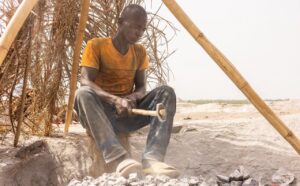
(John’s father, upon arriving at the quarry after his surgery.)
John’s story also mirrors concerns recently raised by Minister of Gender and Children’s Affairs, Dr. Isata Mahoi, who warned that many of Sierra Leone’s social challenges are rooted in poverty, family instability and unequal opportunities.
Speaking on the State of the Family in Sierra Leone, the minister stressed that inclusive development must “leave no one behind” and noted that children in vulnerable households, particularly in rural communities, often face greater hardships. For John, the choice between education and survival reflects the very inequalities the government says it must address.
The Mirage of Opportunity- The tragedy is that Makari Islamic Secondary School is just down the road.
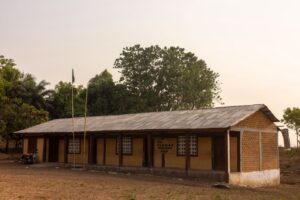
(Makari Islamic Secondary School)
But as Principal Abduli Fornah notes, the system is fraying. With a shortage of government-paid teachers and a lack of basic materials, the gap between “survival” and “schooling” is widening.
“Once they leave for the pits,” Fornah says, “it is nearly impossible to get them back.”
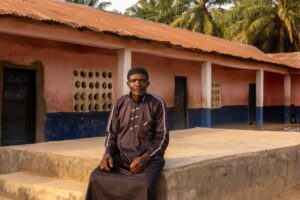
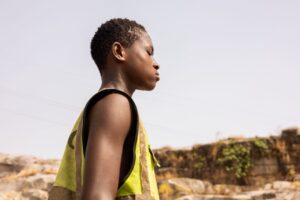
A Future Chiseled Away- As the sun reaches its peak on 16th June, John lifts another heavy pan. The metal rim bites into his shoulders, and dust clings to his dampened skin.
On a day meant to celebrate the potential of the African Continent’s youth, John Tarawalie remains in the pit. He is the living reminder that for many, the promise of Soweto remains unfulfilled buried under a mountain of stone, waiting for a system that values his mind as much as the market values his labor.
At the time of publication, efforts to reach the Ministry of Basic and Senior Secondary Education (MBSSE) proved futile.