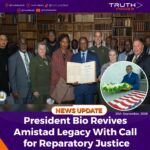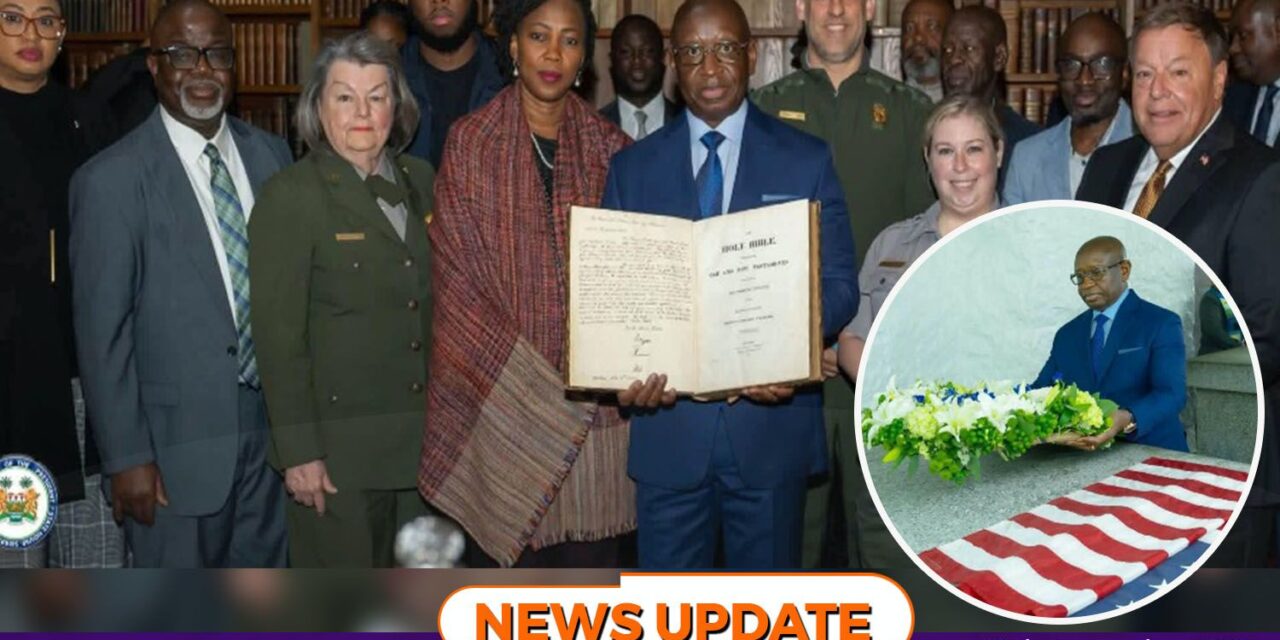
Quincy, Massachusetts –30th September, 2026 – Sierra Leone’s President, Dr. Julius Maada Bio, has renewed his nation’s call for reparatory justice, urging that the lessons of the Amistad revolt must move beyond remembrance to responsibility, justice, and reconciliation.
Speaking at the historic United First Parish Church in Quincy, also known as the Church of Presidents, President Bio addressed the theme “Celebrating Courage: Honouring the Historic Link Between Quincy and Sierra Leone.” He described the bond between Sierra Leone and Quincy as “historical, human, and, in places such as this, deeply personal.”
The President’s visit included a stop at the Adams National Historical Park, where he viewed the Mendi Bible preserved in the Stone Library. He called the Bible “a witness to history, a bridge across the Atlantic, and a sacred link between generations and peoples.”
President Bio recalled the 1839 Amistad case, when Sengbe Pieh (Joseph Cinqué) and fellow Mende captives resisted enslavement aboard the Spanish schooner La Amistad. Their struggle culminated in a landmark U.S. Supreme Court ruling in 1841, argued by former President John Quincy Adams, affirming their freedom.
Bio said the episode embodied two forms of courage: Sengbe Pieh’s defiance against injustice and Adams’ moral conviction to confront it through law and principle.
“Nearly two hundred years ago, Sengbe Pieh came to these shores in chains. Today, the President of the Republic of Sierra Leone comes to Quincy in freedom and friendship. That is the distance history has travelled,” he declared.
Reaffirming Sierra Leone’s commitment to reparatory justice, President Bio stressed that the effort is not about reopening wounds but about acknowledging historical truth, honouring those who suffered, and addressing enduring consequences.
“It is about memory joined with responsibility, and justice joined with reconciliation,” he said.
He linked the Amistad legacy to Sierra Leone’s resilience through crises including the civil war, Ebola, the 2017 mudslide, and COVID-19. “Each time, we grieved. Each time, we stumbled. But each time, Sierra Leone rose again,” he noted.
President Bio emphasized that courage remains essential in confronting modern challenges: educating every child, tackling hunger, expanding opportunities for women and girls, and safeguarding peace.
“Sengbe Pieh fought for freedom. Our responsibility is to give that freedom meaning,” he said, underscoring that true freedom must translate into education, opportunity, equality, and dignity.
Thanking the people of Quincy, the Adams National Historical Park, and the United First Parish Church for preserving the Amistad connection, President Bio concluded: “History must not merely be remembered; it must instruct us. Courage can cross oceans.”
He called for the historic bond between Quincy and Sierra Leone to grow stronger around truth, justice, freedom, friendship, and shared humanity.