Freetown, 8th May, 2026 – Sierra Leone’s Minority Leader in Parliament, Hon. Abdul Kargbo, has raised serious legal and administrative concerns over a recent immigration directive issued to international airlines operating at Freetown International Airport.
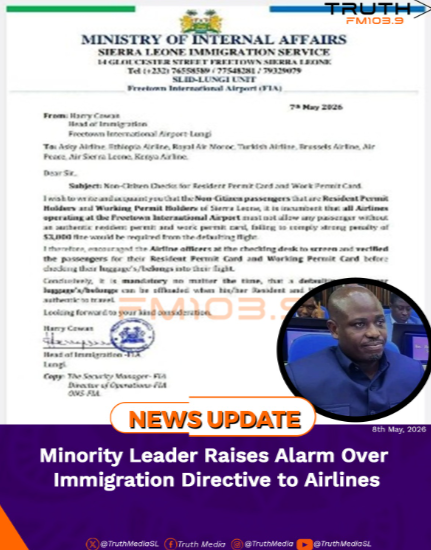
The notice, signed by the Head of Immigration at Lungi, seeks to transfer responsibility for verifying resident and work permits from immigration authorities to airline staff. Airlines were warned they could face a US$3,000 penalty for non-compliance.
Hon. Kargbo argues the directive is legally flawed and operationally impractical. “Airlines are not immigration institutions; neither are their officers trained or legally empowered to authenticate Sierra Leone immigration documents. That responsibility rests with the State,” he said.
He further noted that the directive cites no law, regulation, or statutory instrument to justify the penalty, raising questions about its legality and enforceability. “Administrative notices cannot simply create penalties without a clear legal basis,” Kargbo stressed.
The Minority Leader also questioned whether an airport-based immigration head has the authority to issue binding directives of such magnitude. He pointed out that such instructions should ordinarily come from the Chief Immigration Officer, the Ministry headquarters, or through a formally gazetted regulation.
Beyond legality, Kargbo criticized the directive’s drafting, describing it as poorly written and riddled with grammatical errors. “Official communication directed to international airlines should meet a high standard of clarity, professionalism, and legal precision. Unfortunately, this notice falls short,” he said.
Operationally, the directive has created confusion. It instructs airlines to offload luggage “no matter the time” if permits are found not to be authentic, but fails to explain how authenticity should be verified, what systems should be used, or who bears responsibility if a passenger is wrongly denied boarding.
Equally troubling, Kargbo added, is the absence of any verification mechanism. “There is no hotline, verification portal, contact office, or digital system provided to airlines to enable compliance. This makes the directive practically difficult and vulnerable to arbitrary decisions,” he warned.
Sources within the immigration office have confirmed that the directive apparently originated from an airport commander but was intended as an internal memo to the airlines.
The authorities also acknowledge it was poorly drafted and risked sending the wrong signals, but remedial measures, they say, are already being taken to address it.