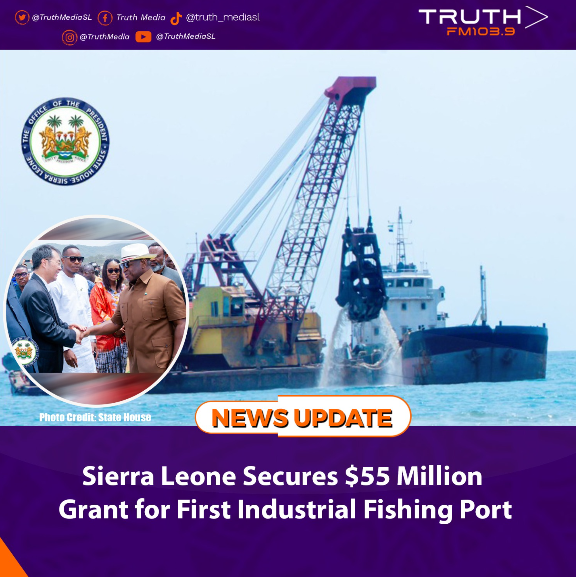
Black Johnson Village, Western Area Rural District, 23rd April, 2026- Sierra Leone has launched construction of its first industrial fishing port, a project valued at US$55 million, funded through a grant from the Government of China.
President Julius Maada Bio turned the sod at Black Johnson, describing the initiative as a historic step toward transforming the fisheries sector and advancing the country’s Blue Economy.
The new Julius Maada Bio Industrial Fishing Port will serve as a comprehensive hub for vessel berthing, unloading, fuel supply, maintenance, transhipment, fish handling, processing, and distribution to both local and international markets. It is designed to meet global fisheries governance standards, including port state measures, positioning Sierra Leone to capture greater value from its marine resources.
President Bio emphasized that Sierra Leone, with 570 kilometers of coastline and an estimated 450,000 metric tons of sustainable fish stock annually, has long lacked the infrastructure to fully benefit from its maritime wealth. Weak systems for harvesting, preservation, and processing have left local fishing communities vulnerable to post‑harvest losses, while foreign fleets extracted disproportionate value from Sierra Leone’s waters.
“This is not a failure of effort, but a failure of infrastructure, investment, and national prioritization. Today, we begin to correct it,” the President said, recalling his early experiences witnessing fishermen’s struggles.
The $55 million port project is expected to boost fisheries productivity and reduce post‑harvest losses, create jobs across fishing, processing, and logistics and enhance exports and strengthen Sierra Leone’s position in the global fisheries value chain.
President Bio expressed gratitude to China and President Xi Jinping for the grant, calling the partnership “responsive, respectful, and results‑driven.” He noted that the project builds on Sierra Leone’s broader maritime framework, which he helped shape as the country’s first Minister of Fisheries and Marine Resources in the 1990s, including ratification of the UN Convention on the Law of the Sea.
The industrial fishing port is expected to become a cornerstone of Sierra Leone’s Blue Economy strategy, enabling the country to move from subsistence‑level fishing toward industrial‑scale operations that generate sustainable economic returns.
“This is not just a local project; it is Sierra Leone taking its rightful place in the global ocean economy,” President Bio declared.