By Joshua Osangie Kamara
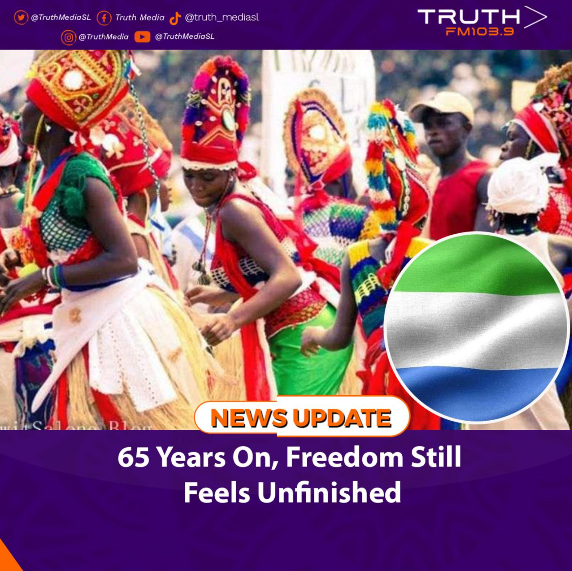
Freetown, 27th April 2026- Adama Koroma, 78, has watched 65 Independence Days come and go from the same doorway in the East End of Freetown. She was a schoolgirl in 1961 when the Union Jack came down at Brookfields Playground and Sir Milton Margai a quiet doctor who became a founding father accepted the instruments of sovereignty from the Duke of Kent. She remembers her mother weeping. Not from grief. From joy.
“We thought everything was going to change,” she says, fanning herself against the April heat. “And some things did change. But I have buried two children. I still carry water from down the hill. My grandchildren cannot find work.”
She pauses. Then: “But I still put out my flag. Because nobody gave us this country. We earned it.”
Adama’s words capture the paradox that defines Sierra Leone at 65: a nation that achieved the political miracle of independence peacefully, proudly, without a single shot fired yet struggles, six decades on, to translate that political freedom into the economic, social, and daily freedoms that ordinary citizens actually feel.
What follows is not a verdict on 65 years. It is an honest account of what was promised, what was
A Nation Rebuilt, On Paper and on the Ground
When the civil war ended in 2002, Sierra Leone was a country in ruins. Eleven years of brutal conflict had killed an estimated 50,000 people, displaced half the population, and shattered every institution. The economy had collapsed. Schools were burnt. Hospitals were looted. An entire generation had known nothing but war.
What happened next was, by any measure, remarkable. Four peaceful democratic elections have been held since 2002 power transferred from the Sierra Leone People’s Party to the All People’s Congress and back again without violence. The country secured a seat on the UN Security Council for 2024–2025, its first in 51 years. Peace held.
But peace and governance are not the same as prosperity. The country Sierra Leone rebuilt after war is one where institutions are fragile, corruption remains entrenched, and the benefits of reconstruction have not reached equally into every district and every home.
Three Presidents, Three Visions One Unfinished Mission
No issue reveals the arc of Sierra Leone’s independence journey more clearly than education. Three administrations Kabbah, Koroma, and Bio each promised to transform what happens in the classroom. Each made gains. Each left work undone.
Ahmad Tejan Kabbah (1996–2007) oversaw post-war reconstruction, reopening schools shuttered by conflict and rebuilding a shattered education ministry from near-zero. Ernest Bai Koroma (2007–2018) expanded school infrastructure and focused on increasing enrolment, particularly in rural areas. Julius Maada Bio (2018–present) launched the flagship Free Quality Education programme in 2018, removing fees for primary and senior secondary pupils and in a landmark 2020 decision lifting the ban on pregnant girls attending school.
The numbers show genuine progress. The adult literacy rate has climbed from 34.8% in 2004 to 48.6% in 2022 a 14-point gain. But at less than half the population, Sierra Leone still ranks 13th lowest globally, behind Zimbabwe (89.8%), Tanzania (82%), and even Guinea-Bissau (53.9%). The world average is 81%.
The Free Quality Education programme is the most ambitious education intervention in Sierra Leone’s history. Fees were abolished. Meals were provided. Pregnant girls were welcomed back. Enrolment surged. But teachers remain underpaid and under-resourced, classroom infrastructure lags demand, and learning outcomes the true measure of any school system remain deeply concerning.
Rising Prices, Falling Leone, a Nation Stretching Thin
Mohamed Bangura, 26, parks his okada outside a junction in Freetown’s East End and wipes the sweat from his forehead. He is not supposed to be here not on this road, not on this bike. He is supposed to be on a construction site, reading engineering drawings, building the roads that Sierra Leone so desperately needs.
He holds a degree in civil engineering from Fourah Bay College the oldest university in West Africa, and one of Sierra Leone’s proudest institutions. He graduated two years ago. He has not worked as an engineer for a single day.
“I drive a motorbike now,” he says, without embarrassment but without joy. “I studied for four years. My family sacrificed everything school fees, food money, everything. And the country has no job for me. On Independence Day, they will show the new roads on television. I want to build those roads. But who will give me the chance?”
He is not bitter about independence itself. He is specific almost clinical about what he needs.
“Give us work. Give us light. Give us a government contract that does not go to somebody’s cousin. That is freedom to me. Not a flag. Freedom is opportunity.”
His story is not unusual. It is the story of a structural mismatch between what the education system produces and what the economy can absorb that has defined Sierra Leone across multiple administrations and continues to define it today.
The data tells a story of volatility and persistent vulnerability. Inflation hit 46.6% in 2023 among the highest in West Africa driven by food prices, fuel costs, and a depreciating Leone. While the rate is projected to ease, ordinary Sierra Leoneans feel the consequences at every market table and every school fee deadline.
Youth unemployment figures present a particular challenge for interpretation. The formal rate 3.6% by World Bank measurement seems low, but this counts only those actively seeking formal employment. In reality, underemployment and informal survival work affect an estimated 60% of young Sierra Leoneans. The engineer driving an okada is not “unemployed” by formal definition. But he is not free.
Light as the Most Honest Test of Progress
Ask any Sierra Leonean what they want most and the answer, with striking consistency, is not abstract. It is electricity. The absence of reliable power which affects hospitals, schools, businesses, and homes equally is perhaps the single most vivid measure of the gap between political freedom and practical liberty.
The Bumbuna Hydroelectric Dam the country’s primary power source since 2009 generates under 50MW at full capacity, serving a fraction of a nation of 8 million people. Independent Power Producers have been brought in, solar initiatives are expanding, and a landmark $480 million MCC compact was signed in September 2024 to strengthen and extend the electricity grid. Sierra Leone has committed to raising its electrification rate from 36% to 80% by 2030 under the Mission 300 initiative.
These are real investments. But for the nurse who delivers babies by torchlight in a district hospital, or the student who studies by candlelight, or the market woman who cannot refrigerate her goods 2030 is a long time to wait.
Where Giving Birth Remains a Life-or-Death Gamble
Fatmata Sesay, 44, has been selling pepper and onions at the Lumley Market for eighteen years. She was not alive in 1961. Independence, to her, is not a historical event it is a daily negotiation.
“Every day I open my table, I choose my own price, I talk to my customers, I go home to my children. Nobody tells me what to do,” she says, arranging her tomatoes with practised hands. “That is a kind of freedom.”
But she is also clear-eyed about what is missing and what it cost her. She has three living children. She lost one pregnancy. She remembers the hospital. She remembers the darkness not metaphorical darkness, but the actual darkness of a ward without power, and nurses working by the light of mobile phones.
“They tried their best,” she says quietly. “But there was no light. There was no blood. What can a nurse do without blood?”
She cannot afford to send all three of her children to school at the same time she rotates them, term by term.
“They say pro-poor government. But poor people are still suffering. On April 27, I will cook a fine meal rice and groundnut soup. I will thank God. And then on April 28, I will come back here and struggle again.”
Fatmata is not a statistic. But she is inside the statistics. Sierra Leone has made remarkable even extraordinary progress on maternal health over two decades. And yet it remains, by any global measure, one of the most dangerous places in the world to give bir
The 74% reduction in maternal mortality between 2000 and 2020 is genuinely one of Sierra Leone’s most significant post-war achievements driven by the expansion of health facilities, free healthcare for pregnant women introduced in 2010, and community health worker programmes. It is progress that deserves recognition.
But 354 deaths per 100,000 live births in 2023 against a global SDG target of 70 means Sierra Leone still has one of the worst maternal mortality rates on earth. The bitter paradox is that over 79% of maternal deaths now occur inside health facilities, suggesting that it is not the absence of facilities but the quality of care within them that is killing women. Hospitals without functioning blood banks. Delivery rooms without reliable electricity. Staff without adequate training or equipment.
The Ebola crisis of 2014–2016 and COVID-19 both exposed and deepened these systemic weaknesses, each disrupting care systems that were already fragile and setting back years of incremental progress.
Corruption, Silence, and the Price of Speaking Up
Sierra Leone has made measurable progress on corruption perception moving from a score of 30 in 2017 to 35 in 2023 on the Transparency International Corruption Perceptions Index, a 22-place improvement over five years. In 2024, however, the score fell back to 33, with a ranking of 114 out of 180 countries.
The improvement is real. But a score of 33 where 0 is completely corrupt and 100 is completely clean still places Sierra Leone firmly in the lower quartile of the world. Citizens
consistently report that public service delivery is mediated by connections that contracts go to political insiders, and that accountability institutions remain under-resourced and politically vulnerable.
The question of press freedom sits at the intersection of political and economic liberty. Sierra Leone’s journalists operate in an environment where laws exist on paper to protect expression but economic pressure the closure of outlets, the withdrawal of advertising, the arrests of reporters continues to constrain what is said and what is published.
A 2026 op-ed in the Sierra Leone Telegraph put it plainly: “The same silence we were forced to learn as children is the same silence destroying us as a nation today.” It is a silence that costs not just journalism, but governance itself.
Youth, Migration, and the Question of Belonging
Ten-year-old Isata Conteh is in Primary 5 at a government school in Wellington. When asked what independence means, she recites what she has been taught Sierra Leone became free from the British in 1961, Sir Milton Margai, green for agriculture, white for peace and Justice, blue for the natural harbor. Then she adds something that is not in any textbook.
“It means we can be anything we want,” she says, her face completely certain. “My teacher told me. She said I can be a doctor, or a president, or a pilot.”
She believes it completely. She has not yet learned not to. And in that belief unbroken, undefended, purely alive in a ten-year-old’s face sits the most important thing Sierra Leone has going for it at 65. Not the data, not the rankings, not the speeches. The child who still believes the promise.
Sierra Leone’s youth bulge is both its greatest asset and its most pressing challenge. More than 60% of the population is under 25. They are the most educated generation in the country’s history. And an increasing number of them are leaving.
The phenomenon mirroring the “Japa” trend across West Africa sees skilled graduates and young professionals emigrating to Europe, North America, and the Gulf states in search of economic opportunity. It is a rational response to structural unemployment. It is also a slow haemorrhage of the human capital the country most needs.
For the young women who remain, additional barriers compound the challenge. While Sierra Leone’s Radical Inclusion policy and the 2023 Education Act have opened school doors to pregnant girls and young mothers, structural violence child marriage, domestic abuse, gender-based discrimination continues to constrain what women can do with their education once they have it.
Independence Gave Sierra Leone Political Freedom. The Rest Is Unfinished.
At the stroke of midnight on April 27, 1961, this country became its own. That was not a small thing. In an era when dozens of African nations were still under colonial rule, Sierra Leone chose a peaceful path negotiated, dignified, led by a man who could have been an ordinary doctor but instead became the founding father of a nation.
Sixty-five years later, that achievement deserves full, unambiguous recognition. Political freedom the right to vote, to speak, to be governed by people chosen from among you is not nothing. It is, in fact, the foundation on which everything else must be built.
But this investigation finds, in the data and in the voices of ordinary citizens, a persistent and deepening gap between political freedom and practical liberty. You are free to vote but your vote may not bring light to your home. You are free to go to school but the school may have no books. You are free to give birth in a government hospital and that birth remains one of the most dangerous in the world. You are free to graduate with an engineering degree and drive an okada.
Sierra Leone at 65 is not a failed state. It is an unfinished one. The direction of travel on education, on maternal health, on governance, on electrification is largely forward. Progress is real. But it is not fast enough, not broad enough, and not felt equally by every Sierra Leonean in every district.
Adama Koroma, 78, standing in her doorway in the East End of Freetown, said it with the economy of someone who has waited a long time:
Independence gave Sierra Leone political freedom. Sixty-five years later, the real question remains: how free truly, practically, daily is the ordinary citizen?
That question has no easy answer. But it is the right question. And a nation that is still asking it honestly, at 65, is a nation that has not given up.