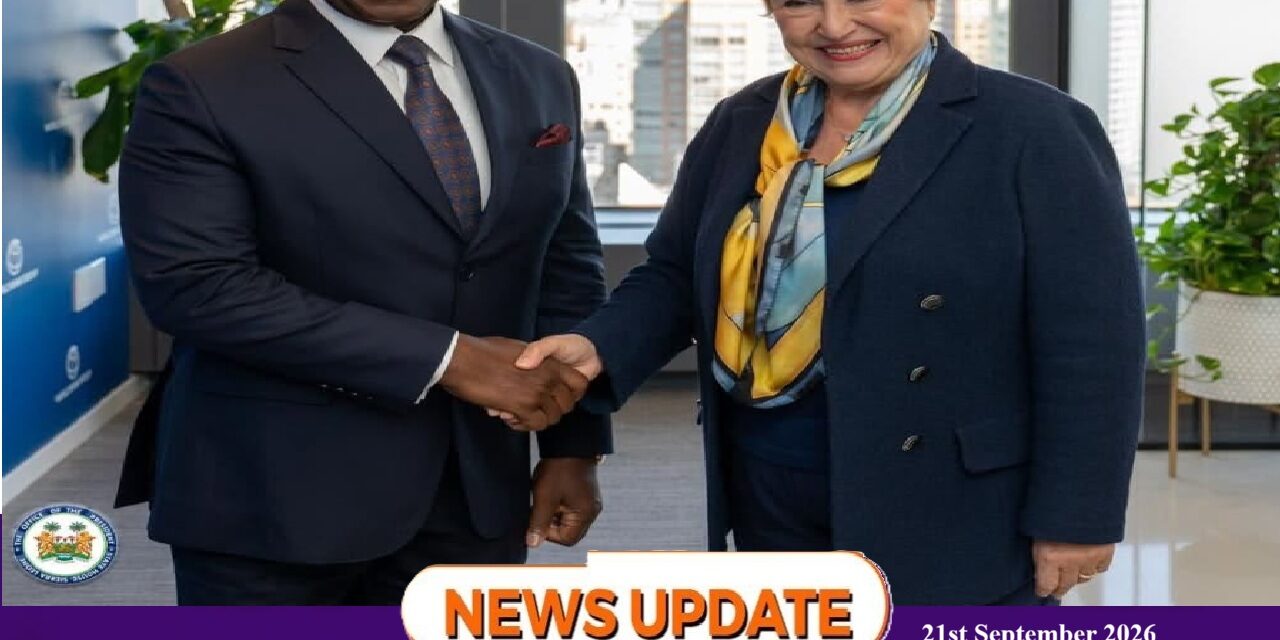
New York, 21st September, 2026 — International Monetary Fund (IMF) Managing Director Kristalina Georgieva has lauded Sierra Leone’s progress in stabilizing its economy, commending President Julius Maada Bio for what she described as “impressive macroeconomic consolidation.”
Georgieva made the remarks during a bilateral meeting with President Bio on the sidelines of the 81st United Nations General Assembly in New York. She noted that Sierra Leone had strengthened its partnership with the IMF despite global economic headwinds, including rising energy costs.
“This is a difficult time for governments everywhere, particularly because of the rising cost of energy,” Georgieva said, reaffirming the Fund’s commitment to supporting Sierra Leone in improving its investment climate. She also urged proactive communication about the reforms already undertaken.
President Bio, who introduced newly appointed Finance Minister Karefa A.F. Kargbo Sierra Leone’s Governor to the IMF reiterated his government’s commitment to prudent economic management as a foundation for growth and job creation.
“The IMF has been a very reliable partner in these efforts, and you, in particular, have been very supportive throughout my presidency,” Bio told Georgieva. He expressed gratitude for the IMF’s role in approving Sierra Leone’s third review under the Extended Credit Facility programme and the Resilience and Sustainability Facility.
The President highlighted progress on structural reforms, including new revenue‑enhancing measures to boost domestic mobilisation. He also briefed Georgieva on the impact of global shocks, noting that while Sierra Leone had achieved historic gains, with inflation falling to 4.4 percent by end‑2025, a stable exchange rate, narrowing fiscal and trade deficits, and recovering reserves — renewed inflationary pressures had emerged due to the Middle East crisis and disruptions in oil supply.
“The closure of the Strait of Hormuz and the resulting disruption to oil supplies led to a sharp rise in international oil prices,” Bio explained. “This translated into higher domestic fuel prices, increased transport costs, and higher costs for producing and distributing goods and services.”
The meeting underscored Sierra Leone’s continued cooperation with the IMF as the government pursues reforms to strengthen fiscal management, stabilize the economy, and create conditions for inclusive, sustainable growth.