By Davida Spaine-Solomon
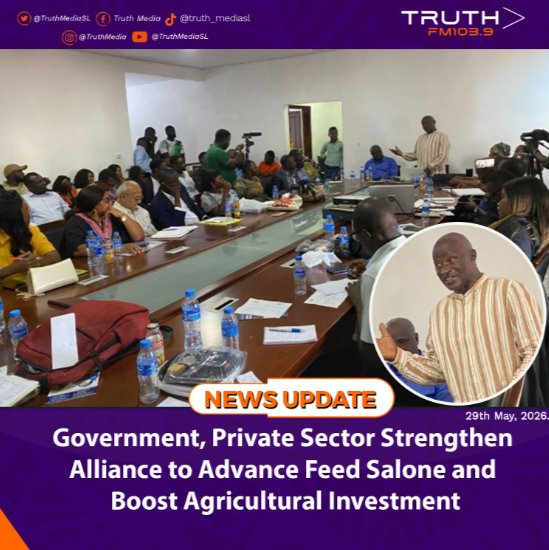
Freetown, 28th May 2026— The Sierra Leone Chamber of Agribusiness Development (SLeCAD) has engaged the Ministry of Agriculture, Forestry and Food Security (MAFS) in a high-level strategic dialogue aimed at deepening collaboration between government and private sector stakeholders to accelerate the implementation of the country’s Feed Salone agenda.
The engagement, held at SLeCAD’s Beach Road office in Freetown, brought together agribusiness owners, farmers, investors, development partners, and senior government officials to discuss practical measures needed to transform Sierra Leone’s agricultural sector, improve food security, and attract sustainable investment.
The meeting focused on strengthening partnerships that can help modernize farming systems, increase local food production, and position agriculture as a major driver of economic growth and employment.
Speaking during the dialogue, Deputy Minister of Agriculture II, Sahr Hemore, reaffirmed the government’s commitment to fostering stronger cooperation with private sector actors, stressing that meaningful agricultural transformation cannot be achieved without sustained investment and collaboration.
He described the private sector as a critical partner in the government’s vision to move agriculture beyond subsistence farming into a competitive and commercially viable industry capable of contributing significantly to national development.
According to Hemore, the government remains committed to creating an enabling environment that encourages innovation, investment, and productivity within the agricultural value chain.
“The private sector has a major role to play in helping Sierra Leone achieve food self-sufficiency and long-term agricultural growth,” he stated, while emphasizing the importance of shared responsibility in achieving the objectives of the Feed Salone initiative.
Deputy Chief Agriculture Officer, Aiah J. Thorlie, highlighted ongoing reforms within the ministry aimed at attracting private investment and strengthening agribusiness development across the country.
Thorlie noted that private institutions are increasingly supporting government-backed agricultural projects through the supply of tractors, farming machinery, improved seedlings, fertilizers, and other essential agricultural inputs.
He said the ministry is working to create a more level playing field for investors and agribusiness operators by improving policy coordination and promoting public-private partnerships that can expand opportunities within the sector.
Thorlie further stressed the importance of mechanization, innovation, and improved infrastructure in increasing productivity and reducing post-harvest losses.
SLeCAD Executive Director, Ahmed Nanoh, described the dialogue as an important platform for strengthening engagement between policymakers and private sector stakeholders.
He said SLeCAD continues to advocate for policies and investments that empower agribusinesses, improve market access, and address long-standing barriers affecting farmers and agricultural entrepreneurs.
Nanoh emphasized the need for increased financing opportunities for small and medium-scale farmers, many of whom continue to struggle with limited access to credit and modern farming equipment.
He also underscored the importance of investing in mechanized farming, storage facilities, transportation networks, and value-addition systems to strengthen local food production and reduce dependence on imported goods.
According to him, improving agricultural infrastructure and creating stronger market opportunities for local producers are essential to ensuring sustainable growth within the sector.
Nanoh further called for sustained collaboration among government institutions, development partners, financial institutions, and private investors to support Sierra Leone’s drive toward food security and agricultural self-sufficiency.
Participants at the meeting openly discussed several persistent challenges confronting the agricultural sector, including inadequate rural infrastructure, high production costs, climate-related risks, limited access to affordable inputs, and insufficient financing for farmers and agribusiness operators.
Stakeholders noted that while agriculture remains one of Sierra Leone’s most important economic sectors, many farmers continue to face difficulties accessing markets, storage facilities, irrigation systems, and modern technologies needed to improve productivity.
Concerns were also raised about the impact of climate change on farming activities, with participants calling for stronger investment in climate-smart agricultural practices and resilience-building initiatives.
Despite the challenges, stakeholders expressed optimism that stronger cooperation between the government and private sector could help unlock the country’s agricultural potential and create jobs, improve livelihoods, and strengthen national food security.
The engagement forms part of broader national efforts to reposition agriculture as a key pillar of Sierra Leone’s economic transformation agenda under the Feed Salone initiative, which seeks to increase local food production and reduce the country’s dependence on food imports.
Observers say sustained public-private collaboration will be critical in ensuring that the country’s agricultural policies translate into measurable improvements for farmers, investors, and consumers across Sierra Leone.