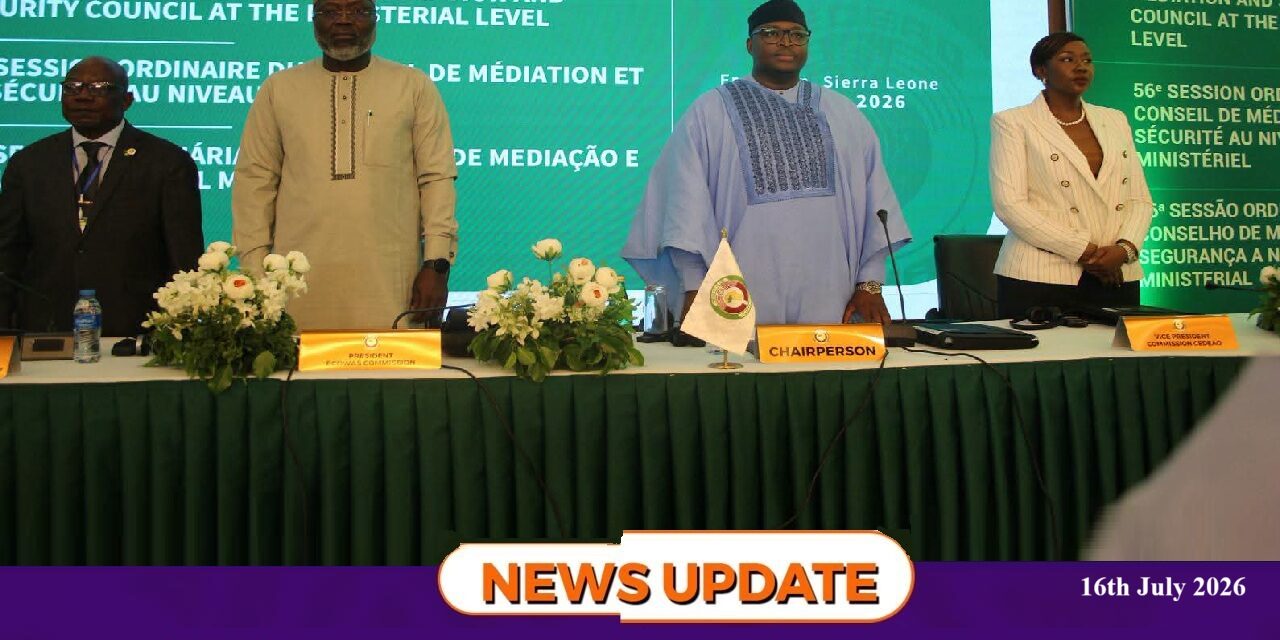
Freetown, July 16, 2026 (SLENA)-His Excellency Alhaji Timothy Musa Kabba, Council Chair and Minister of Foreign Affairs and International Cooperation of Sierra Leone, presided over ECOWAS Mediation and Security Council’s 56th Ordinary Session at ministerial level in Freetown, Republic of Sierra Leone, emphasizing the community’s critical opportunity for strengthening dialogue, consultation, and collective action supporting peace, security, democratic stability, and regional integration across West Africa.
Chairperson Kabba welcomed delegates with profound pride and sincere appreciation for hosting the 56th Ordinary Session, underscoring Sierra Leone’s ongoing commitment to enhancing peace, security, and democratic governance within the West African subregion. He reaffirmed his dedication to regional cooperation, guided by a shared vision of an integrated and prosperous West Africa.
Minister Kabba highlighted the urgency and responsibility entrusted to accomplish meaningful outcomes, acknowledging complex and evolving challenges from threats to democratic consolidation, including transnational organized crime, terrorism, violence, and vulnerabilities affecting democratic institutions. The mandate remains essential, as capacity for convening, consulting, collaborating, and acting decisively proves crucial for promoting peace, security, and good governance throughout the region.
The Chairperson emphasized session reviewed detailed reports providing a comprehensive understanding of community conditions while highlighting improvement areas. “West African peoples depend on leaders ensuring safety, security, and prosperity,” Minister Kabba stated, commending technical experts, ambassadors, commissioners, and cross-commissioning teams for groundwork enabling productive deliberations.
Minister Kabba outlined a forward-looking agenda following an extensive review of political, peace, security, and humanitarian architecture, setting the tone for enriching and fruitful deliberation. He noted the region stands at a pivotal juncture, weighing notable democratic advancement against enduring security threats, political transitions, and severe humanitarian challenges. The session necessitates a proactive approach for evaluating preparedness in preventing, managing, and resolving ongoing political situations.
Chairperson Kabba directed comprehensive discussions addressing regional political situations, electoral processes, security, and humanitarian concerns. Deliberations addressed the ECOWAS Standby Force, requiring credible, rapidly deployable, and sustainably financed instruments of collective security. Efforts to establish the ECOWAS Economic and Social Council received acknowledgement, alongside progress on dispute matters and methodology concerns.
Minister Kabba stressed that enduring peace necessitates a comprehensive strategy founded on good governance, the rule of law, inclusive development, and empowerment of youth, women, and persons with disabilities. Strategic frameworks must reflect realities, dedicating regional solutions to embodying common challenges.
The Chairperson reaffirmed Sierra Leone’s commitment to collaborating with member states, ensuring the session yields practical recommendations for improving the security framework. Sierra Leone’s standing as a pillar of democratic progress testifies to national dedication toward peace, Minister Kabba emphasized.
His Excellency Dr. Omar Alieu Touray, President of the ECOWAS Commission, delivered a welcome address expressing profound gratitude toward the Sierra Leonean government and people for their warm hospitality and excellent arrangements. President Touray noted that Sierra Leone’s transformation from conflict into peace and fragility into democratic resilience stands as a powerful testament to achieving dialogue, reconciliation, regional solidarity, and commitment toward peace.
President Touray acknowledged a rapidly changing global landscape: fragmented international order; new geopolitical rivalries reshaping partnerships; technological advances creating unprecedented opportunities alongside vulnerabilities; climate change intensifying resource competition while contributing to displacement and instability; and economic shocks affecting livelihoods, particularly among young people and vulnerable communities.
The region confronts multiple interlocking challenges, including terrorism, violent extremism, organized criminal networks exploiting porous borders and fragile communities, illicit trafficking, cyber threats, misinformation, and disinformation threatening social cohesion and state resilience. Governance deficits, declining public trust in institutions, political polarization, and shrinking civic space strain the social contract between states and citizens.
Despite these challenges, President Touray highlighted that the region demonstrates inspiring examples of democratic consolidation, peaceful political transitions, national dialogue, reconciliation, and institutional reform. He outlined clear tasks: strengthening collective capacity to prevent, manage, and respond to emerging threats; investing in preventive diplomacy, mediation, and peace-building; and reinforcing institutions to ensure peace and security architecture remains adequately equipped to address contemporary challenges.
President Touray urged the community toward reaffirming guiding principles: solidarity, dialogue, democracy, constitutional governance, and peaceful dispute resolution. “The future of West Africa will be determined not by crises faced today but by choices made in responding to them,” he declared.
The session deliberated on the security situation, including the activation of the ECOWAS Standby Force, understood not merely as a military initiative but as a demonstration of collective resolve to fight terrorism and safeguard constitutional order and stability. The Commission intensifies efforts to engage member states and mobilize outstanding community levy funds for the initial deployment of the counterterrorism force, though predictable and sustainable financing remains fundamental for medium- and long-term effectiveness.
The session concluded with Minister Kabba’s commitment to developing significant regulations advancing the community’s future. Chairperson officially declared the 56th Ordinary Session open, expressing hope for constructive participation and fruitful deliberations under his leadership, with a special summit on the future of regional integration scheduled for July 19, 2026, in Sierra Leone.
Senior Correspondent-Amara Kargbo
MFAIC
Email: [email protected]