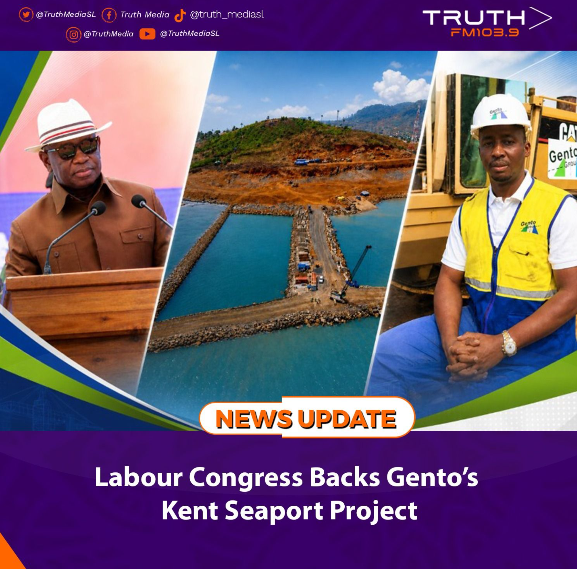
Freetown, 4th May 2026– Sierra Leone’s 2026 International Workers’ Day celebrations became a powerful showcase of unity between labour leaders, government officials, civil society actors, and private sector stakeholders, as the Sierra Leone Labour Congress (SLLC) singled out the Gento Group of Companies for its pivotal role in driving employment and national development through the proposed Kent Seaport project a landmark initiative tied to the legacy of President Dr. Julius Maada Bio.
Held at the Miatta Conference Centre, the May Day event drew high‑level dignitaries including President Bio, Vice President Dr. Mohamed Juldeh Jalloh, ministers, parliamentarians, members of the diplomatic corps, employers, and workers nationwide. Under the theme “Building Workers’ Power for Sierra Leone’s Transformative Agenda,” the gathering underscored the urgent need for stronger collaboration between government and the private sector to unlock sustainable employment opportunities.
In its keynote statement, the Labour Congress emphasized that while government policies shape the labour landscape, the private sector remains the engine of job creation. Within that context, the Congress gave special recognition to the Gento Group, describing it as a shining example of a 100% Sierra Leonean‑owned enterprise capable of delivering large‑scale, high‑impact infrastructure projects.
“We want to appreciate the Gento Group of Companies, a 100% Sierra Leone‑owned company, for the construction of the Kent Seaport which will provide huge employment in Sierra Leone,” the Congress declared, drawing applause from attendees and reinforcing the company’s growing reputation as a national development partner.
The Kent Seaport project is widely regarded as a strategic investment with the potential to reshape Sierra Leone’s maritime sector, enhance trade efficiency, and generate thousands of jobs. Labour leaders stressed that achieving the government’s ambitious target of 500,000 jobs cannot be realized through public sector efforts alone, but requires private enterprises like Gento to deliver employment at scale.
During construction, the project is expected to create over 1,000 direct jobs, with long‑term employment opportunities projected to exceed 10,000 positions. Indirect jobs could range between 50,000 and 100,000, spanning transportation, logistics, trade, and services.
Backing for the Kent Seaport has also come from civil society. A coalition led by William Sao Lamin, Chairman of the Civil Society Consortium on Community Accountability and Service Delivery, reaffirmed its support, describing the initiative as a transformative investment capable of redefining Sierra Leone’s economic future.
The World Bank Country Manager, Abdu Muwonge, hailed the project as a model of collaboration between government, development partners, and the private sector, aligning with the government’s Feed Salone Initiative.
Economic analysts point to the project’s potential to reduce the cost of living by improving shipping efficiency and lowering importation costs. Modern port facilities and logistics hubs are expected to ease congestion, boost supply chain efficiency, and position Sierra Leone as a regional trade hub.
Yet labour leaders also urged government to address persistent challenges, such as inflation, high interest rates, exchange rate instability, and heavy taxation, which continue to constrain private sector growth. Removing these barriers, they argued, would empower companies like Gento to expand operations and maximize their contribution to national development.
While May Day also highlighted pressing worker concerns, rising living costs, fuel prices, and the need for stronger enforcement of labour laws, the spotlight on Gento Group served as a powerful reminder of the role visionary private sector leadership can play in shaping Sierra Leone’s future.
As a wholly Sierra Leonean‑owned company, Gento’s involvement in the Kent Seaport project underscores the capacity of local enterprises to deliver complex infrastructure and drive sustainable development.
The unified message from labour leaders, civil society, and government was clear: progress depends on sustained collaboration. At the centre of those expectations is the Kent Seaport project, a flagship initiative that continues to generate national attention and symbolizes Sierra Leone’s industrial and economic transformation.