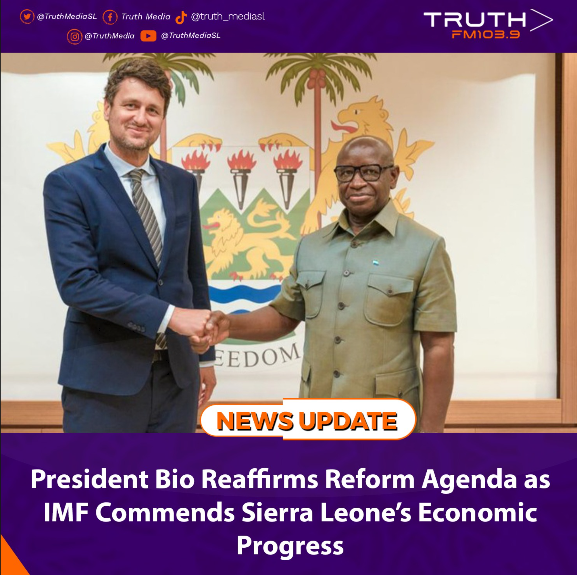
Freetown, 4th May 2026 – President Julius Maada Bio has reaffirmed his government’s reform agenda, pledging to sustain fiscal discipline and macroeconomic stability as Sierra Leone deepens its partnership with the International Monetary Fund (IMF).
During a high-level engagement at State House, IMF mission lead Christian Saborowski commended Sierra Leone’s progress under the Extended Credit Facility (ECF), noting that few countries globally had managed similar gains amid turbulent economic conditions. He highlighted declining inflation, reduced government borrowing costs, and improved private sector access to credit as tangible outcomes of reforms already underway.
President Bio welcomed the IMF delegation and expressed gratitude for the Fund’s continued support, particularly the successful completion of the first and second programme reviews, which unlocked US$89.8 million in budgetary support last year. He underscored Sierra Leone’s achievements in stabilising the economy, citing lower inflation, greater exchange rate stability, and improved fiscal balances.
The President revealed that Sierra Leone had met two of three Quantitative Performance Criteria by end-December 2025 and achieved all indicative targets for March 2026. He stressed that these results reflected his administration’s commitment to prudent macroeconomic management and structural reforms.
“Maintaining a healthy and credible economy is critical to preserving confidence among our international partners, including the World Bank, European Union, and African Development Bank,” Bio said, adding that continued IMF support would be vital in unlocking concessional financing and strengthening investor confidence.
Looking ahead, President Bio expressed optimism about the successful completion of the third ECF review and the anticipated approval of the IMF’s Resilience and Sustainability Facility (RSF), which he said would bolster Sierra Leone’s climate resilience and long-term sustainability goals.
The engagement reaffirmed Sierra Leone’s growing partnership with the IMF as government continues efforts to consolidate macroeconomic gains, protect vulnerable citizens, and build a more resilient economy.