By James Tamba Lebbie
Freetown, Sierra Leone — At a major international gathering on Africa’s future, a U.S.-based Catholic faith-based leader challenged global leaders to rethink a force often overlooked in policy circles: faith.
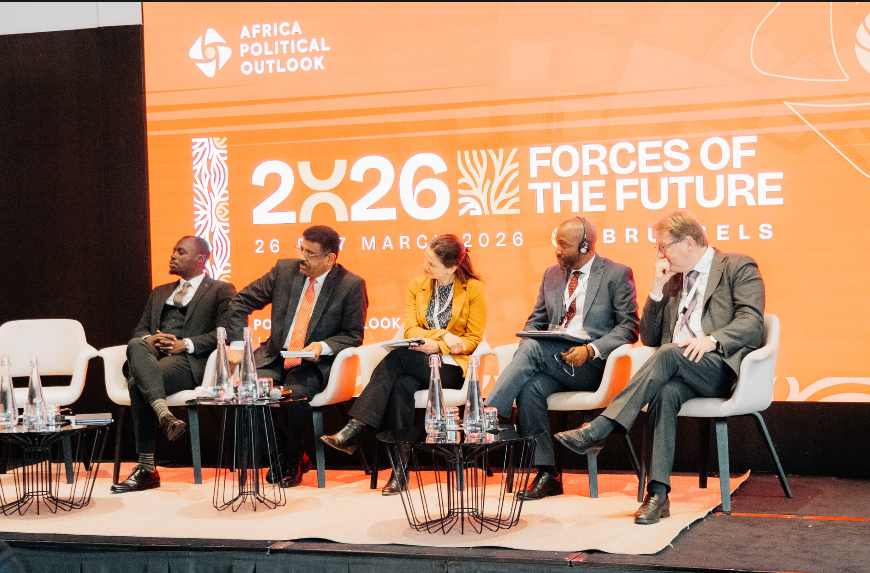
The Africa Political Outlook conference, held March 26–27 in Brussels, convened heads of state, policymakers, civil society leaders and international partners under the theme “Forces of the Future.” While discussions largely centered on economic sovereignty, security and governance, Dr. Steven Nabieu Rogers, Executive Director of the Africa Faith and Justice Network (AFJN), urged participants to look deeper.
“Africa’s future will not be built by policy alone—it will be built by values,” Rogers said during a panel on “Forces of Faith: Africa, God, and Us.”
Faith at the center of African life
Rogers argued that faith remains a central organizing force across African societies, shaping how communities respond to hardship and envision their future.
“Across Africa, faith is not peripheral. It is central,” he said. “It shapes how communities organize, how families endure hardship, and how hope is sustained even in the most fragile contexts.”
He highlighted the longstanding contributions of faith-based organizations—many supported by Catholic and other Christian networks in the United States and globally—in building schools, operating hospitals and delivering humanitarian aid, and noted how interfaith collaboration, led in part by the Catholic Church, helped foster lasting peace in post-war Sierra Leone.
“These institutions are present where the state is absent,” Rogers said. “They educate where systems are weak. They heal where infrastructure is lacking. And they advocate where voices are silenced.”
Beyond economics: a moral foundation
While the conference emphasized growth and investment, Rogers stressed that development must be grounded in ethics and human dignity.
“A society cannot thrive if corruption is normalized, if public trust erodes, or if leadership lacks moral grounding,” he said.
He pointed to the role of religious leaders in mediating conflicts and sustaining communities during crises, particularly where government institutions are weak.
“If we ignore this moral infrastructure, we weaken our approach to peacebuilding. If we embrace it, we gain a powerful partner,” he added.
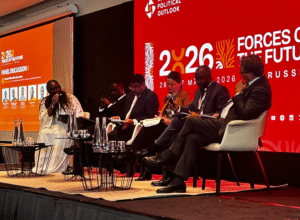
Dr. Steven N. Rogers, Executive Director, Africa Faith & Justice Network, Washington DC among the panelists.
The dangers of politicizing faith
Rogers also warned against the increasing politicization of religion in both domestic and international contexts.
He cited Nigeria as a case where external narratives have sometimes framed insecurity primarily as a Muslim–Christian conflict.
“Reducing such a complex crisis to a binary religious narrative does more than oversimplify,” Rogers said. “It risks inflaming tensions and obscuring the real drivers of insecurity.”
He noted that many Nigerian analysts point instead to governance failures, criminal violence and resource competition as key factors.
“This is precisely the risk when faith becomes a geopolitical lens rather than a moral compass,” he added.
A call for self-examination
Rogers also challenged faith-based organizations to reflect on their role in advocacy and public life.
“Are we still speaking truth to power—or have we become too closely aligned with it?” he asked.
He urged organizations to ensure they amplify local voices rather than overshadow them and to address root causes of injustice, not only symptoms.
“Are we amplifying the voices of the most vulnerable—or speaking on their behalf without accountability?” he said.
Such reflection, he argued, is essential to maintain credibility and remain rooted in justice.
Bridging faith and policy
A central theme of Rogers’ remarks was the need for stronger collaboration between policymakers and faith communities. He called for an integrated approach that combines ethical vision with policy strategy and grassroots trust with national planning.
“It means inviting faith actors into policy conversations—not as symbolic participants, but as strategic partners,” he said.
As the panel concluded, Rogers emphasized that Africa’s future is not only a political or economic project, but a moral one.
“Africa stands at a defining moment,” he said. “Our greatest strength may lie in something less visible—yet deeply powerful: our moral imagination.”