By Kemo Cham
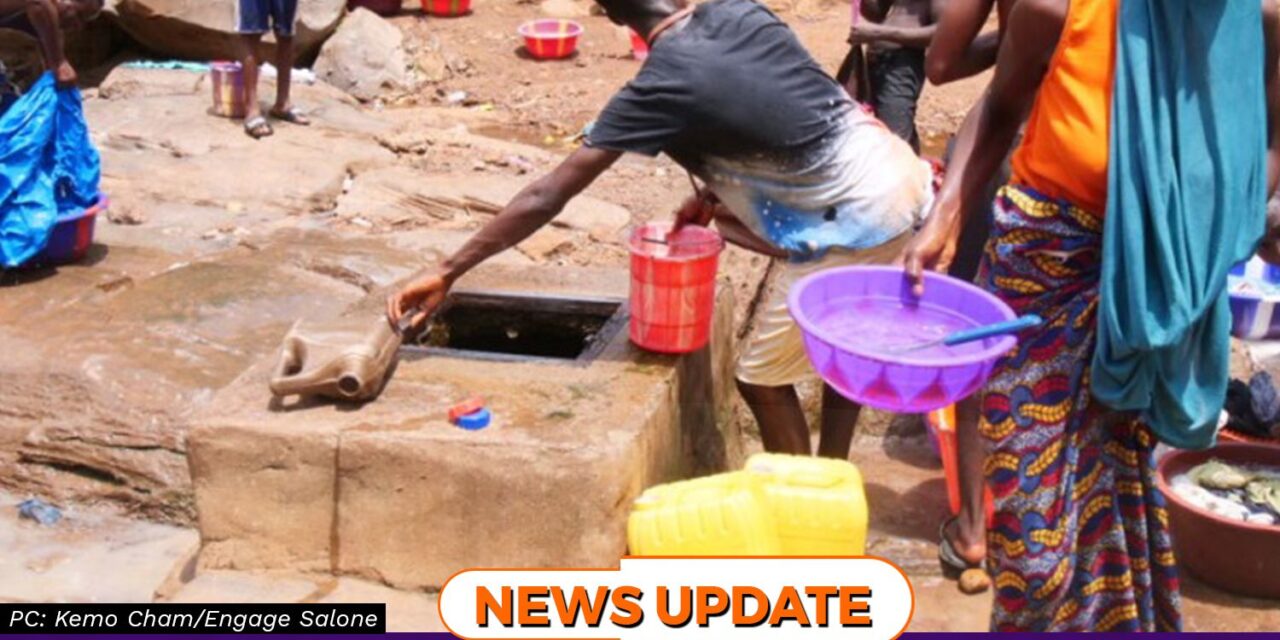
Freetown, 5th June 2026- For many households in Freetown, water is like gold. And for those living in the east of the city, the situation is even worse. It’s a daily struggle, especially for women and girls, who walk long and risky routes, and spend hours in long queues to get water for domestic use.
Hawa Koroma, a resident of Peeler Street, Wellington, is fed up with having to wake up at odd hours to get water from the only privately-owned tap near her. Just a stone’s throw from her doorstep stands a public tap, which hasn’t seen a drop of water for several months. Across the community, there are many such dry taps which serve only one purpose–a relic reminding everyone of days gone by and the harsh realities of the times.
The GUMA Valley Water Company, the government agency responsible for providing water to the city, attributes the challenges to the city’s rapidly growing population, seasonal factors and human interference at the source. This source is the Western Area Peninsula National Park (WAPNP), a 17,000-hectare area of what is left of a biodiversity-rich tropical rainforest. It is home to over 60 water catchment areas, including the GUMA Dam at Mile 13, Charlotte Dam, Kongo Dam and other smaller dams, which supply 90 percent of the water needs of the Western Area, including the capital, Freetown.
The park has been the subject of illegal activities that government and environmentalists say has led to a substantial loss of forest cover in the last decade, resulting in shrinking water levels in the dams and further exposing the city to climate vulnerabilities.
In Wellington and many communities across Freetown, the effect is already being felt. The public GUMA taps in communities that are lucky to still have the few left in Freetown are dry throughout the dry season, especially between December and May, say residents.
A spokesman for GUMA, confirmed the seasonal nature of the water supply and stressed how human interference further complicates the challenges they face.
“This source is seasonal, mostly effective at the peak of the rainy season and dwindles by December,” said Alie Kabba, a communications officer at Guma.
Some members of the Wellington community capitalized on this problem and bought water tanks, from which they provide water to other residents at a cost. A few homes have private running taps supplied by Guma, but rarely have water. The closest such tap to Hawa is at Maxwell Street, which is a two minutes’ walk away from her home. Sometimes the tap opens between 1 am and 4 am, she said. A regular option for the mother of four lies about a one minute walk away at Philip Street. But there, they have to stand in long queues and spend a lot of money to get enough water for the day. She said it costs NLe2 for a five-gallon jerrycan and she needs NLe100 every day. This means she spends at least NLe300 on water alone per week for her family of nine, whose only source of income is a husband who hawks mobile phone accessories.
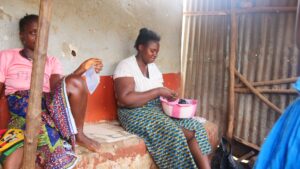
Hawa Koroma spends NLE 300 weekly on water. Photo Credit: Kemo Cham/Engage Salone
“We strain a lot to get water. My family is large, and we use a lot of water,” Hawa told Engage Salone.
For many other residents who can’t afford to buy from private providers, the alternative is an even more tedious, and sometimes dangerous, walk to a nearby stream, where they can fetch water from one of two wells surrounded by garbage and toilets, exposing them to waterborne diseases.
“It’s a hard choice for the people,” said Sulaiman Bun Ibrahim Kamara, a community organizer at Peeler Street. He told Engage that women and girls face the added danger of sexual violence when they venture out for water at odd hours in these crime-infested neighbourhoods.
The 2022 WASH National Outcome Routine Mapping Report jointly published by the United Nations Children’s agency, Unicef and the government of Sierra Leone revealed that only 23% of the country’s population had access to safely managed water services, while 44% relied on basic services. Nearly one-third of the population depends on unimproved or unsafe sources, according to the same report. It noted that in urban Freetown, pressure on existing water systems was already overwhelming, with households reporting irregular water supply, high reliance on unsafe wells, and long queues at standpipes.
That report provides valuable insights to guide policy formulation, resource allocation, and interventions aimed at improving WASH access and behaviors and ultimately advancing Sierra Leone’s chances of achieving safe and sustainable WASH services for all, in line with the UN’s Sustainable Development Goal 6.
At the center of efforts to realise this goal is the protection of the Western Area Peninsular National Park, which has been under sustained encroachment.
“Over the years, especially from 2014 to date, about 5,600 hectares have been destroyed, and we don’t see a pattern that is slowing that process,” Sheikh Ahmed Tunis, Executive Director of the National Protected Area Authority (NPAA), told Engage Salone.
Tunis assumed office at the agency in January 2026, after a long stint at the Environmental Protection Agency (EPA). He says his office has prioritised protecting the Park, which he calls the “lifeline and last defence” of the city. The agency says they have found people building both luxury and low cost homes, burning charcoal and logging in the forest. Cannabis farms have also been discovered deep in the forest. Tunis said charcoal burning is the biggest issue in the forest and that those involved have become more aggressive, confronting forest guards.
Wildfires are also a common occurrence within the forest. Tunis said that while some are natural, many are deliberately started by encroachers to make space for the construction of illegal structures.
The forest guards patrol the area for up to 10 hours a day, but Tunis said most fires are ignited after work hours, between 7 pm and 5 am.
“To stop all these activities, we need to effectively patrol the park 24 hours, round the clock,” he said.
But the problem is that the agency is seriously under-funded. It has only 667 forest guards on staff, 100 handcuffs, and one patrol vehicle. With this, they are responsible for overseeing 15 sites designated as protected areas nationwide.
Tunis said the criminal encroachers have become increasingly violent. On May 31st, several forest guards were seriously injured after they confronted a group of people burning charcoal in the Peninsular Park.
“We are dealing with the strongest criminals. People who are planting cannabis, you don’t go after them empty handed. People who are cutting trees with chain saws, you don’t go and attack them empty handed,” he lamented.
After six months in office, he said he hasn’t received a single cent from either the government or donor partners. “Everything we are doing is either from me and my colleagues, because we love what we do,” he said.
Despite promising to promote environmental protection, the Bio administration has faced repeated criticism from environmentalists and conservation organisations for policies that go against this spirit or lack of action. One notable instance of this is the proposal announced in late 2025 to re-demarcate the WAPNP. While it is unclear why the government put forward such a controversial proposal, critics say it points to official complicity or at least tacit encouragement of illegal activities around the park.
President Julius Maada Bio himself visited the park and toured the Guma Dam catchment area in April 2022. His visit resulted in the establishment of an investigation committee tasked with mapping the extent of encroachment. The committee’s findings, which were submitted in September 2023, were damning. In 2024, the President ordered the demolition of all illegal structures erected beyond the designated Freetown Greenbelt.
“Even if a house belongs to me or my family, it would be broken down,” he was quoted saying at a Townhall meeting later.
In spite of all this, the encroachment has only intensified.
“Protecting the Peninsula protected area comes with very deliberate and intentional implementation of the policies and decisions of the government,” says Berns Komba Lebbie, National Coordinator of Land for Life, one of about a dozen environmental pressure groups that signed an Open Letter in August 2025, urging the government to reconsider its decision to re-demarcate the park. He said what policymakers say and what happens on the ground are quite different.
There is widespread concern among environmentalists over reports that the government itself allocated land within the park to those erecting the structures.
The World Food Programme’s Asset Impact Monitoring from Space (AIMS) extended analysis tracked changes within and around the Park between May 2024 and April 2025. It revealed massive losses in forest cover.
Some investigative reports have also shed light on Chinese-run granite quarries in the national park, activities that communities and activists say threaten water sources and the wider environment. There have been reports of contamination of water sources in the surrounding communities.
Some even believe that the proposal to re-demarcate the park is to legitimise ongoing illegal activities and buildings owned by “powerful people.” It was reported that the proposal was favoured by the NPAA, but Tunis said they opposed the idea.
“There are better solutions. If you re-demarcate today because somebody encroached and you verified that, you accept that encroachment by re-demarcating. It is like validating their crime. What will happen five years from now? Somebody else will do the same thing and you will re-demarcate,” he said, stressing that people must pay for their actions.
The Lands Ministry didn’t respond to Engage Salone’s request for a comment, despite several attempts to reach them.
In a rare move of internal governmental dissent, the Ministry of Water Resources and Sanitation and Guma issued a joint statement publicly opposing the move, citing the imminent risk to crucial water installations, among other concerns.
Amid the heated public debate over the re-demarcation proposal, Chief Minister Dr David Moinina Sengeh led a joint team of government officials to inspect the park. He was quoted in reports downplaying suggestions of reducing the size of the park.
The Western Area Peninsular National Park is also home to Sierra Leone’s premier chimpanzee sanctuary, Tacugama. The sanctuary is home to over 100 rescued and rehabilitated Western Chimpanzees. And the forest around the sanctuary is believed to hold hundreds, if not thousands more of the primates, the country’s national animal.
Bala Amarasekaran, Founder of Tacugama, has repeatedly complained about the impact of encroachment in the Park. The sanctuary provides tours, eco-lodging and forest hiking services. In 2025, it shut its doors to the public for 5 months in protest of the government’s inaction against encroachment.
“We have beautiful laws, but if they are not implemented, it is a waste of time of the people who have made these laws,” Mr Amarasekaran told this reporter in an earlier interview. Tunis of the NPAA echoed this lack of implementation of the existing laws, warning of potential catastrophe if concrete action isn’t taken now.
“In another 10 years, most of the water will dry up because we are destroying everything,” he said.
Meanwhile, for residents of Wellington and many parts of the Freetown municipality, the impact of ongoing environmental destruction is already taking a toll.
For Hawa and her children, the sleepless nights, long queues and having to replace water containers stolen by neighbours is unbearable.
“We are appealing to the government for help. When the dry season starts, it’s sleepless nights for us. We want this to end,” she said.
Courtesy of Engage Salone