By Davida Spaine- Solomon
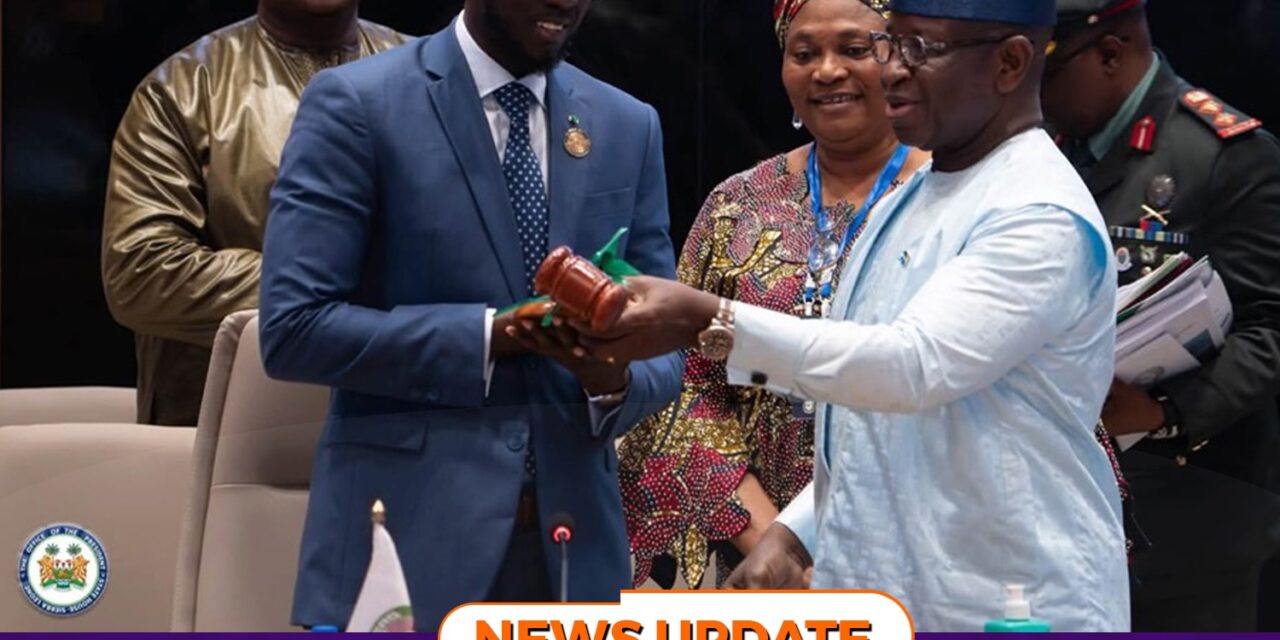
Lungi, Sierra Leone, 20th July, 2026 — President Julius Maada Bio has formally handed over the chairmanship of the Economic Community of West African States (ECOWAS) Authority of Heads of State and Government to Senegal’s President, Bassirou Diomaye Faye, during the bloc’s 69th Ordinary Session, held in Lungi at the Julius Maada Bio International Conference Centre, on 19th July, 2026, marking the end of Sierra Leone’s one-year tenure and reaffirming ECOWAS’ longstanding principle of rotational leadership.
After fulfilling his mandatory one-year term as Chairman of the ECOWAS Authority, President Bio expressed with profound privilege as he handed over the responsibility to the incoming chairman, His Excellency Bassirou Diomaye Diakhar Faye, President of the Republic of Senegal. Bio also extended his best wishes to him.
President Faye, upon assuming the leadership, posted on Facebook, expressing with humility that he welcomed the trust placed in his country, called upon to preside over the ECOWAS. “I thank my peers, Heads of State and Government, for this mark of trust and for the spirit of brotherhood that presided over our work,” he said. He further congratulated General Birame Diop for being elected as president of the Commission, and assured him of his full support. “Long live ECOWAS. Long live a reconciled and united West Africa,” he concluded.
President Faye’s emergence as chairman restores the organisation’s traditional balance of leadership across its Anglophone, Francophone and Lusophone member states after several consecutive years of Anglophone leadership. The transition, achieved by consensus, reflects ECOWAS’ commitment to equitable regional representation at a time when the bloc continues to confront political instability and shifting membership.
President Bio assumed the chairmanship in July 2025 during one of the most challenging periods in ECOWAS’ history, following a series of military takeovers and the withdrawal of Mali, Burkina Faso and Niger from the regional bloc. Throughout his tenure, he pursued diplomatic engagement aimed at restoring regional cohesion and constitutional order.
Among his notable interventions were efforts to encourage Guinea-Bissau’s return to constitutional governance through direct engagement with the country’s leadership. His administration also maintained dialogue with the leaders of Mali, Burkina Faso and Niger despite their exit from ECOWAS, underscoring the bloc’s continued commitment to regional cooperation.
Domestically, President Bio’s tenure coincided with progress on resolving the long-standing Yenga border dispute, culminating in the reopening of the disputed town in Kailahun District after years of occupation by Guinean forces.
His chairmanship also saw several landmark regional infrastructure projects. These included the commissioning of the new ECOWAS headquarters in Abuja, the West Africa Depot, and Sierra Leone’s Julius Maada Bio International Conference Centre, which hosted the 69th ECOWAS Summit.
President Faye’s election also reflects ECOWAS’ unwritten tradition of rotating its leadership among the region’s linguistic blocs. Since Niger’s President Mahamadou Issoufou completed his tenure in 2019, the chairmanship had successively been held by Ghana, Guinea-Bissau, Nigeria and Sierra Leone. With President Bio completing his mandate, the rotation shifted naturally to a Francophone member state.
The practice of rotational leadership has long been regarded as a cornerstone of ECOWAS’ institutional stability, ensuring that no single linguistic or national bloc dominates the organisation’s highest office. Rather than being contested through conventional elections, the chairmanship is typically determined by consensus among Heads of State in line with this established tradition.
As President Faye assumes office, he inherits an organisation navigating one of the most complex periods in its history, marked by democratic transitions, security challenges and efforts to rebuild unity following the departure of three member states.
For Sierra Leone, the successful hosting of the ECOWAS Summit and the orderly transfer of leadership conclude a chairmanship that reinforced the country’s diplomatic profile and underscored its role in promoting dialogue, regional cooperation and institutional continuity within West Africa.