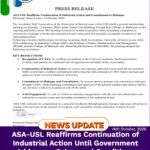
Freetown, 12th October 2026- The Union of Academic Staff Associations (UASA) has pushed back against a recent Ministry of Technical and Higher Education (MTHE) statement on ongoing salary negotiations, accusing the ministry of sending mixed signals and failing to put forward a concrete proposal to address lecturers’ welfare concerns.
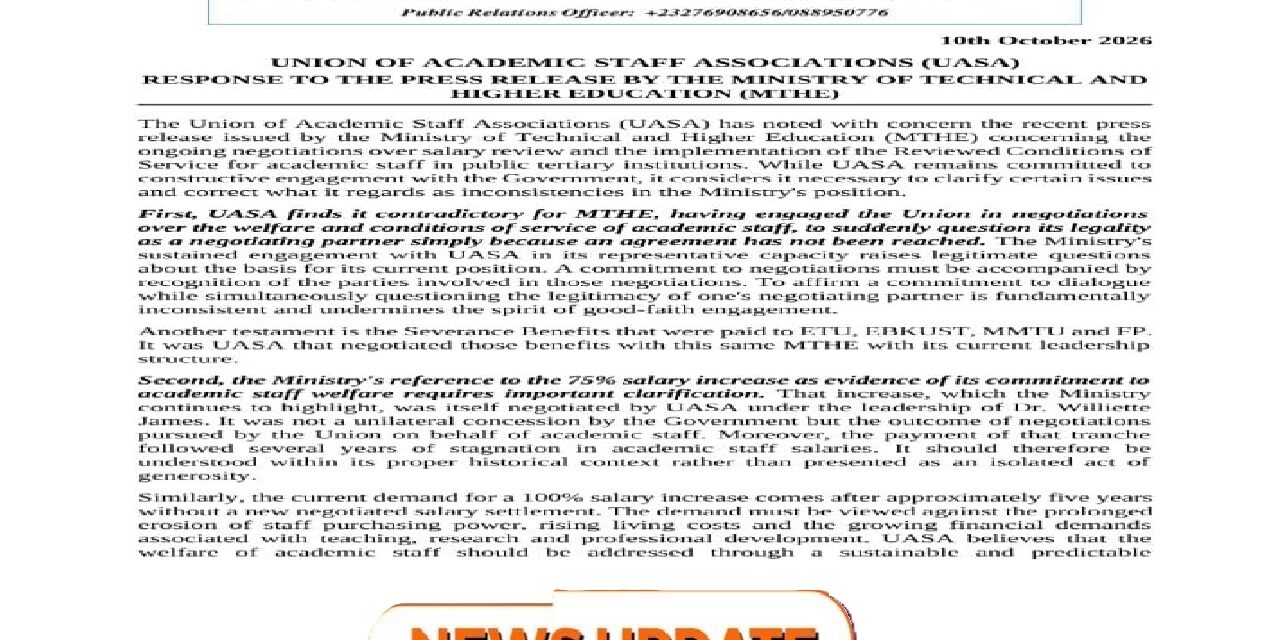
In a detailed response issued by Secretary General Abiodu Williams, UASA said it was concerned by what it described as contradictions in the ministry’s position, particularly its questioning of the union’s legitimacy as a negotiating partner despite having engaged with it in discussions over academic staff welfare and conditions of service.
The union argued that MTHE’s continued engagement with UASA over the years, including negotiations that resulted in severance benefits for staff at public tertiary institutions, undermines any attempt to cast doubt on the union’s representative role. According to UASA, meaningful negotiations can only succeed when all parties recognize and respect each other’s mandate.
UASA also challenged the ministry’s portrayal of the 75 percent salary increase previously granted to academic staff as evidence of government goodwill. The union said the increase was secured through negotiations led by former UASA leadership and was not a unilateral government decision. It further noted that the adjustment came after years of stagnant salaries and should be viewed within that broader context.
The union defended its current demand for a 100 percent salary increase, saying it reflects nearly five years without a new negotiated salary settlement. It argued that rising living costs, declining purchasing power and increasing professional responsibilities have placed significant financial pressure on academic staff.
Addressing criticism over its strike action, UASA insisted that the issuance of a 21-day strike notice was not a rejection of dialogue but a last resort after repeated efforts to secure meaningful progress in negotiations failed to yield results.
The union claimed that despite requesting a 100 percent salary increase, the ministry had not presented any formal counteroffer indicating what level of increase government considered affordable or how such an increase would be implemented. It further stated that authorities only substantively responded to the strike notice when the deadline was close to expiring.
“Negotiations must be substantive and outcome-oriented,” the statement said, arguing that goodwill messages and assurances alone were insufficient without a clear proposal capable of advancing talks.
UASA also criticized what it described as attempts to pressure academic staff into returning to work without first resolving key welfare issues. The union maintained that concerns surrounding salaries, conditions of service and professional dignity are fundamental issues affecting the quality of higher education and cannot be resolved through coercive measures.
The union expressed concern over what it described as threatening language in a series of public statements relating to the dispute, warning that such communication risks undermining academic freedom, institutional autonomy and the right of workers to organize and pursue legitimate industrial demands.
Reaffirming its commitment to dialogue, UASA said it remains open to reasonable proposals and is prepared to continue negotiations in pursuit of a mutually acceptable settlement.
The union urged MTHE to move beyond general assurances and present a specific salary review proposal, including the percentage increase government considers financially feasible, as well as a clear implementation and payment timeline.
UASA said the current deadlock should be seen as an opportunity to strengthen industrial relations within Sierra Leone’s tertiary education sector rather than a basis for questioning the legitimacy of the negotiation process.
Concluding its statement, the union emphasized that its objective is not confrontation but a fair and sustainable resolution that protects the welfare, dignity and professional interests of academic staff while safeguarding the continued development of higher education in Sierra Leone.