By Samuel Hinga Norman
Freetown, 20th April 2026- The search for greener pastures is fast becoming more of a necessity than an option. Migration in Sierra Leone is currently driven mainly by unemployment, poverty, and the search for better opportunities. Many young people continue to leave the country, often through dangerous, irregular routes, facing risks such as trafficking, exploitation, and abuse.
Labour migration to the Middle East and other regions also continues. At the same time, many Sierra Leoneans are being returned home from transit countries, making reintegration a major challenge.
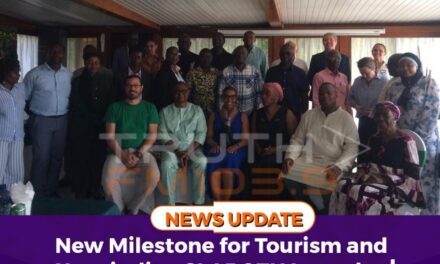
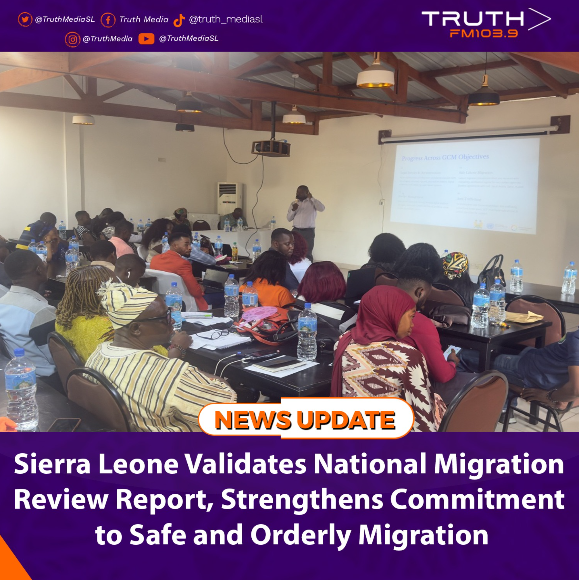
In that light, the Government of Sierra Leone, in collaboration with the United Nations Network on Migration (UNNM), International Organization for Migration Sierra Leone (IOMSL), funded by the European Union, held a session to validate the report of the National Review of the Global Compact for Safe, Orderly and Regular Migration (GCM), under the theme: “From Commitment to Action: Translating the Global Compact for Migration into National Realities for Sustainable Development.” The event was held on 16th April 2026 at Lac’s Villa, Cotonment Road, Freetown.
The gathering was highly attended by Civil Society Organisations (CSOs), representatives from all 16 districts, ministries and agencies, returnees representing different organisations, and members of the media.
According to the Deputy Development Secretary of the Ministry of Planning and Economic Development (MoPED), Mr. Osman Conteh, the importance of the review informed the government’s endorsement of the UN’s GCM proposal in December 2018. Conteh noted that the review is a landmark for the country as it underscores the nation’s commitment to the journey. He stated, “This process marks a significant milestone in that journey as we validate our third voluntary national review…” He highlighted three main purposes of the gathering: “to validate the review report, identify gaps and challenges in the report, and define clear priorities for the period 2026 to 2030.” He encouraged participants to speak freely and give their “sincere and honest” opinions, noting that this was a very important national review stage before the report would be presented in New York later this year.
Speaking on behalf of the CSOs, Rev Martha P. Gbenga Chigozie, CEO for TEEDWOGA, National Coordinator for SATPAMS, and Country Representative for WACTIPSOM, commended the government for the initiative. She believed that through such a review, the realities of migration in the nation that may have been left out would now be included. She reaffirmed the commitment of CSOs, stating that they have the interest of all migrants at heart. She therefore requested that the report should be comprehensive, indicating “the report should address illegal pathway, reintegration, psycho-social support, and some root causes in this particular work”. She further stressed the importance of the report having comprehensive data that would capture the ill-treatment of migrants. She concluded by recommending that the report should be translated into every local dialect, which will enable understanding.
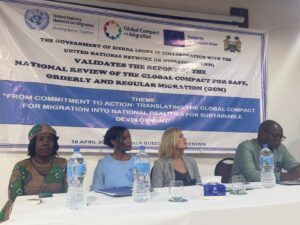
Members of the high table: Far left CSO representative, Officer-in-charge, IOM SL, EU Representative, and far right, Deputy Secretary 1, MoPED.
The Information and Communications Officer of the Bo District Council, Osman Bangura, said in an interview that the representation at the event was quite impressive. He commended the government for the inclusion of the National Implementation Plan (NIP), which was launched last year and incorporated into the report, noting that it is well aligned with the 23 recommendations of the GCM. He observed that migration should not only be viewed from the perspective of people leaving the country, but also from the perspective of internal migration. He said this also poses challenges, noting that “people leaving the provinces for Freetown are also faced with challenges like shelter, improved livelihood, and joblessness.” He emphasized that this should also be considered.
Representative of the Migrant Center for Information and Capacity Building (MiCICaB), Jemilatu Sheriff, expressed her excitement, describing the moment as a long-awaited prayer answered. She said that as migrants, their interest has always been to have a platform where their voices could be documented. She added that she hopes “our voices, information, and complaints would be documented and held of value.” She concluded by expressing hope that the government would continue to include migrants, because only they can tell their stories better.
The Officer-In-Charge of the International Organization for Migration (IOM) Sierra Leone, Madame Pauline Macharia, said Sierra Leone’s commitment is “not only to report but also to demonstrate practical solutions, shared good practices, and sustain the momentum to translate global commitment into national outcome.” She noted that the review came at a critical time as the world prepares to demonstrate its commitment on the global stage in New York later this year. She reiterated that the report validated at the session would represent Sierra Leone internationally. She closed by reaffirming IOM’s commitment to continue supporting the Government of Sierra Leone.
Migration remains one of the defining realities of Sierra Leone today. While many continue to seek opportunities beyond the country’s borders, the validation of this report signals a stronger determination to confront challenges of migration through policy, inclusion, and practical action. If effectively implemented, the outcomes of this review could transform migration from a story of desperation into one of dignity, safety, and sustainable national development.