By Nafisatu Olayinka Deen
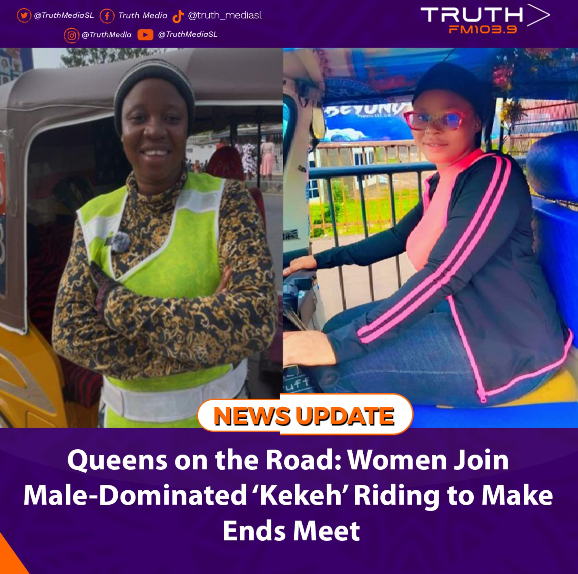
Freetown, 21st April 2026- The public transport sector is a male-dominated space in Sierra Leone. Nevertheless, women are breaking this gender stereotype, as there is now a small but growing number of women riding ‘kekeh’ to make ends meet.
A single mother with one child, Hawa Kallay, said that she entered this space [kekeh riding] because she believed that she could pull it off.
“I had nothing but a will to provide for my son and make life better. My husband is lost to addiction, and he sold everything I once owned. But the will to start over and make life better is fueled by the life I envisage for my little boy, so I got in touch with someone who started teaching me to ride and trusted me with a Kekeh, and today I’m doing fine for myself and my son,” she explained.
A victim of domestic abuse in a marriage, Fatmata Binta Jalloh, said her decision to become a Kekeh rider was ignited by domestic violence, which made her separate from her husband. “I quit my marriage even when I solely depended on my partner to provide for my child and me.” She explained that it was difficult to get a job and riding a Kekeh was a strange adventure she was willing to have hope on, so she could be independent. “I struggled to get a job and at first, the idea of riding a Kekeh was strange, but I did it anyway. I’m using a kekeh on loan and pay up as I work every day,” she noted.
These women entered a male-dominated space ready to defy all odds and make ends meet, but they are grappling with challenges on a daily basis. One of them said, “Most people intimidate us and sometimes refuse to pay us in full because they know that they will probably get away with it.”
Another one, Hawa, said that previously people doubeted them they could perfectly ride kekeh. “At first, people would not enter the kekeh because they didn’t trust that as a woman, I would ride well,” noting that months later, she started getting customers, describing the feeling that she is “doing well.”
Both women said that “they don’t ride during the night because they might be exposed to harassment or abuse.”
Despite these challenges, Hawa and Fatmata said there were good days and good people who made their job easy and fun. “Most people treat us with respect and some admire us for what we do and that feeling is satisfying,” they stated, whilst Hawa added that sometimes she even got “tips” because people were always surprised to see a woman riding a Kekeh.
They mentioned that they are financially doing well to make ends meet, but noted that they needed support to buy kekeh for themselves.
They called on their womenfolk to embark on this adventure and break gender norms. “Kekeh riding is not only for men. Women can ride well, too!” one of them asserted, “I am doing well, so any woman can ride and earn money as long as they are willing to do it.”
Like Hawa and Fatmata, many other women are thriving in this sector, and they are changing the narrative. Hawa mentioned that she is part of a WhatsApp group where over 40 kekeh women communicate with one another and share safety tips.
It is becoming clear and evident that the number of kekeh women riders is growing, and women are challenging this stereotype.