Nafisatu Olayinka Deen
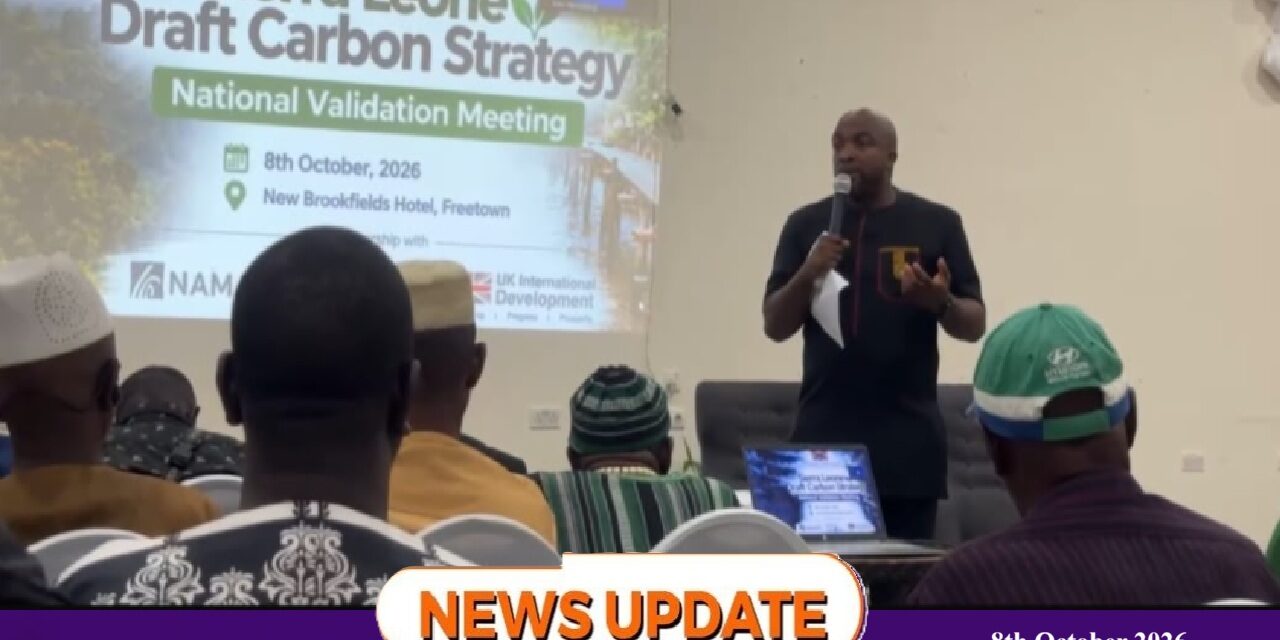
Freetown, 8th October 2026– The Government of Sierra Leone through the Ministry of the Environment and Climate Change, in partnership with Namati Sierra Leone and Invest Salone has taken a major step toward finalising the first National Carbon Strategy Draft at a National Validation Meeting held at the New Brookfields Hotel in Freetown.
The meeting brought together government institutions, communities, civil society organisations, private-sector actors and other stakeholders. Together they reviewed the draft strategy and made contributions before it was finalised.
Director of Policy and Planning, Ministry of Environment and Climate Change, Ken Phillip Sondai noted that the strategy is meant to set up a national framework for Sierra Leone’s participation in carbon markets. “This is a proud moment for Sierra Leone as we have started a carbon project in the sub-region. This strategy will address environmental integrity, community rights, benefit sharing, governance and sustainable development,” he said.
The meeting was the culmination of a wider consultation process that was held in Port Loko, Makeni, Bo and Kenema, where Sierra Leoneans gave their views on what the country’s first carbon strategy should contain. Community members, Paramount Chiefs, and other leaders discussed free, prior, and informed consent, benefit-sharing, and governance. They also engaged directly with project developers and government agencies.
Stakeholders in the regions raised questions, concerns and priorities for the draft. The Freetown meeting gave them a chance to test whether those concerns had been captured and to add further input. Participants praised the initiative, welcoming it as a development, but emphasised the need for a massive sensitisation drive.
The strategy comes as Sierra Leone’s rainforests and mangroves draw the interest of carbon project developers because of the large amounts of carbon they can store. A carbon credit represents one tonne of carbon dioxide kept out of the atmosphere or removed from it. Credits can be issued only after the carbon savings have been measured and independently verified, and they can then be sold to buyers.
During the draft presentation, Managing Director, Namati, Sonkita Conteh noted that the price paid for a carbon credit is not the same as what reaches a community. “Part of the money may go toward running the project and measuring and verifying the carbon, which is why they said benefit-sharing terms should be clearly written down”, he said.
Throughout the consultations, people stressed the need for clear rules to protect forests, respect community rights and ensure benefits are shared fairly. Carbon projects can affect land, farming, fishing, forest use and livelihoods, so the question of who holds rights over the land and who makes decisions remains central to the debate.