By Ishmael Zay-Bangura
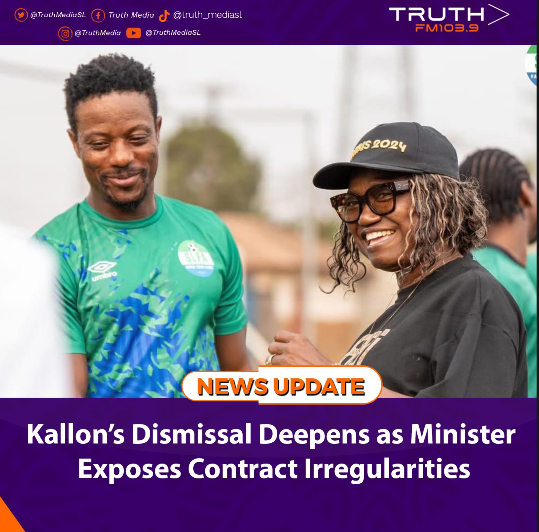
Freetown, 14th April 2026- Fresh questions about the administrative conduct of the Sierra Leone Football Association (SLFA) have emerged following a statement by the country’s Minister of Sports, Madam Augusta James-Teima, who unequivocally stated that former national team head coach Mohamed Kallon and other coaches never signed a formal employment contract with the football governing body.
The Minister made the explosive disclosure during a live interview on Radio Democracy, as the fallout from Kallon’s controversial dismissal continues to grip the nation.
“Mohamed Kallon and other coaches didn’t sign a contract; Saffa Abdulai signed for them,” the Minister is heard stating in the audiovisual from the programme.
The revelation directly contradicts previous public pronouncements by SLFA and National Sports Authority (NSA) officials. It threatens to undermine the credibility of the entire contractual process for national team technical staff.
Minister James-Teima’s comments cut to the heart of the confusion that has surrounded Kallon’s employment status since his appointment in February 2025. Her assertion implies that Dr. Emmanuel Saffa Abdulai, the Executive Director of the NSA, was the person who executed the employment documents on behalf of the coaches, not the coaches themselves.
This would mean that Kallon, despite being the public face of the Leone Stars and one of Sierra Leone’s most celebrated footballers, was never legally bound to the state or the SLFA by a personal contract. The practice, if confirmed, would be a significant departure from standard employment law and professional football governance, potentially leaving both the coaches and the government in a precarious legal position regarding salary, benefits, and termination.
The Minister’s latest statement adds a dramatic new twist to a saga that has been riddled with contradictions and a lack of transparency.
When Kallon was unveiled as head coach, the SLFA and the NSA publicly announced he had been offered a three-year contract with a performance-based renewal clause. NSA Executive Director Dr. Emanuel Safa Abdulai himself was quoted as saying Kallon had been offered the deal, which was overseen by the SLFA, NSA, and the Ministry of Sports.
However, less than a year into his tenure, it became clear that a final, signed agreement was far from complete. In January 2026, SLFA President Babadi Kamara admitted that Kallon was yet to formally sign a long-term contract, though he assured fans that a “pre-contract agreement” was being prepared. By September 2025, Dr. Abdulai had disclosed that Kallon was still only receiving match-day allowances, as his pay package had not been finalized. He further noted that the coach had chosen to continue his duties while negotiations dragged on.
The most damning admission came after Kallon’s sacking in April 2026. SLFA Secretary-General Benson Bawoh stated on Truth Media radio program that Kallon had no contract at all, and therefore the SLFA was within its rights to terminate him. This admission was met with widespread public outrage, with critics calling it “shocking administrative negligence” and “chaos masquerading as governance”.
The lack of a formal contract was the backdrop for a bitter standoff over salary. The government initially offered Kallon a monthly salary of $10,000, which was later increased to $15,000 after discussions involving the Ministry of Sports, the NSA, and the SLFA. Kallon, rumoured, rejected the offer, demanding $20,000 per month, claiming he was worth more and pointing to a purported $40,000 offer from Liberia.
The Liberia Football Association (LFA) later dismissed the alleged $40,000 offer as a rumour. Despite the government’s stance that the $15,000 offer was final, citing fiscal constraints, the impasse over money, combined with disputes over Kallon’s coaching credentials and his conduct during the FIFA Series in Azerbaijan, eventually led the SLFA to terminate his appointment in April 2026.
Minister James-Teima’s latest revelation, that Saffa Abdulai signed the contracts for the coaches, raises a host of legal and administrative questions. If true, it suggests a deeply flawed process where the national team’s head coach was not a direct party to his own employment agreement. This could have serious implications for any legal claims Kallon might pursue regarding his dismissal and for the government’s ability to enforce any performance-related terms.
The public is now left with more questions than answers. Who, exactly, was Mohamed Kallon working for? On what legal basis was his appointment terminated? And what does this practice say about the professional standards of Sierra Leone’s football administration?