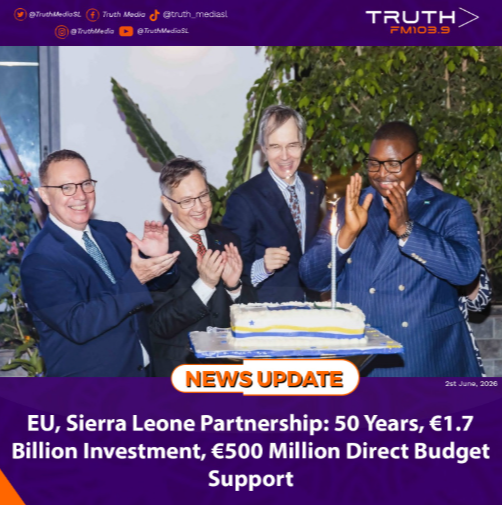
Freetown, 1st June 2026 — The European Union and Sierra Leone have marked Europe Day 2026 with a celebration of their 50‑year partnership, pledging to deepen cooperation in development, trade, democracy, and security. The event in Freetown brought together government leaders, diplomats, and civil society, underscoring both the historic depth and future ambitions of the relationship.
EU Ambassador Jacek Jankowski gave prominence to the financial scale of the partnership, revealing that the EU has invested €1.7 billion in Sierra Leone’s economy over 50 years, including €500 million in direct budget support. He stressed that the EU is the only development partner providing grants directly to Sierra Leone’s national budget, fully aligned with government priorities.
“Even during the civil war, Ebola, and COVID‑19 crises, the EU never discontinued its assistance. We were there massively to support reconstruction, electoral cycles, and health emergencies. Today, we remain proud of 50 years of mutually respectful partnership,” Jankowski said.
Looking ahead, Jankowski outlined the EU’s Global Gateway initiative as a platform to close infrastructure gaps and drive green and digital transitions. He emphasized that EU private sector investment will be central, targeting renewable energy, transport connectivity, agriculture value chains, and digital innovation.
The EU announced the imminent launch of an EU Chamber of Commerce in Sierra Leone, aimed at boosting investment and strengthening Sierra Leone’s role as a supplier to the European single market. Jankowski recalled the Everything But Arms trade policy, which for 25 years has given Sierra Leone duty-free, quota-free access to Europe.
Acknowledging concerns about non‑tariff barriers, he insisted that EU standards on quality and climate action are opportunities, not obstacles. “We are ready to help build the capacity to match them raising the value of your exports and strengthening competitiveness in the world market,” he said.
Ambassador Jankowski praised Sierra Leone’s democratic record, noting that since 2002, the country has invited EU observers to every election. He urged continued progress on reforms agreed in 2023 and 2024, endorsing the International Moral Guarantors’ April 2026 review, which recognized Sierra Leone’s advances in political dialogue and institutional reforms.
The EU commended Sierra Leone’s tenure on the UN Security Council (2024–2025) and its leadership as ECOWAS Chair, particularly in promoting dialogue, resisting coups, and strengthening regional integration. Jankowski stressed shared positions on global issues, including opposition to Russia’s war in Ukraine, but raised concerns about Sierra Leone’s flag appearing on vessels linked to the Russian “shadow fleet.” He urged serious consideration of the matter, framing it as a partner’s concern rather than criticism.
He also warned that trust can be eroded by issues such as drug trafficking, which has drawn global media attention, pledging EU support if Sierra Leone demonstrates a clear commitment to act.
Foreign Minister Alhaji Musa Timothy Kabba echoed the EU’s message, describing the partnership as one built on shared values of peace, democracy, and sustainable development. He traced the EU’s origins to the Schuman Declaration of 1950, noting that the spirit of solidarity continues to define Sierra Leone’s relationship with Europe.
Kabba emphasized that EU support aligns with Sierra Leone’s “Big Five Game Changers” and broader development goals under the UN Sustainable Development Goals and AU Agenda 2063, The Africa We Want. He welcomed the Global Gateway initiative as a forward‑looking platform capable of unlocking inclusive growth, job creation, and regional integration.
He called for deeper cooperation in renewable energy access, sustainable mining, maritime security, climate adaptation, agriculture value chains, digital innovation, and skills development, describing these sectors as vital for resilience and Sierra Leone’s aspiration toward middle‑income status.
Minister Kabba reaffirmed Sierra Leone’s commitment to democracy, constitutional governance, and human rights, stressing that democracy is a continuous process requiring dialogue, tolerance, and accountability. He commended the EU’s role in supporting electoral processes, justice sector reforms, and civic engagement.
On regional security, Kabba warned that terrorism remains the most significant threat to peace in West Africa. He cited President Julius Maada Bio’s leadership as ECOWAS Chairman, emphasizing his vision to revitalize regional security cooperation and strengthen solidarity against extremist threats.
During Sierra Leone’s tenure on the UN Security Council, Kabba said the country convened high‑level dialogues on counter‑terrorism cooperation in West Africa and the Sahel, including participation from Burkina Faso, Mali, and Niger, marking a milestone in inclusive regional engagement.
He also reaffirmed Sierra Leone’s principled stance on global conflicts, including the war in Ukraine, stressing that respect for sovereignty, territorial integrity, and international humanitarian law must be upheld without selectivity.
Kabba welcomed the International Moral Guarantors’ review of Sierra Leone’s Agreement for National Unity, which acknowledged progress in political dialogue, institutional reforms, and democratic stability.
Concluding the ceremony, both Ambassador Jankowski and Minister Kabba raised a toast to the EU–Sierra Leone partnership. Jankowski underscored the unity of Team Europe, represented by France, Germany, Ireland, and 11 honorary consuls, while Kabba extended congratulations on behalf of President Bio and the people of Sierra Leone.