By Samuel Hinga Norman
Freetown, 16th June 2026- June 16 marks the commemoration of the 1976 Soweto Uprising in South Africa, when thousands of Black students marched in protest against poor-quality education and the imposition of Afrikaans as a medium of instruction. The peaceful demonstration turned tragic when police opened fire on the students, resulting in the deaths of hundreds of children.
In recognition of their sacrifice and to highlight the challenges children continue to face across the continent, the African Union declared June 16 as the Day of the African Child in 1991. The day serves as a reminder of the need to uphold children’s rights, including access to education, protection from abuse, freedom from child labor, and quality healthcare.
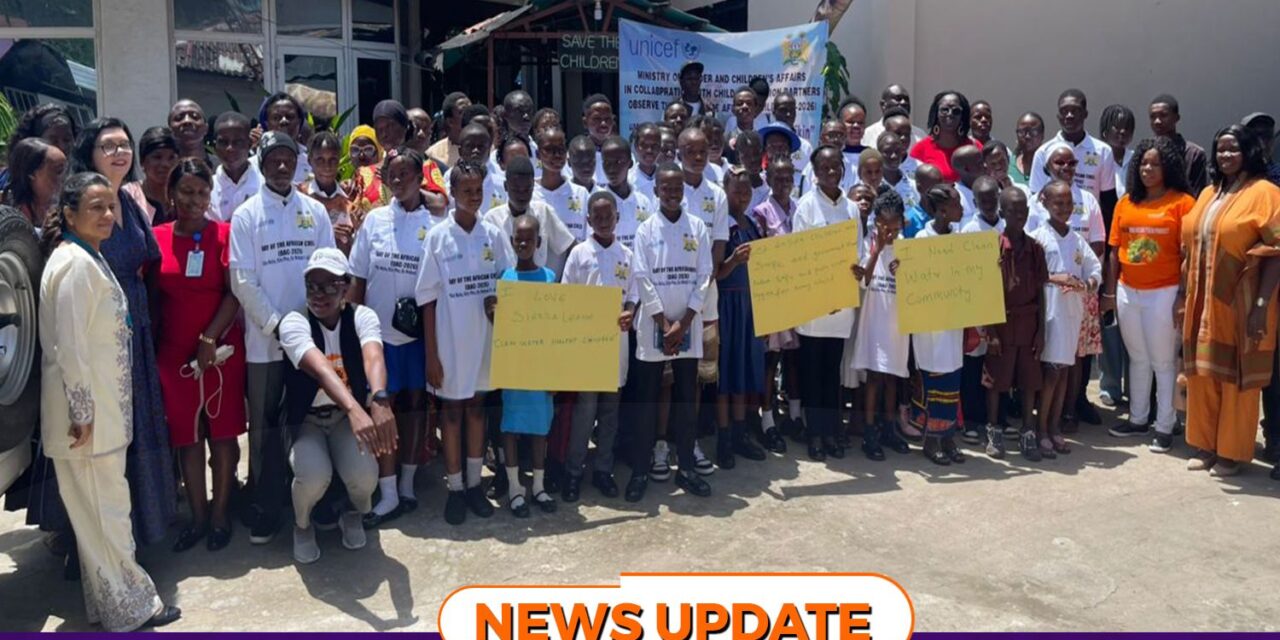
Today, the Ministry of Gender and Children’s Affairs, in collaboration with Child Protection Partners and UNICEF, observed the Day of the African Child (DAC 2026) under the theme: “Ensuring Universal Access to Water, Sanitation and Hygiene for Every Child in Africa.” The event brought together representatives from the Ministry of Water Resources, the Ministry of Gender and Children’s Affairs, the Ministry of Social Welfare, the National Commission for Children, the Child Rights Coalition, UNICEF, and children from various schools and communities. The engagement underscored the importance of protecting every child’s right to clean drinking water, adequate sanitation, and proper hygiene.
Delivering her statement, the Permanent Secretary of the Ministry of Gender and Children’s Affairs, Aminata Y. Sannoh, described the theme as “timely and critical.” She emphasized that access to clean water, sanitation, and hygiene is not merely a development concern but a fundamental right that directly impacts children’s health, education, dignity, protection, and overall development. She highlighted the numerous challenges children, particularly girls, continue to face in accessing these basic services and reaffirmed the Government of Sierra Leone’s commitment to addressing them. She stated:
“As a government, Sierra Leone remains committed to promoting child-responsive water, sanitation and hygiene through investment in water infrastructure, school wash programs, health system strengthening and community-led initiatives in Sierra Leone.” She concluded by stressing the need for partnership, unity, and collective commitment to ensure that every child has equitable access to these essential services.
Speaking on behalf of UNICEF, Officer-in-Charge Deputy Representative Mona Korsqard reiterated the urgency of the theme and emphasized every child’s right to safe drinking water, sanitation, and hygiene. She noted that the theme aligns with Agenda 2040’s vision of “An Africa Fit for Children.” Highlighting the significance of the occasion, she stated:
“This theme speaks a simple truth: without safe water, adequate sanitation and proper hygiene children cannot survive, learn or thrive.” She further noted that progress has been recorded in rural communities, where access to water, sanitation, and hygiene increased from over 38 percent in 2010 to 54 percent in 2022. Korsqard reaffirmed UNICEF’s commitment to working alongside the Government of Sierra Leone, development partners, and local communities to ensure that every child grows up healthy, safe, and with dignity.
Also addressing the gathering, the Deputy Commissioner of the National Commission for Children, Henry M. Sheku, stressed that the theme reflects a fundamental reality affecting children’s wellbeing. He stated that “No child can learn, grow or dream without safe and clean water, improved hygiene and sound health.”
Sheku acknowledged that the struggle for clean water continues in many communities across Sierra Leone and emphasized that “access to water, hygiene and sanitation are not privileges.” He further referenced Article 24(2) of the Rights of the Child, noting that it provides for children’s access to these essential amenities. He called on all stakeholders to hold themselves accountable in ensuring that these rights are enjoyed by every child and not just a select few.
The observance of the Day of the African Child 2026 served as a powerful reminder that access to clean and safe drinking water, proper sanitation, and good hygiene is a fundamental right of every child. While progress has been made, significant challenges remain, particularly for vulnerable children and those living in underserved communities.
As government institutions, development partners, civil society organizations, and communities continue to work together, the collective goal remains clear: to ensure that every child in Sierra Leone and across Africa can grow, learn, and thrive in an environment where safe water, sanitation, and hygiene are guaranteed rights rather than privileges.