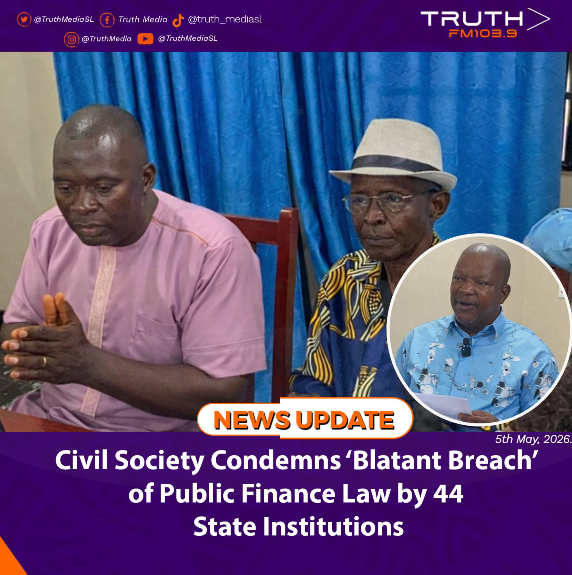
Freetown, 5th May 2026- A coalition of civil society organizations has sounded the alarm over what they describe as a “blatant breach” of Sierra Leone’s public financial management laws, after 44 public entities failed to submit their annual financial statements for the 2025 financial year.
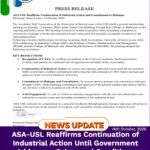
The Budget Advocacy Network (BAN), in collaboration with the Non-State Actors on Public Financial Management, convened a press briefing in Freetown to denounce the widespread non-compliance. The move follows a public notice issued by the Audit Service Sierra Leone (ASSL) on May 4, 2026, which listed dozens of institutions that missed the March 31 deadline mandated by law.
Abu Bakarr Kamara, National Coordinator, described the issue as a perennial problem
“This is a perennial problem that has been happening over the years around the late submission of financial statements by entities, as per the 2016 Public Financial Management Act,” Tarawally said.
“In fact, to address this problem, the Audit Service Act was amended in 2023 to give the Audit Service the power to withhold the salaries of vote controllers who fail to respond to audit queries or submit financial statements,” Kamara noted that, despite these reforms, compliance has worsened.
“Can you imagine a total of 44 entities, big entities, managing millions and even billions of dollars, failing to submit their financial statements? This is a slap on the accountability system around public financial management,” he added.
Hon. Joseph N. Kaindoh, Chairperson of the Non-State Actors, explained the origins of the civil society oversight mechanism.
“The non-state actors came into being in 2019 when the Government of Sierra Leone and the World Bank signed an MOU to establish a civil society outfit to oversee public financial management. CSOs across the country were mapped and trained to monitor accountability,” Kaindoh said.
He emphasized that the coalition’s role is to ensure that financial transparency remains at the top of the government’s agenda.
Reading the coalition’s press statement, Abdulrahman M. Sesay, Senior Programmes Officer at BAN, condemned the conduct of the defaulting institutions.
“The action of these state institutions is a blatant breach of the 2016 Public Financial Management Act. Compliance with this law is not optional; it is a legal and moral obligation,” Sesay declared.
He warned that the scale of non-compliance across critical sectors, including health, infrastructure, and regulatory agencies, undermines the national audit process and parliamentary oversight.
“This failure cripples the audit process, creates dangerous blind spots in the management of public funds, and raises serious concerns about possible financial mismanagement, weak internal controls, and a culture of impunity,” Sesay said.
Among the 44 institutions cited by the Audit Service are: The Sierra Leone Broadcasting Corporation, Sierra Leone Roads Authority, National Minerals Agency, Guma Valley Water Company, Sierra Leone Produce Marketing Company, National Public Procurement Authority, Sierra Leone National Shipping Company, Ernest Bai Koroma University, Office of the Ombudsman and National Telecommunication Authority and many others spanning education, infrastructure, health, and regulatory oversight.
The coalition urged the Ministry of Finance and Parliament to enforce sanctions against defaulting entities.
“We call on the Audit Service Sierra Leone to invoke Section 3g(i) of the Audit Service Amendment Act 2023, which recommends that the emoluments and allowances of a person who fails or refuses to submit annual financial statements should be withheld,” the statement read.
Civil society leaders warned that continued inaction would erode public confidence and weaken service delivery.
“Sierra Leone cannot afford a system where public institutions operate above the law,” Sesay stressed.
Section 86(1) of the Public Financial Management Act 2016 requires that:
“Within three months after the accounts of a financial year are closed, the vote controller of every entity shall submit to the Auditor-General annual financial statements of the entity for the financial year.”
The Audit Service Act (2014, amended in 2023) further empowers the Auditor-General to enforce compliance, including withholding salaries of vote controllers who fail to meet their obligations.
The coalition’s press briefing underscores growing frustration within civil society over weak accountability in Sierra Leone’s public sector. With 44 entities failing to meet their statutory obligations, the call for sanctions marks a critical test of the government’s commitment to transparency and financial discipline.