Freetown, 27th November, 2026 – Parliament has passed into law ‘The Finance Act 2027,’ which provides for the imposition and alteration of taxes to give effect to Government’s financial proposals for the 2027 financial year.
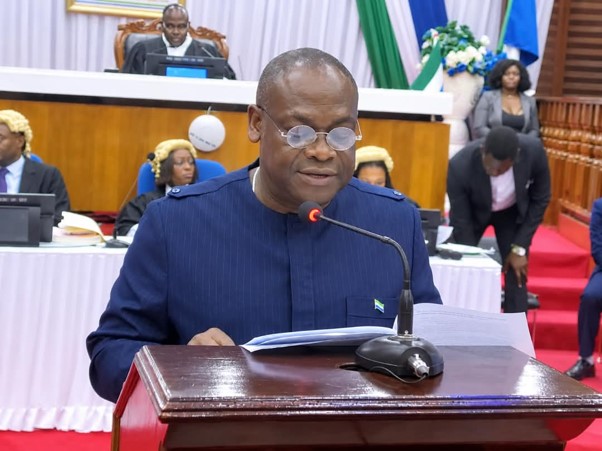
Presenting the Bill for its second reading on 26th November, the Minister of Finance, Karefa A.F. Kargbo, said that the legislation is intended to give legal effect to the Government’s revenue and taxation measures for 2027.
The key sections of the Bill amend Income Tax Act, 2000 and the Customs Act, 2011. It also introduces measures aimed at strengthening the monitoring of tax exemptions, annual poll tax, electronic tax administration, and performance-based incentives for revenue-generating Ministries, Departments, and Agencies (MDAs).
Kargbo stated that the reforms were essential to close revenue loopholes, strengthen local industries and reduce dependence on external borrowing.
In his submission, Chairman of the Parliamentary Finance Committee in Parliament, Hon. Keikura C. Vandi, welcomed the Bill, describing it as critical to strengthening the country’s fiscal position.
He raised a concern over revenue shortfalls recorded by the National Revenue Authority (NRA) in the first half of 2026, particularly in GST, personal income tax, customs duties and petroleum-related taxes.
Vandi called for stronger revenue monitoring, upfront payment of petroleum taxes, transparency in duty waivers and effective enforcement of export proceeds repatriation. He also supported performance incentives for revenue-generating institutions and urged that tax exemptions be properly justified and monitored.
The Deputy Speaker of Parliament, Hon. Ibrahim Tawa Conteh, raised concerns about customs clearance procedures and the proposed financial requirements for clearing and forwarding agents. He said that importers and clearing agents should not be penalised for delays beyond their control, particularly where shipping documentation and shipping agents contributed to the problem.
Conteh also called for a review of duty-free concessions granted through MDAs, stronger parliamentary scrutiny of investment agreements, improved electronic payment systems, protection of indigenous businesses, stronger port operations and reform within the NRA.
The Opposition Deputy Leader 2, Hon. Aaron Koroma, called for a comprehensive review of tax waivers and concessions. He stated that excessive exemptions were depriving the country of much-needed revenue. He stressed improved tax compliance, consistent use of tax collection machines and stronger accountability in public institutions. He also addressed petroleum pricing, the influence of exchange rates and Government taxes on pump prices and cautioned against excessive financial requirements that could exclude young Sierra Leonean entrepreneurs. He called for urgent action on port congestion and maritime infrastructure.
Hon. Mustapha Sellu from Moyamba District said he had examined the Bill and had issues to raise. He said some clearing and forwarding agencies face major problems at the quay, questioning the requirement for agencies.
Sellu also asked whether the Minister of Finance consulted Paramount Chiefs, Local Government Councils and the Ministry of Local Government before increasing local tax. He also questioned the requirement of a Taxpayer Identification Number before opening a bank account.
The Deputy Opposition Whip 1, Hon. Catherine Zainab Tawarallie, called for greater clarity in the amendments, particularly the distinction between the National Civil Registration Authority (NCRA) and the NRA.
She also expressed concern about the proposed US$25,000 bank guarantee for clearing and forwarding agents, arguing it could disadvantage indigenous operators. She raised concern on sugar classification, cargo manifest amendments, customs auction procedures, smart prepaid electricity meters and GST on electricity payments. She stated fair taxation that protects ordinary citizens and local businesses while encouraging responsible foreign investment.
The Opposition Whip, Hon. Abdul Karim Kamara, also called for a comprehensive review of tax waivers and concessions, improved business tax compliance, and stronger accountability in public institutions. He echoed concerns on petroleum pricing, customs brokerage requirements and port congestion.
Hon. Billor Shaw from Falaba District said increasing taxes alone would not guarantee improved revenue collection, arguing instead for a broader tax base and stronger compliance.
He called for greater accountability in Government agreements, protection of indigenous businesses and timely disbursement of constituency development funds. He also raised monopolistic practices in motorcycle importation, investment outside Freetown, improved traffic management, infrastructure maintenance and equitable distribution of resources to underserved districts like Falaba and others.
Hon. Unpha Sorie G. Koroma from Western Area cautioned that revenue mobilisation should promote fairness, efficiency and accountability, not just higher taxes.
He called for public education and effective monitoring before enforcing penalties on online businesses, supported digitalisation of revenue collection, and advocated a gradual approach to increasing financial requirements for customs operators. He also raised penalties for customs clearance delays, taxation of sugar used as industrial raw material and alleged unofficial payments in the electricity sector.
The Deputy Leader of Government Business, Hon. Bashiru Silikie, called for stronger financial scrutiny of agreements presented for ratification. He proposed a formal understanding between Parliament and the Ministry of Finance to ensure financial implications of investment agreements and concessions are thoroughly examined before approval. He warned against abuse of duty-free concessions by contractors who import beyond project needs and divert excess goods into commercial markets. He also called for increased funding for parliamentary committees to strengthen oversight.
Rounding up the debate, the Acting Leader of the Opposition, APC, Hon. Daniel Brima Koroma, urged firm action against tax-defaulting companies, particularly in the extractive sector.
He disclosed that seven companies had allegedly failed to meet their tax obligations, with outstanding liabilities reportedly exceeding US$1 million, and called for recovery of taxes, interest and penalties.
He advocated for a comprehensive review of tax exemptions, improved local tax compliance, sustainable financing for state-owned enterprises and adequate availability of prepaid electricity meters before existing payment arrangements are discontinued. He further proposed considering proof of local tax payment as part of voter registration to encourage compliance.
Concluding the debate, the Leader of Government Business, Hon. Mathew Sahr Nyuma, defended the reforms as essential to addressing longstanding weaknesses in domestic revenue mobilisation.
He disclosed that projected domestic revenue of approximately NLe27.1 billion was below expenditure requirements exceeding NLe30 billion, leaving a financing gap of about NLe2.9 billion.
He advocated automated tax administration, improved TIN and banking integration, stronger monitoring of tax exemptions and performance-based revenue incentives for MDAs. He also supported incentives for solar energy, prepaid electricity meter and protection of local businesses, while calling for accurate customs valuation and stronger institutional accountability.
Despite political differences, MPs shared concern over the need to strengthen the domestic revenue base, protect national resources, promote fair competition and ensure Government institutions fulfil their responsibilities.
Credit: Parliamentary and Public Relations Department, Parliament of Sierra Leone
📞 +23278495023 / +23276625960 / +23278426851 / +23278697776 / +23277473804 / +23275710747