By Haja M’balu Tejan Kamara
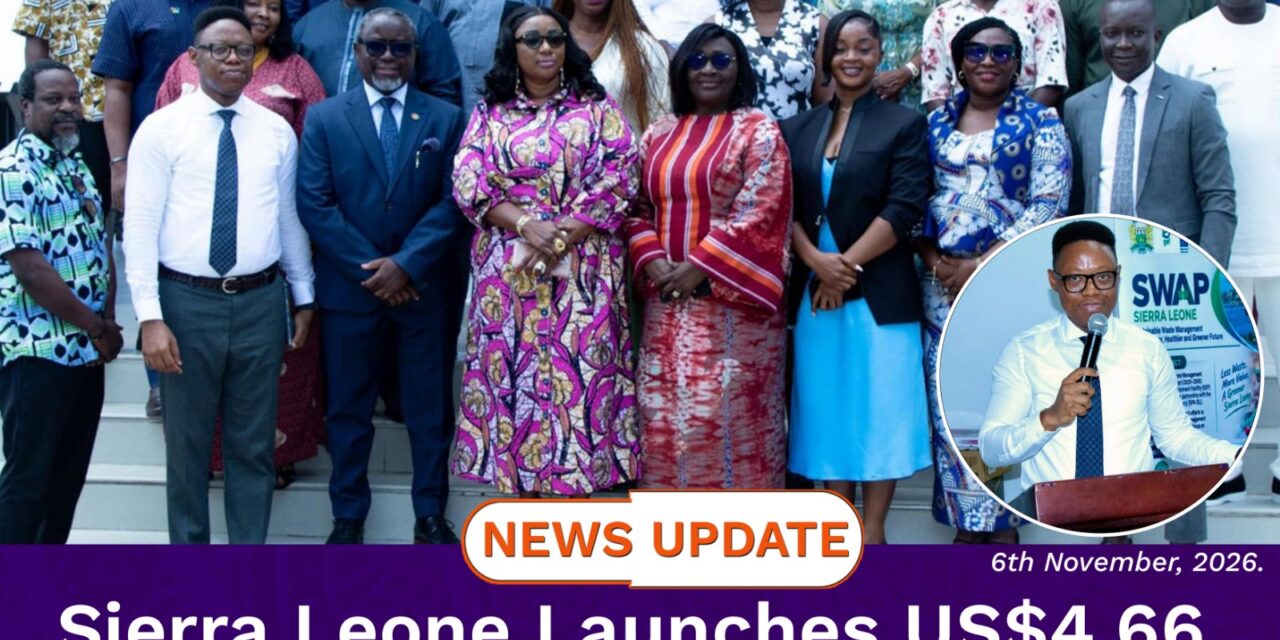
Freetown, 5th October, 2026 – The Environment Protection Agency (EPA-SL), in partnership with the United Nations Development Programme (UNDP) in Sierra Leone, Global Environment Facility (GEF), Freetown City Council (FCC) and Women’s Network for Environmental Sustainability (WONES), has officially launched the US$4.66 Million Shifting to Zero Waste Against Pollution Project (SWAP).
Funded by the Global Initiative for five years, the project aims to address growing waste management challenges and reduce environmental pollution in Freetown. The launch took place at the Country Lodge Hotel, Hill Station, Freetown.
The launch brought together stakeholders and development partners to discuss sustainable approaches to waste management, promote recycling and protect the environment. The five-year project seeks to move away from the traditional system of waste collection and disposal towards a more sustainable approach that encourages waste prevention, reuse and recycling.
In his keynote speech, the Executive Chairman of the Environment Protection Agency, Dr Abu-Bakar S. Massaquoi, said that the project would focus on building technical capacity, improving waste management systems, strengthening regulations and encouraging investment in the waste management sector. He said that proper waste management is everyone’s responsibility and requires strong collaboration among government institutions, the private sector and communities.
Dr. Massaquoi said that the project connects with the Government’s broader waste governance efforts, including the Integrated Waste Management Facility (IWMF) at Masiaka, the National Pollutant Inventory (NPI), and among others.
The Representative from the UNDP, Tanzila Sankoh, highlighted the rapid increase in waste generation in Freetown, noting that the city’s growing population and economic activities continue to contribute to the problem. She emphasised that waste materials could be transformed into useful products through recycling and other sustainable practices. She warned that poor waste management could lead to increased pollution of land and water resources, as well as higher greenhouse gas emissions.
As part of its planned activities in Freetown, the project will support the development of a city waste management plan and zero-waste strategy, improve waste collection and coordination, and strengthen systems for managing different types of waste. It will also promote recycling and reuse initiatives, cleaner production, green businesses and training for local authorities, waste collectors and community stakeholders.
The project has four major components: integrated planning and programming; financing instruments; sustainable production, consumption and materials; training, education, advocacy and evaluation.
The SWAP Project is funded with 4.66 million United States dollars from the Global Environment Facility (GEF), while an additional 3.9 million United States dollars has been identified as co-financing from different partners.
The initiative is expected to encourage changes in how people produce, consume, and dispose of materials, while creating more opportunities for waste reuse and recycling.