New York, 23rd September 2026 – Sierra Leone’s Minister of Information and Civic Education, Chernor Bah, has called for school feeding programmes to be treated not as charity, but as a strategic national investment linking education, agriculture, youth employment and economic self-reliance.
Speaking at a high-level event on the margins of the 81st United Nations General Assembly, Bah told global leaders that school meals must be seen as “where our investment in the child meets our belief in ourselves as a country.”
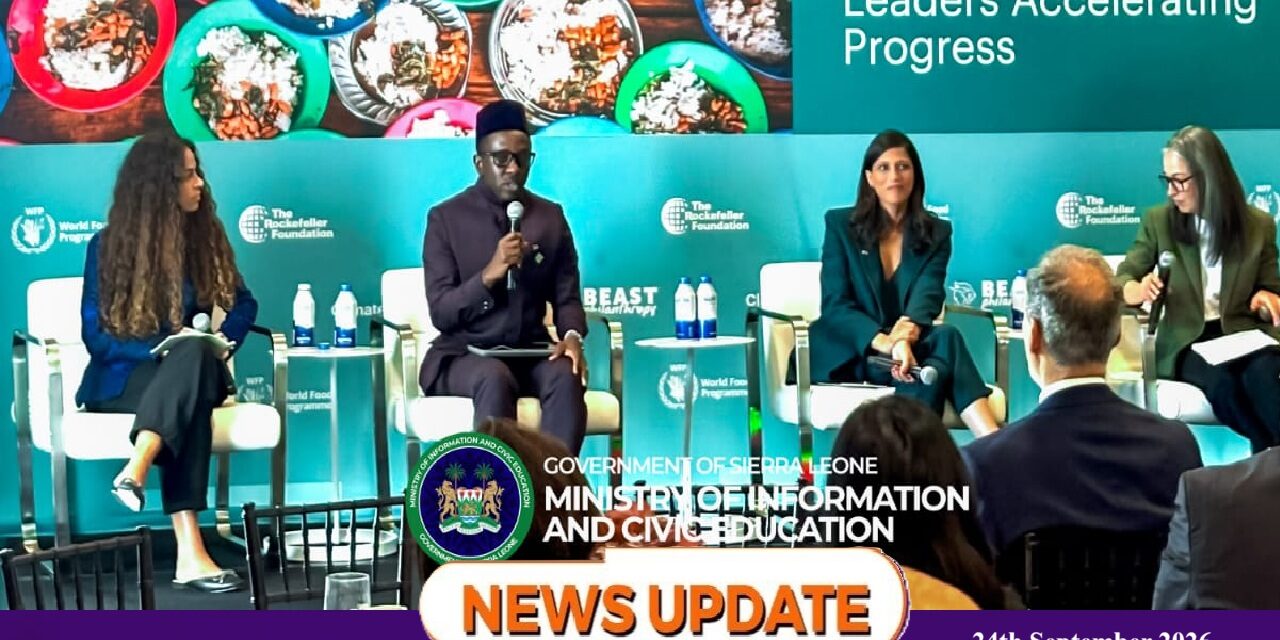
The event ‘School Meals for the Future: Leaders Accelerating Progress’ was co-hosted by the World Food Programme and The Rockefeller Foundation. It drew senior government officials, philanthropists, development leaders and global influencers, including Lesotho’s King Letsie III, Kenya’s First Lady Rachel Ruto, former UK Prime Minister Gordon Brown, Nobel Peace Laureate Muhammad Yunus, and content creator Jimmy Donaldson (MrBeast).
Bah joined France’s Minister Delegate for International Partnerships, Éléonore Caroit, and youth climate educator Sage Lenier on a panel exploring how civic action and youth leadership can accelerate progress.
The Minister’s intervention was deeply personal. “I went to school hungry,” he recalled. “Like many children in Sierra Leone, I knew what it meant for a parent to face an impossible choice: food for the family or transport to school.”
He argued that hunger and education cannot be separated in the lives of children. “For a child, the questions are simple: Can I get to school? Can I eat? Can I concentrate? Can I dream beyond today?”
Bah connected his experience to President Julius Maada Bio’s flagship Free Quality School Education programme, which has expanded access and placed human-capital development at the centre of national policy.
“But once we made that bet on education, we also had to bet on feeding children in school,” he said. “And once we commit to feeding children in school, we must confront the bigger national question: can we feed our own country?”
He stressed that Sierra Leone’s school feeding initiative is inseparable from the President’s Feed Salone programme, which aims to boost agricultural productivity, create jobs and strengthen food security.
With Sierra Leone’s median age at 19 and more than half of its land arable, Bah argued that school meals can be designed as an integrated solution: providing reliable markets for farmers, creating opportunities for youth across the agricultural value chain, and ensuring children receive nutritious meals.
“These are not disconnected facts,” he said. “We have millions of young people who need opportunities, farmers who need reliable markets and children who need nutritious meals. Properly designed, these are not three separate problems. They can become one integrated solution.”
Bah also framed school feeding as part of Sierra Leone’s civic education agenda. He highlighted the slogan of Feed Salone: “Grow what we eat. Eat what we grow.”
“That is not only an agricultural slogan. It is a statement about citizenship,” he said. “When a young Sierra Leonean grows food, builds an agribusiness, chooses locally produced rice or develops technology that connects farmers to schools, that is not only economic activity. It is civic action.”
Closing his remarks, Bah underscored Sierra Leone’s connected national ambition: “We bet on education. So we had to feed children in school. Now we must bet on feeding the country and we must do it locally.”
He added that a locally produced school meal can keep a child in school, provide a farmer with a market, create work for a young person and strengthen national confidence.