“When they stop you, you go inside the unfinished building and pay Le50. After you pay, they mark your kekeh”
By Davida Spaine-Solomon
Freetown, 21st September 2026 – A shadow system of payments at police checkpoints appears to have returned to Freetown, months after earlier investigations exposed the practice. This time, drivers say the collection method has changed and the new system is marked by a Le50 fee and a pen stroke on their vehicles.
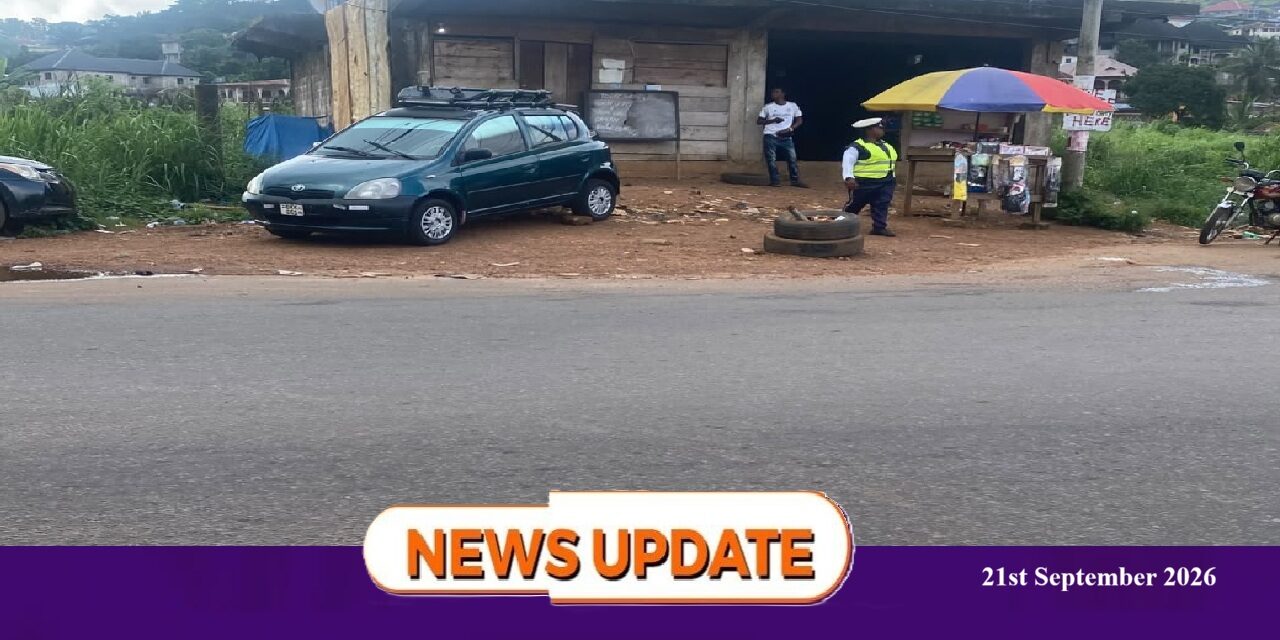
Over the past three months, checkpoints have reappeared around Imatt Junction, Regent, and Jui, with operations beginning as early as 9 p.m. The most striking development is at Regent, where officers once stationed along the Jui road now gather near the Regent Police Station.
There, a repeated sequence unfolds: kekeh drivers are stopped, directed into an unfinished building, and emerge moments later without the money they carried in. The pattern is consistent, not isolated.
Interviews with drivers over consecutive days revealed a uniform account. Those stopped are told to pay Le50 inside the unfinished building, where police officers allegedly collect the money. After payment, drivers say their kekehs are marked with a pen, a symbol that functions as a day-long clearance.
“When they stop you, you go inside the unfinished building and pay Le50. After you pay, they mark your kekeh. For the whole day, no matter where you run, they don’t stop you,” one driver explained.
Two other drivers independently confirmed the same arrangement: a Le50 payment, a mark on the vehicle, and freedom from further stops. None reported receiving receipts.
This is not the first time such allegations have surfaced. In August 2025, Truth Media published “Cash for Access: Freetown’s ‘Booking’ Scheme”, detailing how taxi, poda-poda, kekeh, and motorbike riders allegedly paid money at checkpoints to avoid harassment. A follow-up in April 2026, “You Nor Dae Score Ball?”, examined the hidden costs of night travel under the scheme.
Following those reports, checkpoints in the Regent–Jui corridor disappeared for months. But since June, they have gradually returned now with what appears to be a more organised collection method.
In earlier investigations, drivers described money being passed through intermediaries, including children selling recharge cards near checkpoints. Today, the process is more direct: a fixed fee, a specific location, and a visible mark on the vehicle.
If drivers’ accounts are accurate, the marker is not just ink, it is a daily license to operate. That raises urgent questions: Who introduced the marking system? Who authorised the Le50 payment? How many drivers pay each night? and where does the money go?
What distinguishes this practice is repetition. On multiple nights, drivers were seen leaving their vehicles, entering the same unfinished building, and returning without money. Interviews confirmed this was not an occasional demand but a routine expectation.
Drivers emphasised they are not paying for a service but to avoid obstruction. For those already struggling with fuel costs, maintenance, and daily targets, even Le50 becomes significant when repeated daily. Passengers may ultimately bear the cost, but the deeper concern is whether road access is being determined by unofficial payments.
Efforts to obtain comment from the Sierra Leone Police on the alleged Le50 payments, the marking of kekehs, and the presence of officers around the unfinished building were unsuccessful. No official explanation has been provided for the re-emergence of checkpoints or the reported collection system.
The return of the “booking” scheme suggests more than isolated misconduct. It points to a pattern of informal policing that undermines public trust and burdens drivers. Whether sanctioned or not, the practice effectively creates a parallel system of road clearance one that operates outside official channels and accountability.
Until authorities respond, one fact remains clear: the checkpoints are back, and drivers say the rules of passage now come with a Le50 price tag.