By: Andrew Chokpeleh
Freetown, 15th May, 2026 – The National Protected Area Authority (NPAA) has intensified its crackdown on illegal environmental activities within the Western Area Peninsula National Park and the Sierra Leone River Estuary, recording dozens of arrests and convictions in a sweeping enforcement campaign aimed at protecting Sierra Leone’s rapidly threatened ecosystems.
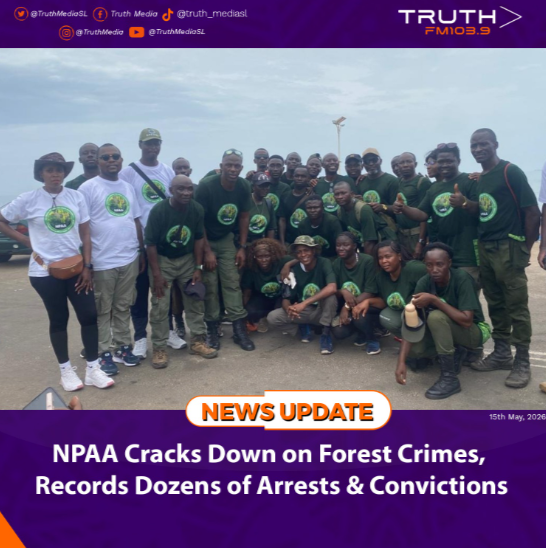
During a major awareness exercise dubbed “Walk for the Forest,” authorities warned enforcement officers and illegal encroachers alike that stricter surveillance, tougher disciplinary actions, and increased patrols will now define the fight against bush burning, illegal logging, charcoal production, and land encroachment across the country’s protected areas.
The Executive Director for the National Protected Area Authority, Sheikh Ahmed Tunis, has raised serious concerns over the increasing destruction of forest reserves through illegal bush burning, timber cutting, and encroachment activities, warning that stricter disciplinary measures will now be enforced against officers who fail to protect their assigned zones.
Speaking during an engagement with Park Enforcement Officers and Commanders, Tunis stressed that the current level of forest destruction remains alarming despite the deployment of personnel across various operational zones, noting that while dozens of arrests are reportedly being made every month, illegal activities such as bush burning and tree felling continue to spread deeper into protected areas.
Tunis stated that the core responsibility of officers is not only to patrol the outskirts of the reserve, but to move deep inside the forest zones to monitor and prevent illegal activities before they escalate. He noted that many destructive acts are being carried out in remote sections of the forest where there is little or no surveillance.
He further explained that recent assessments revealed that several zones remain highly vulnerable, with fire incidents and illegal logging continuing to occur unchecked. He cited instances where individuals allegedly entered the forest early in the morning to set fires before moving to other locations, making it difficult for authorities to quickly identify perpetrators.
Tunis described a pattern in which illegal operators cut down trees on one day and later return to remove or transport the timber, warning that such activities are rapidly degrading the protected ecosystem.
To strengthen accountability, the management announced tougher sanctions for commanders and deputies responsible for areas where illegal activities persist, noting that under the new measures, any commander whose zone records repeated incidents of illegal bush burning or encroachment could face suspension without salary for one month.
Addressing commanders assigned to Zones One through Five, Tunis issued a one-week ultimatum for visible improvements in monitoring and enforcement operations, emphasized that after the grace period, any continued destruction within a zone would attract disciplinary action against the officers in charge, including both security heads and deputy commanders. The warning forms part of broader efforts by conservation authorities to tighten forest protection measures and preserve the Western Area Peninsula National Park from increasing environmental threats.
Dauda L. Bangura Esq. the Law Enforcement and Compliance Manager of the National Protected Area Authority, revealed that the institution has intensified enforcement operations across the Western Area Peninsula National Park and the Sierra Leone River Estuary, as part of efforts to protect the country’s fragile ecosystems and curb illegal activities within protected areas.
Bangura Esq. explained that the initiative, dubbed “Walk for the Forest,” was aimed at raising public awareness about environmental conservation and demonstrating the readiness of the authority’s staff to conduct regular patrols and surveillance operations within protected zones.
According to him, the exercise involved the management and staff of the authority marching from the NPAA headquarters at 55 Siaka Stevens Street and Lewis Road through Aberdeen and Lumley before ending at Gigibonta Park. He noted that the event was not merely a symbolic activity, but also served as an opportunity to engage officers, motivate enforcement teams, and issue directives geared towards strengthening discipline, law enforcement, and environmental management within the Western Area Peninsula National Park and the Sierra Leone River Estuary, including the Aberdeen Creek.
Bangura also disclosed that between February and April 2026, the authority arrested 52 individuals and secured the conviction of 43 persons for various environmental offenses. These offenses include encroachment on protected lands, deforestation, charcoal production, and unlawful entry into protected areas.
He commended the support provided by the Sierra Leone Police and the Judiciary, stating that their collaboration has enabled the authority to send a strong warning to individuals involved in illegal environmental activities. He emphasized that protected areas are meant to be preserved and safeguarded for future generations and should not be subjected to unlawful exploitation. He further stated that officers of the authority had taken a firm commitment to intensify enforcement measures aimed at stopping illegal activities within the Western Area Peninsula National Park and the Sierra Leone River Estuary.
Responding to questions about the scope of the authority’s operations, Bangura clarified that the National Protected Area Authority is responsible for managing 15 protected areas nationwide, comprising seven wetland ecosystems and eight terrestrial ecosystems spread across all five regions of Sierra Leone.
He explained, however, that the current exercise specifically involved game guards and enforcement teams assigned to the Western Area Peninsula National Park and the Sierra Leone River Estuary because of the ecological sensitivity of the two protected sites within the Western Area. He concluded by announcing plans to replicate similar awareness and enforcement exercises in other protected areas across the country as part of the authority’s nationwide conservation efforts.