By Alpha Amadu Jalloh (Op-Ed)
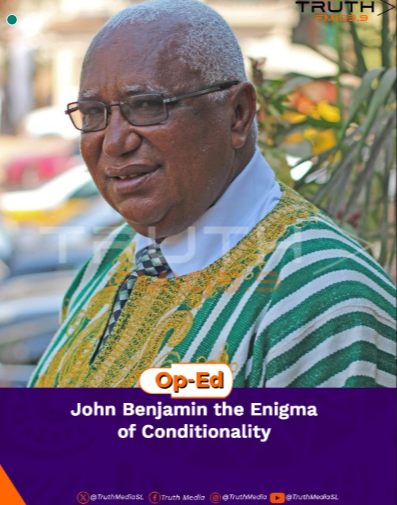
Freetown, 10th March 2026- In moments when political tempers rise and ambition begins to outrun discipline, nations look for steady hands. Parties search for voices that are not driven by desperation but by doctrine. Sierra Leone today finds itself in such a moment. Fortunately, the Sierra Leone People’s Party still has among its ranks a man I can confidently describe as an enigma. A man whose calmness is not weakness, whose patience is not silence, and whose clarity is not confusion. That man is John Benjamin.
John Benjamin is not new to turbulence. He has seen the SLPP in its glory and in its fractures. He has stood inside rooms where decisions were prepared long before they were publicly announced. He has felt the heat of internal contests and the weight of national expectations. Yet, he remains composed. There is something deeply instructive about a politician who understands both power and restraint.
Recently, in his open declaration to run for the SLPP flag bearer position, John Benjamin did not merely announce ambition. He introduced conditionality. And that is what makes him an enigma.
Conditionality is not obstruction. It is discipline. It is the insistence that rules must precede personalities. In his interview, he touched every hidden corner of the debate surrounding the SLPP constitution. He made it absolutely clear that any attempt to amend the party’s constitutional provisions must follow due process. More importantly, he emphasized that such amendments cannot be weaponized to serve narrow aspirations.
The SLPP constitution is not a decorative document. It is the backbone of internal democracy. Benjamin reminded the nation that constitutional amendments, if contemplated, cannot take effect in a way that undermines the existing roadmap toward a national convention. In simple terms, the rules cannot be bent mid race to favor particular runners.
That clarity unsettles those who prefer shortcuts. What John Benjamin is saying is straightforward. If the party intends to review or amend its constitution, that process must respect the timeline and procedures already agreed upon. The national convention must first elect its flag bearer under the current framework. Only after that can new provisions legitimately take effect. This is not merely a legal argument. It is a moral one.
Because what is at stake here is not just the SLPP flag bearer position. It is the integrity of party democracy.
Let us not forget that Sierra Leone’s political history has been scarred by moments when rules were manipulated to serve convenience. That culture of convenience has cost us national stability. The SLPP cannot afford to replicate such patterns within its own walls. Benjamin understands this.
To appreciate his current posture, one must revisit his journey.
John Benjamin’s political footprint stretches back to the era of the National Provisional Ruling Council. During the NPRC period, when Sierra Leone was navigating uncertainty, he served in governance structures that demanded administrative competence under pressure. Those were not comfortable years. They were formative years.
He later transitioned into mainstream democratic politics and rose within the ranks of the SLPP. His stewardship in financial governance and his broader administrative roles built a reputation for diligence and fiscal discipline. He is not a man intimidated by figures. He understands budgets, revenue realities, and fiscal responsibility.
As SLPP National Chairman and Leader, he presided over one of the most difficult periods in the party’s history. Internal divisions were sharp. Emotions ran high. Yet he managed the party with a firm but measured hand. He did not weaponize his office against internal dissenters. He relied on the constitution.
That consistency is what defines him today.
When he speaks about conditionality, he is not inventing new principles. He is applying the same standards he once defended. In a political culture where flexibility often means bending the rules, Benjamin’s flexibility means strengthening the rules.
Some critics suggest that by insisting on procedural correctness, he is complicating the path to unity. But unity built on manipulated foundations collapses quickly. Unity grounded in respect for agreed rules endures.
Sierra Leone does not need another season of political engineering. It needs political maturity.
Benjamin’s declaration to run for flag bearer is not an act of rebellion. It is participation within the rules. And that is healthy. A democratic party should never fear competition. What it must fear is competition distorted by constitutional gymnastics.
He was emphatic that no constitutional amendment should be tailored to advantage or disadvantage any particular aspirant. That message resonates beyond the SLPP. It is a message to every political formation in Sierra Leone. Rules must not be retrofitted.
Let us examine why this matters nationally.
The presidency of Sierra Leone is not a ceremonial seat. It carries enormous influence over state institutions. If a party normalizes the culture of adjusting rules internally to suit ambitions, it risks carrying that culture into state governance. Benjamin’s insistence on conditionality is therefore not just about internal party affairs. It is about safeguarding democratic norms.
He understands the psychology of power. He has been close enough to see how fragile institutions can become when leaders prioritize expedience over principle.
Those who wish to bypass procedures often frame their urgency as necessity. But necessity does not cancel legality. The SLPP constitution provides mechanisms for amendment. It outlines timelines. It specifies conventions. To circumvent these processes would undermine the very document that binds the party.
Benjamin’s argument is rooted in sequence. First, conduct the national convention. Elect the flag bearer according to the current constitution. After that, if the party collectively decides that reforms are needed, let those reforms take effect in an orderly and transparent manner.
This sequencing protects fairness.
There is also a psychological dimension to his candidacy. His calm demeanor sends a message that leadership is not noise. In an era where political declarations are often accompanied by aggressive rhetoric, Benjamin’s tone is measured and deliberate. It steadies rather than inflames.
He has never claimed perfection. But he has demonstrated institutional loyalty. He did not abandon the party when it faced internal crises. He did not exploit weaknesses to gain leverage. That restraint builds credibility.
Furthermore, his background in financial governance equips him with an understanding of economic realities that Sierra Leone urgently needs. Fiscal prudence, debt management, and disciplined expenditure are not academic exercises. They are survival tools for a struggling economy. His experience in managing public finances and navigating complex administrative environments demonstrates that he is not merely a political tactician but also a technocrat.
The SLPP must decide whether it wants a flag bearer shaped by conditional opportunism or by constitutional conditionality. There is a difference.
John Benjamin represents the latter.
His career from the NPRC era through ministerial responsibilities and party leadership reflects continuity. He has operated across systems and administrations. That exposure gives him perspective. It allows him to compare eras and evaluate what worked and what failed.
In his recent interview, he did not attack personalities. He attacked processes that risk distortion. That is a subtle but powerful distinction. By focusing on procedure rather than individuals, he elevated the debate.
Sierra Leoneans are watching closely. They have grown weary of internal party battles spilling into national instability. They want assurance that political actors understand the gravity of constitutional commitments.
Benjamin’s message offers that assurance.
If elected as SLPP flag bearer and subsequently President of the Republic, his emphasis on conditionality could translate into governance anchored on law rather than impulse. A leader who respects internal party rules is more likely to respect national constitutional boundaries.
The political season ahead will test the SLPP’s commitment to its own principles. It will reveal whether rules are truly supreme or merely convenient.
John Benjamin has placed his card on the table. He has declared his intention openly. He has articulated the boundaries within which competition must occur. He has reminded the party that constitutions are not decorative ornaments but binding commitments.
Whether one supports his candidacy or not, one must acknowledge the seriousness of his argument.
Sierra Leone deserves politics that honors process. It deserves leaders who understand that legitimacy cannot be manufactured. It must be earned within the framework of agreed rules.
John Benjamin, the enigma of conditionality, has challenged his party to remember that truth.