By: Andrew Chokpeleh
Freetown, 15th May, 2026 – Freetown City Council has intensified efforts to transform the Central Business District into a modern, resilient, and inclusive city centre.
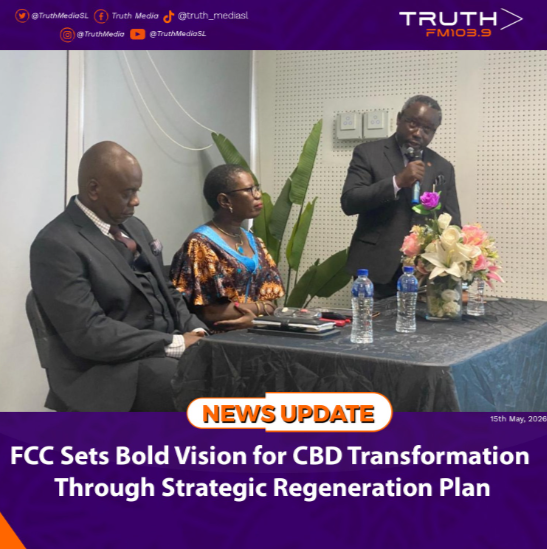
At a high-level participatory workshop on the CBD Regeneration Programme and Area Action Plan, FCC authorities, development partners, planners, and stakeholders have outlined an ambitious roadmap aimed at tackling decades of unplanned urban growth, congestion, environmental degradation, and weak development control systems.
Backed by partners, including UN-Habitat and several key national institutions, the programme is expected to reshape how Freetown plans, manages, and sustains urban development for generations to come.
Mayor of Freetown City Council, Yvonne Aki-Sawyerr, emphasized that the city’s ongoing urban renewal efforts extend far beyond the construction of schools, nurseries, and markets, describing them as part of a broader agenda aimed at creating a more liveable, resilient, and well-planned Freetown. She stressed the urgent need for effective urban planning, noting that cities left without proper planning inevitably develop in a fragmented and disorganized manner.
“I have always been an advocate for planning,” she said. “If we do not plan a city, it will plan itself, and that planning will be ad hoc, disjointed, fragmented, ineffective, and unproductive.”
The mayor also observed that while the original layout of Freetown’s Central Business District (CBD) still reflects deliberate planning through its grid structure, many areas beyond central Freetown have been developed without coordinated urban design. According to her, the workshop presents an opportunity to “reverse the clock” by reimagining and restructuring the future of the city through strategic planning.
She also clarified that land use planning and the issuance of building permits currently remain under the authority of the Ministry of Lands rather than the City Council. However, she explained that an Act of Parliament has already been passed to eventually devolve those responsibilities to local councils nationwide, although the required regulations are still being finalized.
“As we sit here today, land use planning and building permits are not the council’s function,” she explained. “But councils do have the authority to create Area Action Plans, which can then be submitted to the Ministry of Lands for approval and implementation.”
She described the two-day workshop as a platform for residents, stakeholders, and city planners to collectively shape a long-term vision for Freetown. The discussions, she said, will address issues such as street trading, pedestrian walkability, and how economic activities can coexist with a modern and organized urban environment. “There are people whose livelihoods depend on trading,” she noted. “But it is also important for the city to have walkability and safe spaces for people to move around. These are issues that require us to think creatively, imagine possibilities, and mobilize the resources needed for implementation.”
In highlighting ongoing development initiatives, Mayor Aki-Sawyerr announced that construction of the new King Jimmy Market project, funded by the European Union, is expected to commence on June 1 this year. “As we identify the problems, we must also identify the solutions,” she stated, encouraging participants not to limit their thinking during the planning process. “Let’s dream. Let’s think outside the box. We should imagine the kind of city we want first, and then begin working out how to secure the resources to make it happen.”
The Mayor further explained that although the CBD occupies only a relatively small portion of Freetown’s total land area of 82 square kilometres, transforming it into a model of urban excellence could inspire similar improvements across the rest of the city. “If we can make this area a centre of excellence through the CBD regeneration programme and the ideas generated from this workshop, it will become an inspiration for the rest of Freetown,” she said.
She also stressed the importance of ensuring that future development strictly follows approved plans, warning that the absence of coordinated planning and enforcement has contributed significantly to disorderly urban growth. “We have not had a plan, and we have not had a building permit regime that adheres to a plan,” she said. “As a result, everybody builds anything, anywhere, and that cannot give us a beautiful or resilient city.”
Aki Sawyer called for stronger collaboration with the Ministry of Lands to ensure that future building permits align with agreed urban development frameworks.
“What will give us a resilient and beautiful city is having a plan that is strategically designed, works for everyone, and is respected in the way permissions are granted,” she concluded.
The Chief Administrator at the Freetown City Council, Rahman Tom Farma, reaffirmed the Council’s commitment to transforming the city’s CBD through a comprehensive regeneration programme aimed at creating a safer, greener, and more accessible urban environment for residents and businesses. Farma described the initiative as a designed, which seeks to improve urban mobility, strengthen governance systems, expand public spaces, and enhance environmental sustainability across the city centre.
According to him, the project seeks to support the implementation of the CBD Regeneration Programme by establishing safe and efficient transportation systems, improving public spaces, promoting a greener urban environment, strengthening water safety measures, and enhancing project management and governance structures.
Described as a five-year initiative, the programme is now approaching its second year of implementation. Key development partners supporting the initiative include UN-Habitat and the Mayor of Switzerland, while several national institutions are collaborating to ensure its success. These include the Sierra Leone Roads Authority, Sierra Leone Water Company, the Ministry of Energy, the Sierra Leone Police, and other members of the Project Review and Delivery Committee.
Farma explained that the programme focused on supporting policymakers with practical planning tools and strategic development frameworks to guide urban renewal efforts.
He noted among the major achievements so far are efforts to strengthen the technical capacity of the Freetown City Council, develop an Area Action Plan, and improve community and social management mechanisms, adding that the initiative includes the establishment of stronger public governance structures, including stakeholder committees and improved systems for regulating public spaces and urban activities.
He noted that one of the most visible interventions under the programme has been the installation of new street lighting, which is expected to improve security and contribute to a more vibrant and welcoming city centre. Another key feature of the project is its participatory approach, which seeks to involve communities, universities, professional institutions, and residents in shaping the future of the city.
He also highlighted that the project is introducing a new national planning framework that will help strengthen decentralised planning and governance systems across Sierra Leone. This emerging planning tool is expected to support national, regional, district, and local planning structures while integrating climate resilience and sustainable development principles into urban design and policy making. Central to the programme is the development of the CBD Area Action Plan, which will serve as a strategic roadmap for the regeneration of the city centre.
The plan is designed to guide future land use and development, improve mobility and accessibility, expand and connect public spaces, support economic revitalisation, and strengthen climate resilience through better environmental management.
Officials emphasized that the Area Action Plan will focus on several critical areas, including population and socio-economic characteristics, urban morphology and land-use patterns, transportation and accessibility, economic activities, public spaces and facilities, land tenure and management, environmental conditions, and infrastructure and basic service delivery.
According to Farma, the strategic framework also prioritizes reducing traffic congestion, improving pedestrian walkability, enhancing public safety, and upgrading essential infrastructure such as drainage systems, street lighting, waste management, and other core services needed to support a functional and attractive city centre, adding that climate resilience remains a major focus of the programme, with interventions designed to address recurring flooding, environmental degradation, urban heat, and the need for greener infrastructure.
He said Urban design guidelines under the action plan will further define building standards, including height regulations, façade requirements, architectural consistency, and block layouts to preserve the city’s visual identity and ensure coordinated development. He noted that public spaces will also be clearly designated and structured to support both commercial activities and community interaction.
He said that the action plan will identify and prioritize catalytic, high-impact projects that can deliver immediate and long-term benefits to the city, stating that these interventions will be categorized into short-medium and long-term phases, allowing for quick wins while building momentum toward broader transformation goals.
The framework will also establish implementation responsibilities, identify funding mechanisms, align investments with ongoing municipal finance reforms, and ensure coordination with existing city plans and initiatives.
Monitoring and evaluation were highlighted as critical components of the programme. Farma also stressed the importance of tracking progress and building sustainable systems capable of maintaining project outcomes over time.
He concluded by reaffirming, that the Area Action Plan will include a development control framework aimed at guiding future growth within the CBD, stating that the framework will regulate land use, building permits, and activity zones to ensure that future development aligns with the city’s broader regeneration vision.
As Freetown continues to confront challenges related to rapid urbanization and infrastructure pressure, FCC leaders said the CBD regeneration initiative represents a major step toward building a more organized, inclusive, and resilient capital city for future generations.