Freetown, 14th May 2026 — Sierra Leone’s fiscal accounts for 2025 highlight a government still grappling with structural imbalances, as recurrent obligations continue to dominate expenditure while capital investment remains persistently underfunded.
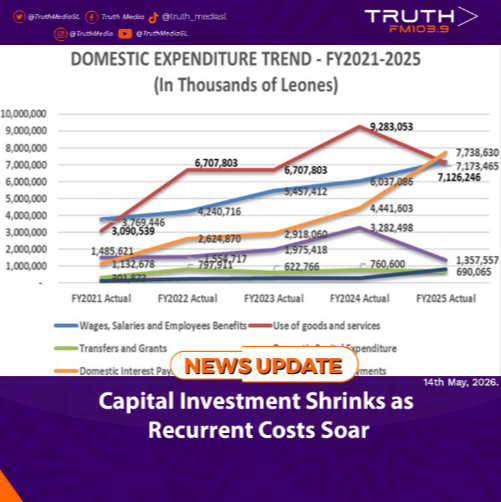
Data from the domestic expenditure trend (FY2021–2025) show that total spending on wages, salaries, and employee benefits climbed steadily over the five‑year period, rising from NLe3.77 billion in 2021 to NLe7.13 billion in 2025. This represents nearly a doubling of payroll costs in just four years, underscoring the growing weight of the public‑sector wage bill on national finances.
Spending on goods and services also surged, peaking at NLe9.28 billion in 2024 before easing to NLe7.74 billion in 2025. While the 2025 figure was 48 percent above the budgeted NLe4.82 billion, it marked a 23 percent decline compared to the previous year, reflecting efforts to rein in operational costs after an unusually high outturn in 2024.
Transfers and grants contracted sharply, falling to NLe690 million in 2025 (0.3% of GDP) 63 percent below the budgeted NLe1.84 billion and 9 percent lower than the NLe761 million recorded in 2024.
Capital expenditure suffered the deepest retrenchment. Development spending dropped to NLe1.36 billion in 2025, down 59 percent (NLe1.92 billion) from NLe3.28 billion in 2024. The actual outlay represented just 1 percent of GDP and 5 percent of total expenditure, far below the budgeted domestic capital allocation of NLe3.45 billion.
Debt dynamics added further pressure. By the end of December 2025, Sierra Leone’s total public debt stood at NLe67.96 billion, equivalent to 38 percent of GDP. Domestic debt rose sharply to NLe26.44 billion, compared with NLe18.31 billion in 2024, while external debt eased slightly to NLe41.52 billion from NLe42.75 billion.
The figures underline a widening imbalance in Sierra Leone’s fiscal structure: recurrent obligations, wages and operational costs continue to crowd out investment in infrastructure and long‑term development. Economists warn that without decisive reforms to strengthen fiscal discipline and prioritize capital spending, the country risks undermining growth prospects and deepening its exposure to rising debt‑servicing costs.