By Abdulai Fofanah
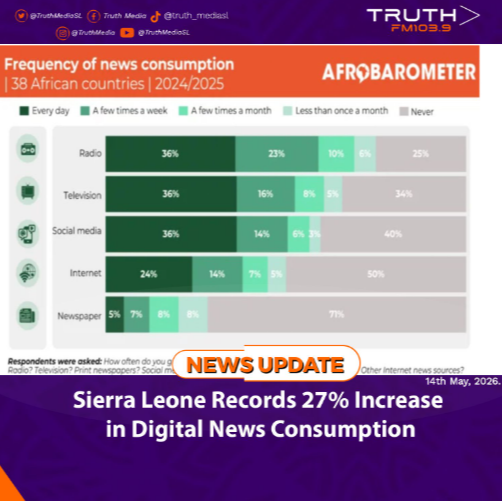
Freetown, 14th May, 2026 – Sierra Leone has recorded a 27‑percentage point increase in digital news consumption since 2014/2015, placing the country among Africa’s stronger performers in the shift toward online media, according to a new Afrobarometer report. The country also recorded a 10 percentage point increase in the use of other internet news sources during the same period.
The report placed Sierra Leone among the stronger performers in digital news adoption, though still behind regional leaders, such as Senegal (+49 points in social media news use and +26 points in other Internet news use), Gabon (+47 and +26 points), Mauritius (+44 and +25 points), Cameroon (+43 and +29 points), Benin (+40 and +22 points), and Côte d’Ivoire (+40 and +26 points).
Across the 38 countries surveyed, radio remains the most-common news medium for all age groups except for the youngest adults (aged 18-35 years), who narrowly prefer social media (58% to 55%). Regular radio news use increased with age, reaching 68% among senior citizens, while use of digital media declined with age: The youngest cohort is more than twice as likely as the oldest to frequently consume news via social media (58% vs. 28%) and the Internet (44% vs. 20%). Television and newspaper figures are flat across age categories.
Despite the digital progress, the survey recorded a 7-percentage-point drop in the proportion of citizens who viewed the media as “somewhat free” or “completely free” between 2019/2021 and 2024/2025, 55 percent of Sierra Leoneans described the media completely free from government interference.
A slim majority (53%) of Africans describe their media as “somewhat free” (32%) or “completely free” (21%) of government interference or censorship, while 43% consider it less than free. But public assessments of media freedom vary widely across surveyed countries. More than three-fourths of citizens described the media as at least “somewhat free” in Tanzania (81%) and Liberia (77%), while fewer than one in three do so in Congo-Brazzaville (16%), Comoros (28%), Cameroon (31%), and Eswatini (31%).