PONDER MY THOUGHTS
By: Andrew Keili
It happened on Thursday, January 19, 1995. The RUF rebels attacked Sierra Rutile Mines. We, the workers, had harboured a misplaced hope that the mine was impregnable. After all, we had a large contingent of military and SSD Police to guard the mine. They were the first to flee when the rebels struck! The rebels had overrun Sieromco Mines, 14 miles away, the day before and abducted some senior staff.
When we heard they were heading for Sierra Rutile, workers fled in all directions, as whatever evacuation plan we had was vacuous. In panic, I headed for my house, bundled my children and wards into my car and headed aimlessly for the coastal villages. I later abandoned the car and we moved surreptitiously from village to village until we found our way by boat to Bonthe Island two weeks later.
The rest of the senior staff of the company headed for Nitti port and were later hauled as cargo in mineral barges to Freetown. My wife, Helen, who had been in Freetown, had no idea where we were until we could establish communication from Bonthe. Some of our colleagues had fared worse and lost their lives. Others were forced to stay under rebel occupation.
In Freetown, having lost everything and being jobless, we were guests of a kind friend and brother who put us up until we could rent a small house in Brookfields. Helen, who had been head of the Sierra Rutile primary school, applied for several teaching jobs. She came home exasperated one day and announced she was going to start a school, as the salaries on offer were abysmal.
I didn’t think it was a good idea because of our dire financial predicament. Besides, the war was still raging. She was insistent, and so we set about establishing Modern Elementary School (MES) in a rented building on Main Motor Road, Congo Cross. Her ambition initially was very limited and was based on providing a source of employment for herself and some of her teachers who had made it to Freetown. And so MES was born, with herself and four other teachers from the Rutile school (Mr. Samba Conteh, Mr. Andrew Mansaray (RIP), Mrs. Nancy Sheriff (RIP) and Mrs. Hawa Barnett), a handful of students, including four of ours, children of friends we knew and a few other children.
Times were hard and it was difficult to even pay the teachers. I had to lend a hand writing various project proposals to solicit furniture and educational materials. Since she could not afford to hire a bursar, I became the first bursar. A very good friend advised her the best way to audit the bursar was to search his back pocket to determine if any fees had been stashed away for purchasing beer! I served for sometime and left for USA when I had a job.
High rental costs and quite often unreasonable landlords who threatened eviction for a myriad of reasons meant the school had to move several times to new locations. The student roll expanded slowly and more teachers were added. The school started performing well in pubic examinations and with this, there was growing confidence amongst more parents to enroll their children. Helen and her teachers persevered to overcome those initial difficulties as best as possible.
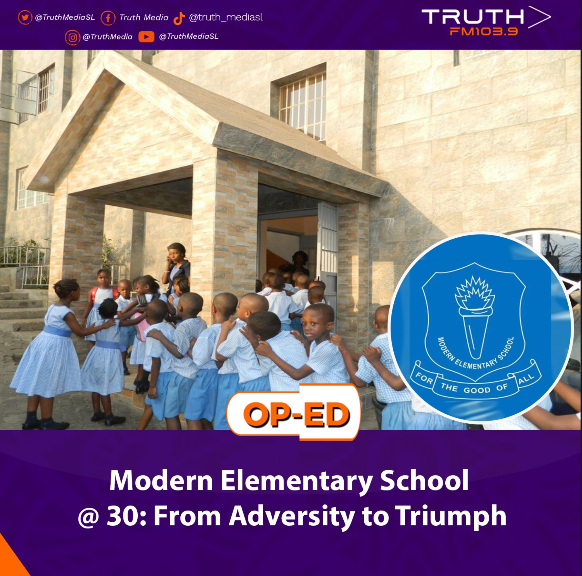
Fast forward to 2026. MES is now housed in three campuses. The campus at Carol Lane houses a Daycare center and early primary learning classes. The Jomo Kenyatta Campus on 1.5 acres of land with several multi-story buildings, houses the rest of the Primary school and shares the compound with Modern High School (MHS), a logical extension of the school to include a secondary school wing in 2004. The Mambo campus, with both primary and secondary school facilities, is on several acres of land. With prudent financial management and helped by bank loans, the expansion of MES has been made possible. Both the MES and MHS are now in buildings owned entirely by the school. The schools are well-equipped with modern facilities.
Today, MES is one of the best elementary schools in Sierra Leone and is known for its outstanding performances in the country’s national public examinations; for many years, producing the overall best collective result and individual results. The “Modern” educational institutions have produced many students who are now working in key sectors in Sierra Leone.
MES has 81 teachers and 56 auxiliary workers and caters for 1,079 pupils in all its campuses. MHS has a student roll of 524 and has 65 teachers and 23 auxiliary workers. Some 60 percent of the students in both schools and 65 % of the teachers are female. The heads of the various sections of the Elementary school are female.
Looking back over the past 30 years during which I have unwittingly become an educationist by induction, I can only marvel at Helen’s achievements. Her success perhaps should not come as a surprise, as she draws her inspiration from her parents, who were both renowned educationists.
Her work has not gone unrecognized. She was bestowed the national award of the Order of the Rokel in 2014 for her contribution to Sierra Leone in the field of education and was one of the two recipients of the Integrity award presented by the Anti-Corruption Commission in 2012.
But other stakeholders are also worthy of praise, teachers, students, parents, the Ministry of Education, etc. If there are any lessons to be learnt, I will attempt to list a few.
Lesson 1- Have a passion for the job and be undeterred by problems
One has to have a passion for education to run a private educational institution because there are so many challenges that could discourage one. The money motive should not be paramount, as you would need to make a lot of sacrifices.
Lesson 2: Have a healthy learning environment, be well-equipped and employ good teachers that you treat well
Helen buys textbooks and other educational materials from abroad, placing large orders every year for everything from books to furniture, equipment and learning materials. Running a school also entails employing a large number of auxiliary workers, administrative and finance staff, maintenance staff, logistics officers, drivers, cooks, etc. Good teachers need to be recruited and paid well.
She runs an empowerment fund for her staff and offers scholarships to a limited number of their children to attend the school. Her teachers and workers are family and she gets involved in a variety of their activities and other interests. Her teachers are well paid, earning salaries in the top tier of private school salaries.
The heads of the various sections, Mrs. Florence Jarette, Mrs. Mahawa Sesay, Mrs. Nancy Barnett, Mrs. Melinda Kamara Cole and Ms. Irene Tamba are as driven to produce results as the Proprietress. They are following in the footsteps of Mr. Samba Conteh, Rev. Mrs. Williams, Mrs. Rhodes and Mrs. Kpanabom, who have retired. The school’s zero tolerance to cheating by students and teachers, strict enforcement of discipline and teachers committed beyond the ordinary enhance its reputation and performance.
Lesson 3- Parents must be given spurs for their support of the school
Not all parents are happy as there are some who complain about high fees. However, the Parent Teachers Association has been very effective in discussing these issues and having a reasonable accommodation with the school. Purchasing school materials from abroad (bringing several container loads of items from China every year), buying books from Ghana, paying teachers a competitive salary, purchasing and operating seven 50-seater buses to ease the transportation problem, infrastructure development, maintenance activities all demand high expenditures.
Being candid about these expenses and letting the parents see the effect of good tutelage and a good learning environment on their kids do help. I commend some of the parents, especially those who, though of meagre financial means recognize the advantage of getting their kids into a school like MES and appreciate the stellar work of the teachers. Parents generally are enthused and avidly support all the school functions.
They could be seen marching with pride astride their kids at the 30th anniversary march past in March, after a thanksgiving Church service at Saint Augustine’s church.
Lesson 4-Let the students be proud of their school and get a sense of belonging to a premier school
Encouraging the students and ensuring they are proud of their educational output and their institution is key. They must be made to be proud of their school. Good results in public exams do help.
Lesson 5- Have a strong bond with the Ministry of Education and proprietors of other private schools
Helen ensures she has a good relationship with proprietors of other schools. The healthy relationship and sharing of experiences help with mutual growth. She appreciates the assistance given by a mentor like Mrs. Daphne Pratt, former head of the International School at the school’s inception. Overall, though there is the occasional schism, the Education Ministry does a good job of regulating.
The question may legitimately be asked whether private for-profit schools like MES have contributed to this country’s development. It is a resounding yes.
For-profit private schools enroll 17.1 percent, while non-profit private schools enroll 56.9 percent of all children and Government schools enroll only 16.9 percent. Private schools provide most of the pre-primary (nursery) needs of children.
The proprietors of major for-profit schools are entrepreneurs who make a very positive contribution to the development of Sierra Leone in the areas of education, employment and taxes (in the case of MES and MHS employing some 225 staff). There are many private school owners who have had the passion to establish schools of repute. These include the late Mrs Odette Awada of Awada school in Bo, Mrs. Allen of Tower Hill Kindergarten Primary school, the late Mrs Conton of Leone Preparatory school, Rev. Mrs. Janette Davies of Apex, Mrs Betts-Priddy of Ronsab, Mrs. Luke of Merriweather and a host of others.
Helen Keili stands on the shoulders of these pioneers. Her contribution to education, business enterprise, and the development of the lives of children, especially the girl child in Sierra Leone, over the years can only be described as spectacular.
Modern Elementary School’s rise from the adversity of the ravages of war to today, thirty years later, can truly be considered meteoric and a triumph. Helen Keili would, however, be the first to say: “Well begone is half done”, as she has many plans to take MES to even higher heights in future.
Congratulations to MES for 30 years of unstinted service in the field of primary education and long live the first bursar!
Ponder my thoughts.