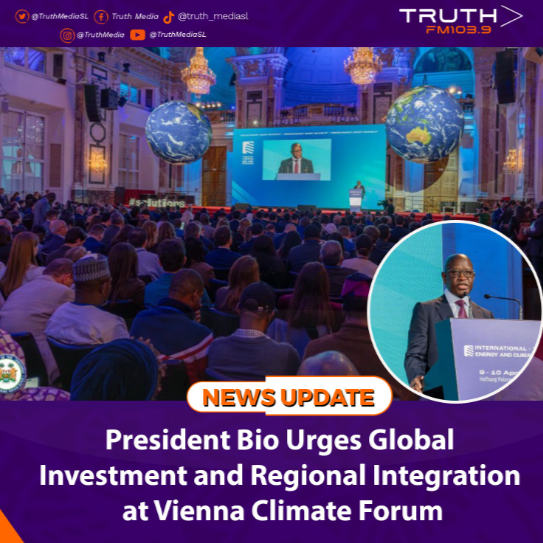
Hofburg Palace, Vienna, Austria, 9th Thursday 2026 – His Excellency, President Dr. Julius Maada Bio has called for accelerated global investment, stronger regional integration, and practical implementation of climate and energy commitments while addressing the International Vienna Climate and Energy Conference.
Delivering a keynote statement at the high-level forum, President Bio emphasized that the global energy transition must go beyond commitments and focus on tangible outcomes that create value, generate jobs, and transform lives.
He noted that prosperity, security, and stability are interconnected development goals, stressing that Africa must position itself not merely as a supplier of raw materials but as a hub for industrial growth and value creation.
“Africa will not be the warehouse of the global energy transition. Our continent will be a centre of value creation and industrial growth,” President Bio stated.
Speaking in his capacity as Chairman of the ECOWAS Authority of Heads of State and Government, the President highlighted ongoing efforts to reposition West Africa as an integrated and investment-ready economic region through policy alignment, infrastructure connectivity, and coordinated development corridors.
He outlined opportunities within the Mano River Union, comprising Sierra Leone, Liberia, Guinea, and Côte d’Ivoire, where integrated industrial corridors linking mining, energy, transport, and ports could drive large-scale industrialization, including aluminium refining and steel production.
At the national level, President Bio reaffirmed Sierra Leone’s commitment to energy sector transformation through the Mission 300 initiative, supported by the World Bank and the African Development Bank. He disclosed that the country has developed a $2.2 billion Energy Compact aimed at expanding electricity access, scaling clean energy, and attracting private sector investment.
He announced ambitious targets to increase electricity access from 36 percent to 78 percent by 2030, expand clean cooking access, and ensure that no community is left behind through both grid and off-grid solutions.
President Bio further emphasized the need for accessible and affordable climate finance, noting that many viable projects across Africa fail to reach financial closure due to high capital costs and perceived risks.
“Climate finance must become more accessible, more affordable, and more responsive to the needs of developing economies,” he stressed.
Looking ahead, the President revealed plans for ECOWAS to deliver a pipeline of bankable cross-border energy and industrial projects within the next year and announced an upcoming West Africa Integration and Investment Summit aimed at driving execution rather than declarations.
He concluded by inviting global partners to engage not only as financiers but as co-investors in long-term, value-driven projects that will shape the future of the energy transition.
For media enquiries:
State House Media and Communications Unit
[email protected]