By Ishmael Zay-Bangura
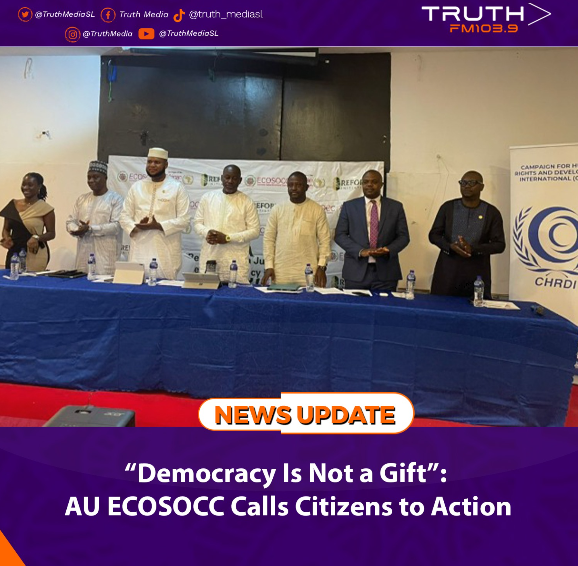
Freetown, 28th April 2026 – The African Union Economic, Social and Cultural Council (AU-ECOSOCC), in partnership with Reform Initiatives, the ECOSOCC Sierra Leone National Chapter, and the Campaign for Human Rights and Development International (CHRDI), has convened a high level multi-stakeholder dialogue at the Sierra Palms Hotel in Lumley, Freetown, under the theme: African Charter on Democracy, Elections and Governance (ACDEG).
The dialogue brought together election management bodies, the judiciary, security apparatus, civil society, youth, women, and digital innovators to confront a central question: How can citizens, not just governments, build a resilient democracy?
In his keynote address, the Head of Secretariat of AU-ECOSOCC, Ambassador William Carew, reframed that democracy is not a gift from the state, but as a continuous, ground-up construction by an active citizenry. Carew delivered a deeply personal and urgent call to action, citing his own childhood in Sierra Leone. “Democracy is not a gift that government bestowed upon the people. It is something citizens build, protect, and must be prepared to reclaim when it is threatened,” he said.
Carew noted that many of today’s political leaders were once the very advocates, journalists, and lawyers…, holding power to account from the outside. “This is not a small thing,” he said. “When civil society populates the leadership of the state, it is democracy doing exactly what democracy was designed to do.”
He warned that the difference between consolidated democracies and those that slide backwards is rarely the quality of the constitution, noting “the quality of the civic culture.” That culture, he argued, is forged in honest dialogue between citizens and institutions.
“I have travelled most of this continent. I have seen democracies consolidate. I have seen others slide. What separates one from the other is rarely the quality of the constitution. It is the quality of the civic culture. It is whether ordinary people feel that the democratic process belongs to them, or whether it has been captured by elites who no longer hear them.”
In his opening remarks, the Chief Executive of CHRDI, Abdul Fatoma, set a firm, solution-oriented tone, acknowledged that Sierra Leoneans know their problems intimately, they feel and experience democratic deficits daily, stating that the purpose of the gathering was not to lament.
Fatoma then stated that “Democracy is not a loan to a political party. It is a daily contract. And the two classes that are important in that project are honesty and also sincerity. With that, we will be able to do a better story here.”
Abdul Fatoma reinforced this call, reminding participants that democracy is a daily contract built on honesty and sincerity, not a loan to political parties.
AU-ECOSOCC was established in 2004 under the AU Constitutive Act to serve as a bridge between the African Union, civil society, and national chapters, which civil society is also part of. In 2023, CHRDI partnered with ECOSOCC to host an awareness workshop in Freetown, launching the country chapter of ECOSOCC in Sierra Leone. Fatoma noted that this was followed by a series of conflict prevention activities ahead of the 2023 elections, which proved successful, stating that the 2026 dialogue was therefore not an accident but a deliberate follow-up. “Today, ladies and gentlemen, we are here not by accident, but asking ourselves to re-imagine how we want to date or contribute to the progress of our democracy.” Abdul Fatoma asked.
The dialogue also responded to the African Union’s operationalization of the National ECOSOCC Chapters Framework (adopted February 2023), which structurally guides member states in embedding civil society support into the AU’s national-level work.
As the dialogue closed, Ambassador Carew reminded participants that the “ACDEG is not simply a document in archives in Addis Ababa; it is a living compact between African citizens and the state.”
In a country that has survived war, navigated fragile democratic transitions, and refused to be defined by its scars, the message was clear: democracy will not be perfected by laws alone, but by citizens who show up every day, not as borrowers of power, but as its rightful owners.