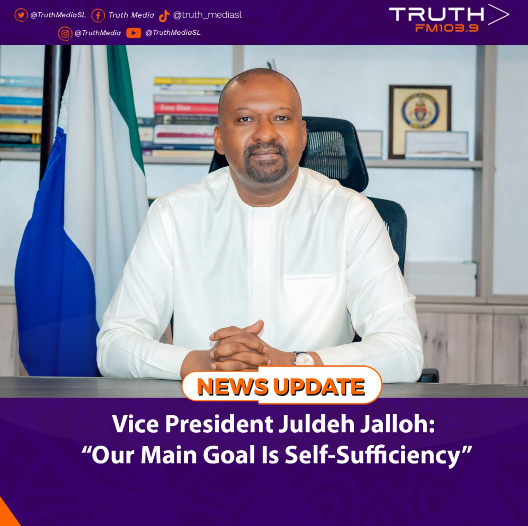
Freetown, 30th April, 2026 — Sierra Leone’s Vice President, Dr. Mohamed Juldeh Jalloh, has outlined the government’s priorities for food security, energy access, and regional stability in an interview with French broadcaster RFI, conducted by journalist Charlotte Cosset ahead of the Africa Forward Summit in Nairobi.
Speaking about the country’s flagship “Feed Sierra Leone” program, Dr Jalloh said the government is working to achieve food self-sufficiency by expanding agriculture and agro-processing. He noted progress in reducing imports and highlighted investments such as Jolaks, an agro‑industrial company financed with €20 million from Proparco, which now exports vegetable oil to Mali and Senegal. “Within the next two or three years, Sierra Leone will no longer need to import onions,” he said.
The Vice President emphasized that infrastructure and energy remain critical to sustaining growth. Electricity access has increased from 16–18 per cent in 2019 to 34 per cent today, with projects underway to reach 80 per cent by 2030. “This will transform agricultural zones, processing, and agribusiness,” he explained.
On foreign relations, Dr. Jalloh pointed to Sierra Leone’s growing partnership with France, which opened a diplomatic office in Freetown in 2020. He confirmed that Sierra Leone will deploy 300 troops to Haiti under UN arrangements and has begun sending officers to the International Academy for Counter‑Terrorism in Abidjan. “We want to establish an international peacekeeping training center, beginning with our experience in Haiti,” he said.
The Vice President also addressed the impact of the Middle East crisis, noting sharp increases in fuel, electricity, and food prices. Transporting a bag of rice to the regions, he said, has risen from 20 leones to 50 leones, more than a 50 percent increase. He acknowledged IMF concerns about subsidies but said Sierra Leone is negotiating with partners, including the World Bank, to identify funding windows.
Turning to regional security, Dr. Jalloh reaffirmed President Julius Maada Bio’s efforts as ECOWAS Chair to engage Mali, Burkina Faso, and Niger following their withdrawal from the bloc. He revealed that Sierra Leone has proposed a “stability pact” to encourage dialogue and eventual reintegration. “We cannot imagine the founding members of ECOWAS leaving permanently. We will actively work to bring them back,” he stressed.