By Nafisatu Olayinka Deen
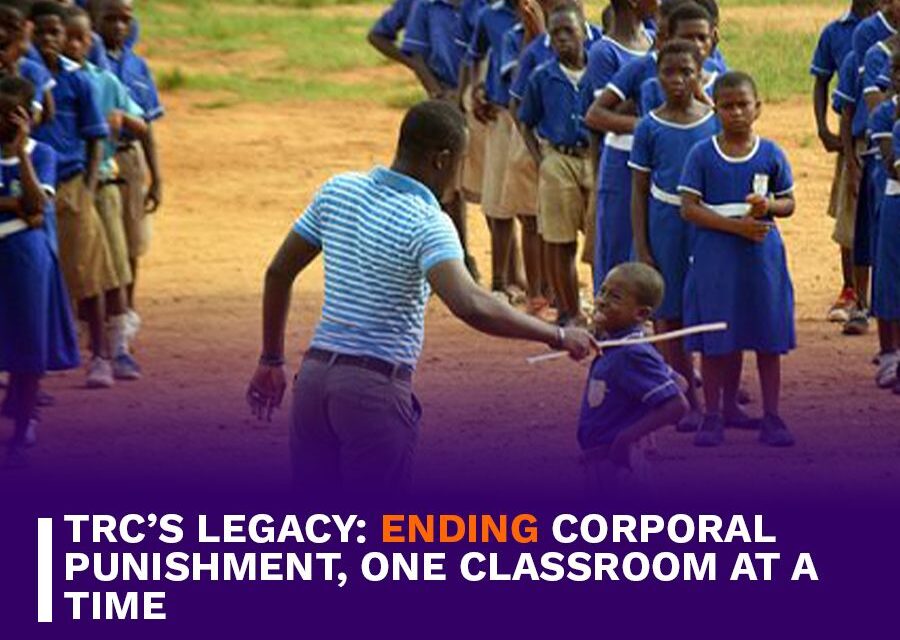
Freetown, 3rd November 2025– Corporal punishment which refers to the use of physical force intended to cause pain or discomfort as a method of discipline, typically administered by caregivers, teachers, or authority figures and widely recognized as a form of violence against children, was officially banned in Sierra Leonean schools through the Basic and Senior Secondary Education Act, passed in 2023. This was as a result of recommendations by the Truth and Reconciliation Commission (TRC) after the Eleven years civil war.
Children suffered gross physical abuse at the hands of adults in the Sierra Leonean conflict thus the commission described corporal punishment as a form of legitimizing violence. “Corporal punishment is inflicted with the intention of causing physical pain and humiliation. The use of beatings for purposes of correcting behaviour in schools legitimise violence as a means to control behaviour more generally. This message goes out to both children and adults. The message says that hurting others is acceptable behaviour.” Volume 2, Chapter 3, p.133, section 90.
As a form of transitional justice, the TRC recommended a ban on corporal punishment describing it as a form of legitimizing violence. “Children are the future of Sierra Leone. There is no justification for permitting another generation of children to be subjected to brutality, whether this is in the name of education or ideology. The Commission recommends the outlawing of corporal punishment against children, whether this be in schools or the home. This is an imperative recommendation.” Volume 2, Chapter 3, p.134, section 92
School teacher, Ezekiel Conteh believes that corporal punishment persists in some schools but doesn’t practice it in his school because he recognizes corporal punishment as a form of abuse on children. “The school unequivocally opposes corporal punishment and fully endorses the recommendations of the Truth and Reconciliation Commission (TRC), which was established to end the abuse and brutalization of children, particularly in the wake of Sierra Leone’s 11-year civil war. Guided by the TRC report and supported by key legal instruments including the Code of Conduct for Teachers and Other Education Personnel (2021) and the Child Rights Act (2007) the school is firmly committed to promoting non-violent, child-centered discipline” he noted
Speaking to Truth Media, President of the Children’s Forum Network, Phillipa Cride Dole, recognized corporal punishment as a form of violence against children. She emphasized that this understanding has driven the forum’s advocacy efforts and policy influence, which have contributed significantly to the reduction and in some cases, eradication of violence against children, including corporal punishment.
“Corporal punishment is not discipline, it is violence. At the Children’s Forum Network, we believe every child deserves protection, dignity, and respect. That’s why we’ve worked tirelessly to influence policies that will eliminate or rather, all forms of violence against children” she echoed.
Elizabeth Mansaray, a mother of two, expressed a nuanced view on the ban of corporal punishment. While she does not fully support a complete ban, she believes that mild and controlled physical discipline, particularly for older children, can be effective when used sparingly. Citing the biblical phrase “spare the rod and spoil the child,” she argued that corporal punishment only becomes violent when it is excessive or harsh. Despite her personal beliefs, Elizabeth acknowledges the legal ban and chooses to discipline her children through counselling and non-violent methods. “I believe in using the rod occasionally, especially for older children, but only in a mild and measured way. It becomes violence when it crosses that line. Still, I respect the ban and choose to guide my children through counselling and understanding” she said.
Ezekiel Conteh says that eliminating corporal punishment has truly transformed his relationship with the pupils and he hopes that corporal punishment ultimately end in schools and in homes. In 2022, before the ban came into effect in 2023, he used a cane to discipline students. That method, however, created emotional distance, students became fearful and reluctant to share their concerns or open up to him. “Since the ban, everything has changed. I’ve become more approachable and supportive, and the pupils now feel comfortable coming to me. Some even call me ‘Daddy’ at school, and I’ve taken on a mentoring role in their lives. I often advise them and help them understand the value of education. The classroom has become a space of trust, not fear and that has made all the difference. I hope others choose gentler, non-violent methods of disciplining children, approaches that guide and correct without causing physical harm” he said, clearly hoping things will improve.
Cride Dole says that Corporal punishment harms children not only physically, but also mentally and emotionally and believes that corporal punishment still occurs in some schools but assures that they will continue to advocate so it ultimately ends. “As child advocates, we continue to urge educators to adopt non-violent, alternative methods of discipline that foster a safe and supportive learning environment. While we acknowledge that corporal punishment still occurs in some schools, we strongly encourage teachers to abandon such practices and embrace approaches that uphold the dignity and well-being of every child” she said with optimism.
‘This story is brought to you with support from the Africa Transitional Justice Legacy Fund (ATJLF) through the Media Reform Coordinating Group (MRCG), under the project ‘Engaging Media and Communities to Change the Narrative on Transitional Justice Issues in Sierra Leone.’