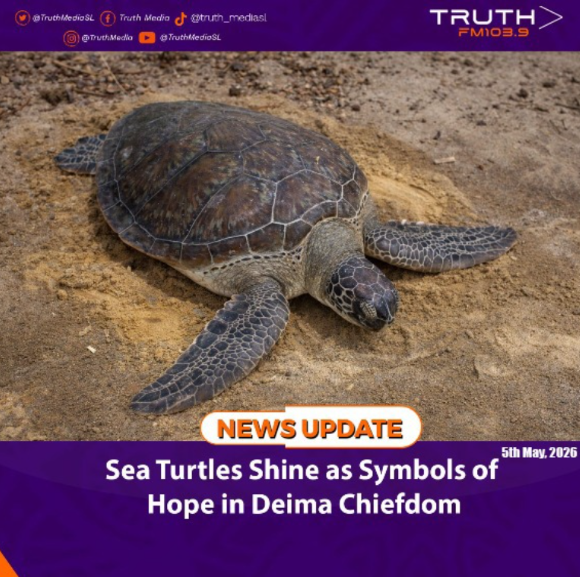
Bonthe, 5th May 2026— “Sea turtles are the light of Deima Chiefdom.” That was the resounding message from over 80 community stakeholders, councillors, fisherfolk, harbour masters, and local leaders who gathered at the Chiefdom Administration Barry in Chepu in April to reaffirm their commitment to marine conservation.
The sensitization meeting, organized by the Reptile and Amphibian Program–Sierra Leone (RAP-SL), highlighted how conservation has transformed Turtle and Sherbro Island communities. Paramount Chief P.C. Anshun Ngabay IV praised RAP-SL for bringing education and enlightenment, noting that all four sections of the chiefdom now boast two schools each, a benefit far greater than the days when sea turtles were hunted for food.
“We have realized more now than when we used to kill turtles,” he said, commending residents for respecting laws that prohibit turtle hunting and mangrove cutting. Violators, he warned, face fines of Le500 and the full force of the law.
Chief Ngabay acknowledged progress but pressed for more support. Over 150 improved energy-efficient ovens have been distributed with donor backing, yet demand remains high. Fishmongers testified that the ovens slash firewood costs from Le2,000 to just Le400, with coconut shells now usable for drying fish. “If conservation laws are to be adhered to, NGOs must provide for the people,” the chief stressed, calling for healthy competition among organizations to accelerate sustainable development.
He also rejected proposals to mine zircon in the chiefdom, warning that such activity could sink the island. “We must protect our land and report all cases undermining development,” he urged.
RAP-SL founder Edward Aruna underscored the program’s flagship mission: protecting sea turtles, manatees, and mangroves. He cited international recognition, including an award from Prince William under the TUSK initiative, and donor support from PRCM and RAMPAO. “Together, we are working towards a common goal the protection of Sierra Leone’s marine resources,” he said.
Aruna warned that climate change is already reshaping Turtle Islands. Rising sand temperatures above 28°C skew turtle hatchlings toward females, disrupting population balance. “Ninety-nine percent of turtles caught in fishing activities are female,” he revealed, explaining how temperature determines sex during incubation.
Manatees, recorded in Bonthe and Moyamba Districts, face similar threats. RAP-SL urged communities to safeguard them as protected species under Sierra Leonean law.
Mangroves took center stage as vital coastal defenders. Aruna explained their unique ability to filter 90–97% of salt at their roots, thrive in low-oxygen mud, and sequester carbon at unmatched levels. RAP-SL is partnering with Njala University, the University of Manchester, and European institutions to study mangroves across Sierra Leone, Guinea, and Liberia. While some organizations pursue carbon credits, RAP-SL focuses on conservation. “Climate change and the environment have no boundaries,” Aruna cautioned.
The meeting closed with a lively Q&A and distribution of T-shirts, but the message was clear: Deima Chiefdom sees sea turtles not as prey, but as symbols of survival and prosperity. With education, improved livelihoods, and global partnerships, stakeholders pledged to defend their coastline, proving that conservation is not just an obligation, but a pathway to a sustainable future.