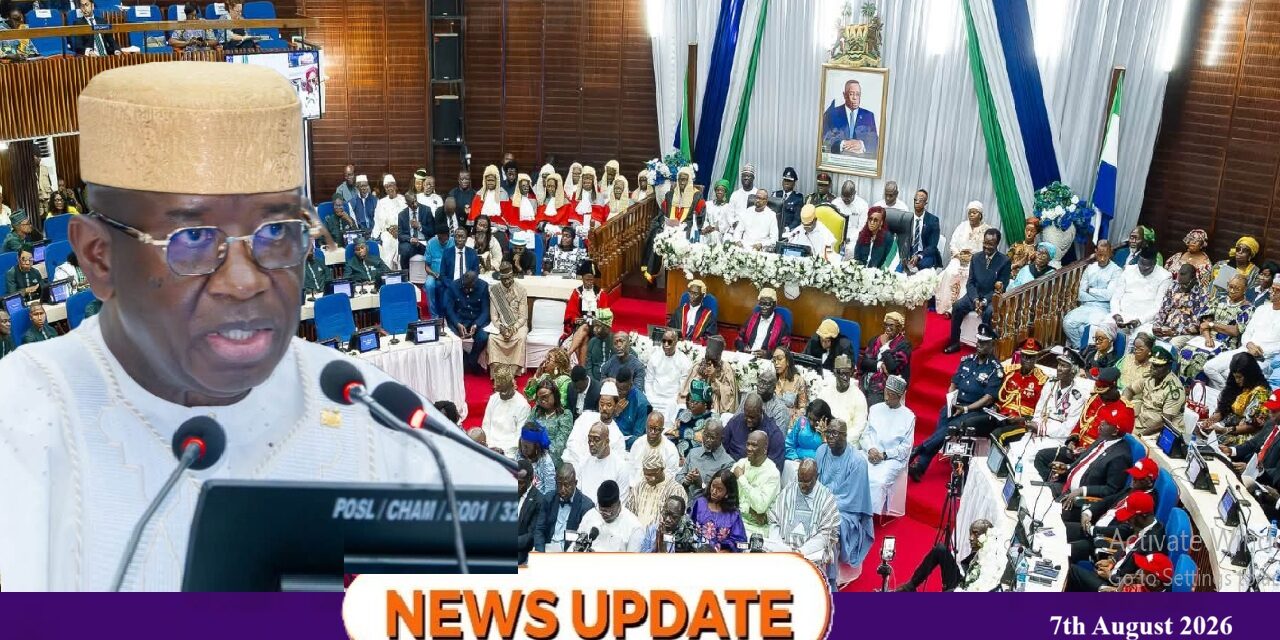
Freetown, 7th August 2026– President Julius Maada Bio has told Parliament that Sierra Leone’s economy is stabilising despite global disruptions from wars in Ukraine and the Middle East, which have driven up food, fuel, fertiliser and transport costs.
Delivering his State Opening Address on Friday, 7 August 2026, the President said government measures had shielded families from the worst impacts while laying foundations for resilience.
“Stabilisation is taking hold. Recovery must now enter daily life through more affordable food, transport and electricity; more work; and better public services,” he declared.
Growth and Inflation Trends- Real GDP expanded by 4.6 percent in 2024 and 4.8 percent in 2025, reflecting stronger investment and private‑sector activity. Inflation fell to 4.4 percent in December 2025, its lowest in nearly two decades, before surging to 10.8 percent in April 2026 due to higher oil prices. Government responded with temporary fuel support and continued electricity‑tariff subsidies.
The exchange rate depreciated by less than 1 percent in 2025, helping protect purchasing power. Treasury bill rates declined, while private‑sector lending rose by 50 percent, giving businesses room to expand and employ.
Fiscal and External Position- Domestic revenue climbed to 18 billion Leones, the trade deficit narrowed by about one‑third, and public debt fell as a share of GDP.
Sierra Leone’s IMF Extended Credit Facility programme remains on track, with reviews in December 2025 and June 2026 releasing approximately US$79.8 million and US$31.7 million respectively. A further US$211.45 million under the Resilience and Sustainability Facility will strengthen climate resilience.
Development Partnerships- In 2025, government brought 12 new development agreements worth US$374.9 million into effect, while disbursements to ongoing partner‑supported projects reached US$254.4 million.
The World Bank Group and African Development Bank are backing Mission 300, Sierra Leone’s landmark National Energy Compact, requiring an estimated US$2.2 billion. The Millennium Challenge Corporation is providing US$480.7 million, alongside US$14.2 million from government, for the Power Compact.
Other partners, including the European Union, European Investment Bank, IFAD, Islamic Development Bank, OPEC Fund, the Global Fund, the United Nations system, and Denmark continue to support agriculture, health, education, water, digital connectivity, social protection and climate resilience.
President Bio thanked international partners for their confidence, pledging transparent management and disciplined delivery. He emphasised that stabilisation must translate into tangible improvements for citizens: “I know how urgently our people want to feel that change.”
The address underscores Sierra Leone’s progress in stabilising its economy, narrowing deficits, and securing major development financing even as external shocks continue to test resilience.