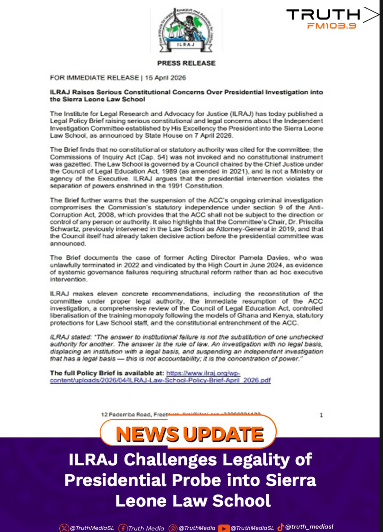
Freetown, 15th April 2026- The Institute for Legal Research and Advocacy for Justice (ILRAJ) has raised serious constitutional concerns over President Julius Maada Bio’s decision to establish an Independent Investigation Committee into the Sierra Leone Law School.
In a Legal Policy Brief released on Tuesday, April 15, ILRAJ argued that the presidential intervention lacks constitutional or statutory authority. The group noted that the Commissions of Inquiry Act was not invoked, nor was any constitutional instrument gazetted. It stressed that the Law School, governed by a Council chaired by the Chief Justice under the Council of Legal Education Act, is not an executive agency and therefore falls outside presidential control.
ILRAJ further warned that suspending the Anti-Corruption Commission’s (ACC) ongoing investigation undermines the Commission’s statutory independence under the 2008 Anti-Corruption Act. The Brief also pointed to potential conflicts of interest, noting that Committee Chair Dr. Priscilla Schwartz had previously intervened in Law School affairs as Attorney-General in 2019.
The Policy Brief highlighted systemic governance failures, citing the unlawful dismissal of former Acting Director Pamela Davies in 2022, later overturned by the High Court in 2024. ILRAJ argued that such issues require structural reform rather than ad hoc executive action.
Among its eleven recommendations, ILRAJ called for the committee to be reconstituted under proper legal authority, the immediate resumption of the ACC investigation, a review of the Council of Legal Education Act, statutory protections for Law School staff, and constitutional entrenchment of the ACC. It also urged controlled liberalisation of legal training, drawing on models from Ghana and Kenya.
“The answer to institutional failure is not the substitution of one unchecked authority for another. The answer is the rule of law,” ILRAJ stated. “An investigation with no legal basis, displacing an institution with a legal basis, and suspending an independent investigation that has a legal basis — this is not accountability; it is the concentration of power.”