Freetown, 14th October, 2026 – The Sierra Leone Institution of Geoscientists (SLIG) has urged residents not to panic following reports of light earth tremors felt in parts of Freetown on Monday, stressing that there is currently no scientific evidence to suggest that another major earthquake is imminent.
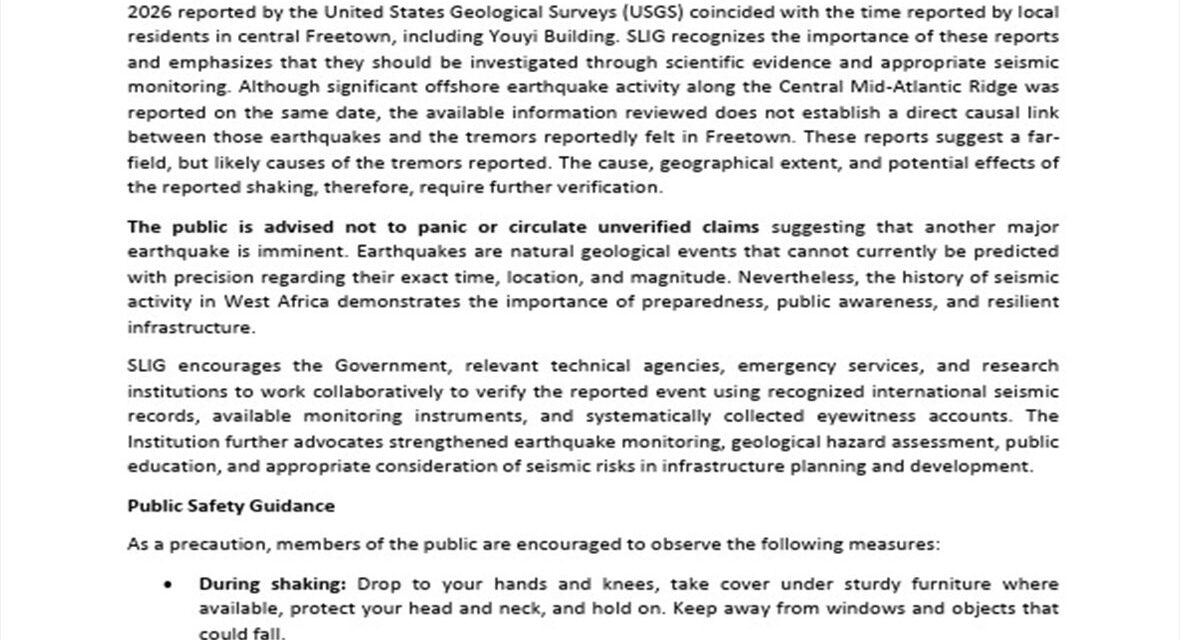
In a public advisory issued on Wednesday, the institution said reports of shaking were received from several locations in central Freetown, including the Youyi Building, around the same time a magnitude 6.9 earthquake occurred along the Central Mid-Atlantic Ridge at approximately 12:23 UTC on October 13.
However, SLIG cautioned against concluding a direct connection between the offshore earthquake and the tremors reportedly experienced in the capital.
“The available information reviewed does not establish a direct causal link between those earthquakes and the tremors reportedly felt in Freetown,” the institution stated, noting that the cause, geographical extent and potential effects of the reported shaking require further scientific verification.
The professional body emphasized that reports of tremors should be investigated using scientific evidence and appropriate seismic monitoring rather than speculation.
SLIG also warned the public against spreading unverified information or predictions of an impending major earthquake.
“Earthquakes are natural geological events that cannot currently be predicted with precision regarding their exact time, location and magnitude,” the institution said.
While reassuring the public, SLIG underscored the importance of preparedness, pointing to the history of seismic activity in West Africa as a reminder of the need for public awareness and resilient infrastructure.
The institution called on government agencies, emergency responders, research institutions and other relevant stakeholders to work together to verify the reported tremors using international seismic records, available monitoring equipment and eyewitness accounts from affected areas.
It also advocated for stronger earthquake monitoring systems, enhanced geological hazard assessments, increased public education and the inclusion of seismic risks in infrastructure planning and development.
As a precautionary measure, SLIG encouraged citizens to follow standard earthquake safety procedures. Residents were advised to drop to their hands and knees, take cover under sturdy furniture, protect their head and neck, and stay away from windows and objects that could fall during any future shaking.
The institution further advised people to inspect for injuries and avoid damaged structures after any seismic event, while reporting emergencies and suspected structural damage to the relevant authorities.
SLIG urged residents who experienced the tremors to document the approximate time, duration, location and any effects observed, adding that such information would assist scientists and authorities in determining the nature of the event.
“The Institution reiterates that public safety must be guided by credible science, responsible communication and preparedness, not fear or speculation,” the statement said.
SLIG concluded that while there is currently no basis for declaring an imminent major earthquake near Sierra Leone, continued scientific investigation and preparedness remain essential for public safety.