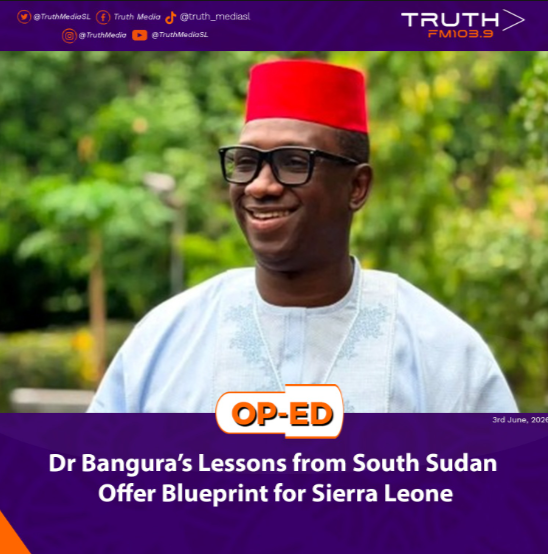
Freetown, 3rd June 2026- In his widely cited study Peace in Pieces: The Politics and Pitfalls of Peacemaking in South Sudan, Dr. Ibrahim Bangura dissects why peace agreements collapse, why elite‑driven bargains fail, and why societies relapse into violence when root causes are ignored. His insights are not just about South Sudan; they resonate deeply with Sierra Leone’s own democratic journey.
Bangura argues that peace processes dominated by elites and external actors often “postpone conflict rather than resolve it,” creating what he calls the revolving‑door syndrome. He shows how militarised politics, exclusionary governance, and the absence of accountability mechanisms perpetuate instability. In his words, “violence is often reconfigured and not addressed, with it gradually institutionalised and normalised over the years.”
For Sierra Leone, these lessons are urgent. Our country has endured war, trauma, and cycles of political mistrust. We know too well the dangers of elite bargains that sideline ordinary citizens. Bangura’s scholarship insists that peacebuilding must be people‑centred, rooted in justice, legitimacy, and healing, not just transactional deals among politicians.
Bangura’s experience as a peace researcher and practitioner positions him uniquely to lead Sierra Leone into a new era of governance. He understands that: Inclusive governance is the antidote to exclusionary politics. Accountability mechanisms are essential to prevent corruption and elite impunity. Healing and reconciliation must accompany development, so that trauma does not reproduce violence and locally rooted initiatives are more sustainable than externally imposed solutions.
His South Sudan research shows he can diagnose complex conflicts, balance international diplomacy with grassroots realities, and push for reforms that strengthen institutions rather than personalities. These are precisely the qualities Sierra Leone needs in a leader who can move beyond rhetoric to build durable peace and prosperity.
Bangura’s candidacy offers Sierra Leoneans a chance to embrace leadership grounded in evidence, scholarship, and lived experience. He has studied how fragile states collapse under the weight of mistrust and exclusion and he has mapped out how nations can rise when leaders choose inclusion, accountability, and justice.