By Kelfala Kargbo
Freetown, 5th October 2026- The Ministry of Defence and the Republic of Sierra Leone Armed Forces (RSLAF) have requested an allocation of NLe7.59 billion for 2027, warning that the country currently lacks the capacity to effectively secure its territorial waters, airspace and vast border network.
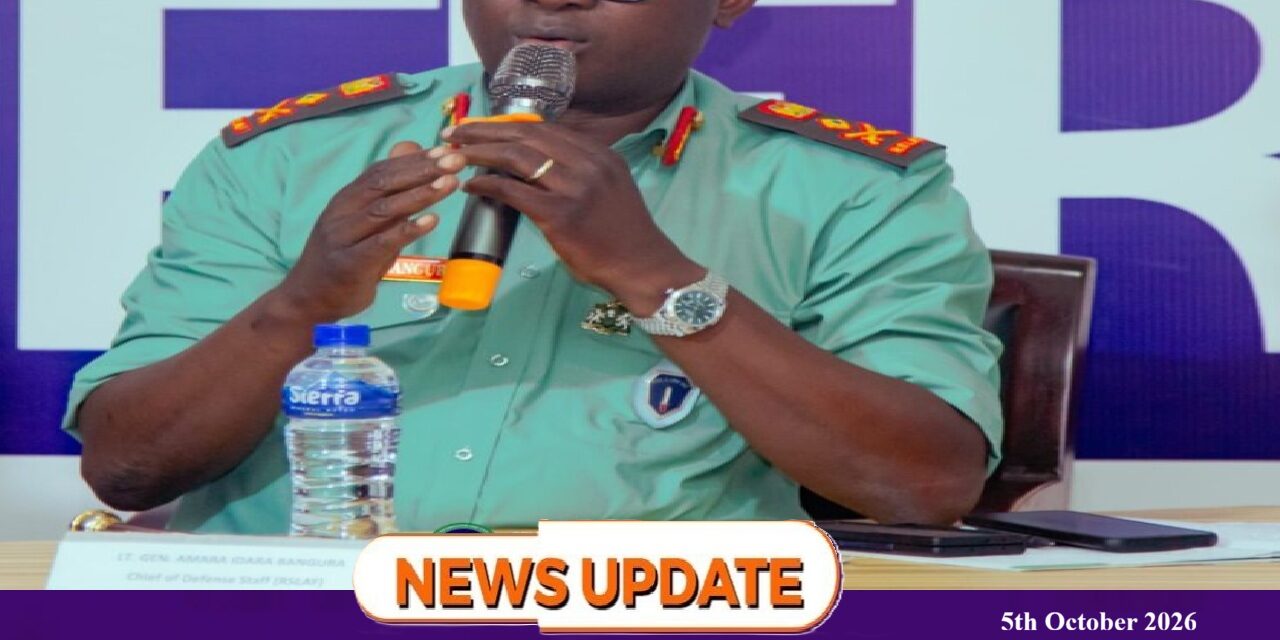
Presenting the defence sector’s budget proposal, Chief of Defence Staff, Major General Idara Bangura, said Sierra Leone faces significant security challenges due to limited equipment, inadequate border coverage and the absence of dedicated funding for military intelligence.
Bangura disclosed that Sierra Leone remains the only country in West Africa without a naval vessel capable of effectively patrolling and protecting its maritime territory, leaving authorities unable to respond adequately to illegal activities at sea.
“We are the only country in West Africa without a boat that can cover up to 600 kilometres,” he said. “When other vessels invade our waters, we can see them but cannot reach them.”
The military chief warned that the absence of maritime assets has weakened efforts to combat transnational crimes, including drug trafficking and the smuggling of other illicit goods through Sierra Leone’s coastal waters.
He further revealed that the country lacks modern surveillance and counter-surveillance systems to monitor activities within its airspace, describing the situation as a major national security concern.
Beyond maritime and air security, Bangura said the country’s extensive land borders remain largely unprotected. According to him, the armed forces maintain a presence at fewer than 20 of Sierra Leone’s more than 1,000 known border crossing points.
To address the gap, he said plans are underway to recruit and train 500 border guards and veteran guards to strengthen security in border communities and improve surveillance along key crossing routes.
Bangura also highlighted logistical challenges affecting border operations, stating that the government has yet to provide vehicles to support personnel deployed in remote border areas.
A major concern raised during the presentation was the absence of a dedicated budget for intelligence gathering. Bangura argued that insufficient investment in intelligence continues to expose the country to security risks while increasing operational costs.
“We do not have any budget for intelligence,” he said, adding that the military remains limited in its ability to proactively identify and neutralise threats.
Describing the situation as a strategic weakness, Bangura noted that improved intelligence capabilities would significantly reduce the need for costly emergency operations.
“If we spend on intelligence, we don’t need to spend too much on operations because every pin that drops in Sierra Leone we will know,” he said.
The proposed NLe7.59 billion budget, which covers both recurrent expenditure and the Public Investment Programme, is expected to support a range of strategic objectives in 2027.
Among the sector’s key targets are the recruitment of 4,000 additional personnel, expansion of military agriculture projects, upgrading healthcare services to a Level 3 Hospital, professional education and training for at least 30 percent of personnel, and the construction of additional accommodation for serving members of the armed forces.
Bangura concluded by stressing that national security requires sustained investment, urging government to prioritise defence spending to address longstanding operational and infrastructure gaps.
“Security is expensive,” he said, calling for increased support to strengthen the country’s ability to protect its borders, territorial waters and airspace.