By Saidu Kargbo
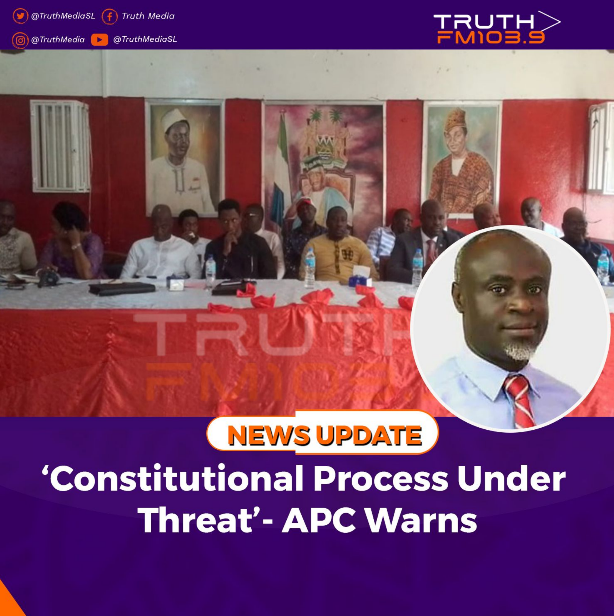
Freetown, 2nd February 2026- The main opposition All People’s Congress (APC) has raised serious concerns over certain provisions contained in the Constitution of Sierra Leone (Amendment) Act, 2025, warning that the country’s constitutional process is under threat.
The concerns were made public during the party’s monthly press conference held at its headquarters in Freetown.
Speaking at the event, Dr. Kelfala Marah warned that the entire constitutional reform process is facing serious challenges.
“The whole constitutional process is under threat. It doesn’t mean there are no good things, but grassroots members and everybody should wake up,” he retorted.
He further stated:
“We’re not in the right place, and government needs to do the right things.”
In his remarks, the Chairman of the APC Census Committee, Hon. Balugu Koroma, criticised the conduct of the recent census exercise, particularly the pilot census carried out by Statistics Sierra Leone. According to him, the institution—mandated to count the population and national facilities—conducted the pilot census in four regions instead of five, excluding the North West Region.
Hon. Koroma said he was unaware of the reasons behind the exclusion, describing the decision as troubling.
“For the first time in the history of politics in Sierra Leone, the party in its wisdom decides to set up a Census Technical Committee,” he reiterated, explaining that the move was necessitated by what he described as the ‘discredited’ 2025 Mid-Term Census.
He further warned that without credible census data, the country risks holding a non-credible 2028 general election, stressing that census figures form the foundation for effective electoral planning.
Addressing the legal implications of the proposed constitutional amendment, Hon. Osman Timbo cited Section 108(1) of the Constitution. He explained that before the first reading of a Bill intended for constitutional amendment, it must be published in two gazettes, at least nine days apart, before being presented to Parliament for ratification.
He noted that whether this constitutional requirement has been met remains unclear.
“Whether it is being done or not is beyond our knowledge,” he said, adding, “If there’s anything within the Bill that is not reflective of the aims, aspirations, and desires of the people we’re representing, we will stand against it.”
The party’s concerns reflect growing anxieties about transparency, inclusivity, and constitutional compliance in Sierra Leone’s governance processes. APC officials stressed that constitutional amendments carry long-term national implications and must be handled with strict adherence to legal procedures and public interest.
Also speaking at the press conference, Hon. Abdul Kargbo emphasised that lawmakers’ interpretation of the law may differ from how ordinary citizens perceive it.
“The way lawmakers see the law is not the same way other people will see it. You cannot make the law to be prone to abuse,” he said.
Hon. Kargbo further expressed concern over the inclusion of district vote thresholds in determining presidential elections. He argued that district votes should not be used as a criterion for determining the presidency.
According to him, provisions in the Local Government Act of 2022, as well as the Local Government Act of 2004, allow the President to declare new districts based on advice from the Minister of Local Government, the Chief Electoral Commissioner, and the Minister of Finance. He explained that such declarations are done through a statutory instrument laid before Parliament, which can only be blocked by a two-thirds majority.
He warned that if a constitutional requirement mandates a presidential candidate to secure 20 percent of votes in at least half of the districts, it could encourage the creation of additional districts, potentially disadvantaging opposition parties.
“If more districts are created, it becomes difficult for the opposition to secure 20 percent in half of the districts,” he cautioned.