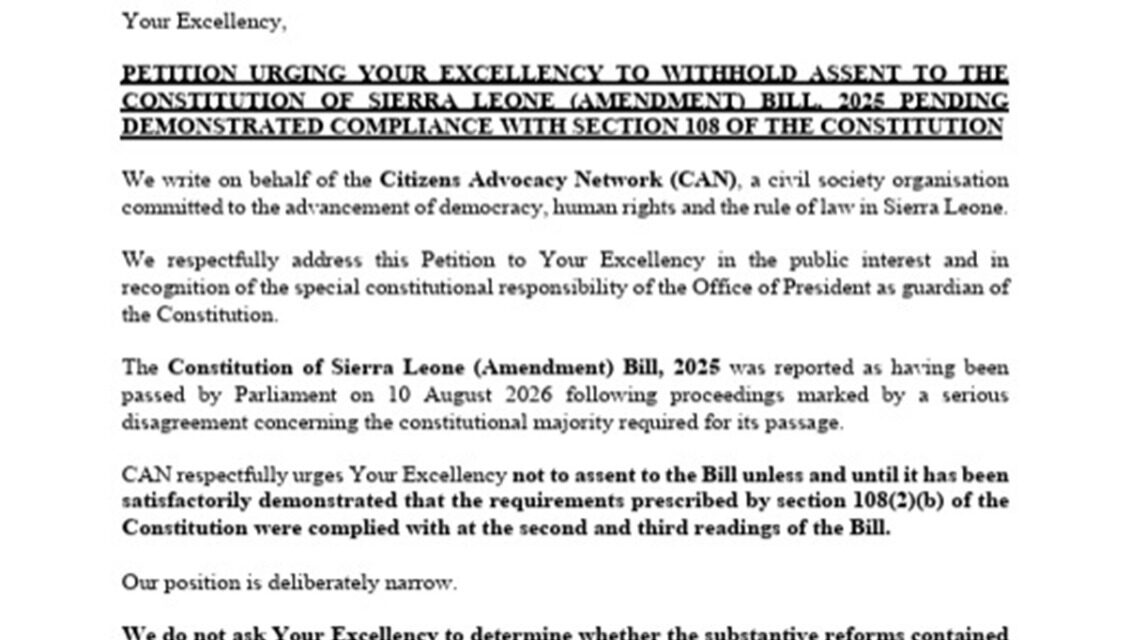
Freetown, 26th August, 2026- The Citizens Advocacy Network (CAN) has formally petitioned President Julius Maada Bio to delay assent to the Constitution of Sierra Leone (Amendment) Bill, 2025, citing unresolved questions over whether Parliament met the strict voting threshold required for altering the nation’s supreme law.
In a letter dated August 24, CAN argued that the Bill, reportedly passed on August 10 after heated parliamentary proceedings, may not have secured the constitutionally mandated two‑thirds majority at both its second and third readings. Section 108(2)(b) of the Constitution requires “not less than two‑thirds of the Members of Parliament” to support any amendment, a higher bar than the ordinary majority rule under section 91.
CAN emphasized that this threshold refers to the total membership of Parliament, not just those present and voting. With 149 valid Members at the time, the group insists that at least 100 affirmative votes were required at each stage. “The Constitution may be changed, but it must be changed constitutionally,” the petition stressed.
The civil society group dismissed suggestions that the opposition’s walkout during the debate was decisive, noting that absence or abstention cannot reduce the special majority prescribed by law. Instead, CAN insists the official parliamentary record must show whether the Bill truly met the 100‑vote requirement.
CAN urged the President to obtain certified records confirming: The number of valid Members of Parliament on the date of passage, the exact number of affirmative votes at the second and third readings.
If fewer than 100 votes were recorded, CAN contends the constitutional threshold was not met, rendering the process defective.
While acknowledging the importance of constitutional reform, CAN argued that legitimacy depends on strict adherence to procedure. The petition reminded President Bio of his constitutional duty as “guardian of the Constitution,” urging him to either return the Bill to Parliament or refer the matter to the Supreme Court for authoritative interpretation under section 122.
CAN warned that the precedent set in this case will shape future constitutional reforms, regardless of which party holds power. “Measures affecting presidential elections, political representation, women’s participation and the broader democratic architecture of Sierra Leone should not enter the Constitution carrying an avoidable dispute,” the petition stated.
The letter, signed by CAN Executive Director Thomas Moore Conteh, was copied to key national and international stakeholders including the Speaker of Parliament, the Attorney‑General, the Human Rights Commission, and diplomatic missions from the United States, United Kingdom, Ghana, Nigeria, and others.