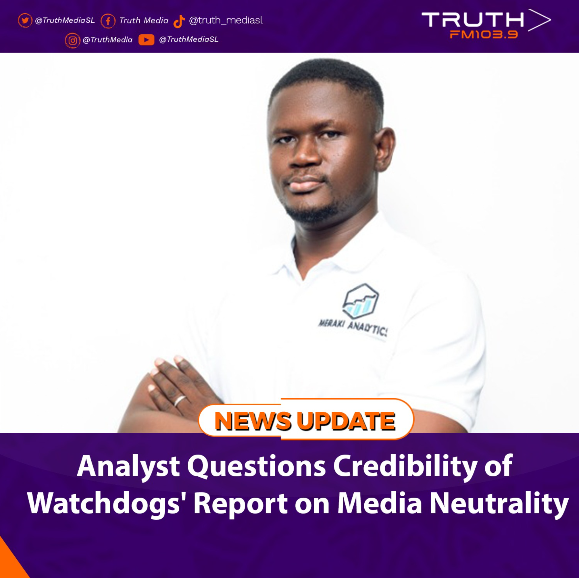
Freetown, 14th April 2026 — Engineer and data scientist Joel Abdulai Kallon, Chief Executive Officer of Meraki Analytics, has raised serious concerns about the credibility of a recent report on the political leanings of Sierra Leone’s civil society and media.
The report, authored by Augustine Navo Esq., claimed that watchdogs are losing neutrality in an increasingly polarized environment ahead of the 2028 elections. While acknowledging the timeliness of the piece and its public-service intent, Kallon argued that the methodology and framing fall short of global standards.
According to Kallon, the author conflates neutrality with fairness and impartiality. “Neutrality is not a reasonable expectation for the media and civil society,” he noted, citing global journalism ethics that emphasize truth, accuracy, independence, fairness, accountability, and minimizing harm. He warned that neutrality as a standard is a “fiction” that risks bias toward the status quo.
Kallon also highlighted methodological flaws, including the absence of a clear sampling frame. Although the report referenced 725 radio programs, 53 press releases, and eight print outlets, it did not explain how these were selected or whether they were representative. He further questioned how newer outlets, such as Truth Media, were analysed, given that they were less than a year old.
Another limitation, he said, was the lack of reproducibility. “With the current approach, even if the same data were presented to new assessors, the likelihood of arriving at different conclusions is extremely high,” Kallon explained. He pointed to the absence of standardized definitions for terms such as “tone,” “framing,” and “political positioning,” which undermines consistency.
Ethical concerns were also raised. Kallon criticized the failure to seek comment from the 30 individuals and institutions labeled with “quantitative leanings,” arguing that basic journalistic norms require right of reply. He also noted the lack of peer review or external validation.
Despite these shortcomings, Kallon acknowledged the report’s value in drawing attention to the erosion of impartial oversight. He urged a more rigorous, evidence-based approach, recommending multi-assessor blind reviews, transparent sampling methodologies, anonymized datasets, and external peer review.